Junte-se a nós em uma viagem ao mundo dos livros!
Adicionar este livro à prateleira
Grey
Deixe um novo comentário Default profile 50px
Grey
Assine para ler o livro completo ou leia as primeiras páginas de graça!
All characters reduced
Shujing - Book of Documents - cover
LER

Shujing - Book of Documents

Autores Varios

Editora: Aroha

  • 0
  • 0
  • 0

Sinopse

The Shujing, or Book of Documents, is one of the oldest and most influential classics of Chinese civilization. Compiled over centuries during the Shang and Zhou dynasties, it gathers a collection of royal speeches, political proclamations, moral instructions, and early historical records that shaped the foundations of Chinese governance and statecraft.

Far more than a historical anthology, the Shujing articulates the ethical vision that guided early rulers: the Mandate of Heaven, the moral responsibilities of leadership, and the belief that political power is legitimate only when exercised with virtue. Each chapter reflects a world where ritual, authority, and cosmic order were deeply intertwined, revealing how ancient societies imagined the relationship between humans, ancestors, and the divine order.

This modern edition presents a renewed reading of a foundational text that influenced Confucian philosophy, imperial governance, and East Asian culture for over two millennia. The Shujing remains a profound lens for understanding the origins of political ethics, state ritual, and moral responsibility—ideas that continue to resonate in contemporary discussions about leadership and legitimacy.
Disponível desde: 09/01/2026.
Comprimento de impressão: 100 páginas.

Outros livros que poderiam interessá-lo

  • Auschwitz Children And Mengele Experiments - The Immoral and Atrocious Research on Children in the Auschwitz Concentration Camp during World War II - cover

    Auschwitz Children And Mengele...

    Jack Stew Barretta

    • 0
    • 0
    • 0
    This audiobook is narrated by an AI Voice.   
    Many doctors in Germany were convinced that they were the chosen people to create a healthy, racially pure Volkskörper (body of people) and by doing so, establish a racial utopia. As strong supporters of National Socialism, they welcomed the founding of the Third Reich. After Hitler acceded to power, German physicians joined the SS in particular. During the twelve years of the Nazi era, seven percent of German doctors became members of the SS. The average membership of the population was only 0.6 percent. Moreover, doctors were also overrepresented as a profession, with teachers consisting of less than half a percent and musicians only three percent. Only lawyers had a larger share in the SS than doctors. 
    The average income of German doctors increased extremely after 1933, even exceeding the income of lawyers. The Nazi doctors of the human experiments also joined the SS in large numbers. German doctors were far more reluctant to join the NSDAP than the SS. Before 1933, only seven percent of all German doctors joined the NSDAP (Nazi party). They joined the party when it seemed opportune to do so, in 1933, and particularly in 1937. In 1933, physicians made up almost a quarter of all academic professionals in the NSDAP. Most doctors joined the NSDAP in 1937, with a membership rate of 43 percent of the total profession. German physicians sat on the fence during the first years of the Nazi era, insecure about the effects of the new regime on their profession. By 1937, the Third Reich had won the trust of several reasons. The NSDAP had solved the economic crisis and had reorganized the medical profession. Moreover, the regime had solved “the Jewish question” in the medical sector.
    Ver livro
  • History of Marathas EP01 - Deccan before Shivaji - cover

    History of Marathas EP01 -...

    Vikrant Pande

    • 0
    • 0
    • 0
    The story of the Marathas starts with Shivaji for most of us. The action happened in what is called the Deccan and its geography and politics plays an important role. We must understand what the Deccan means, who ruled there and what was the condition of the Deccan part of India before, and when, Shivaji was born.
    Ver livro
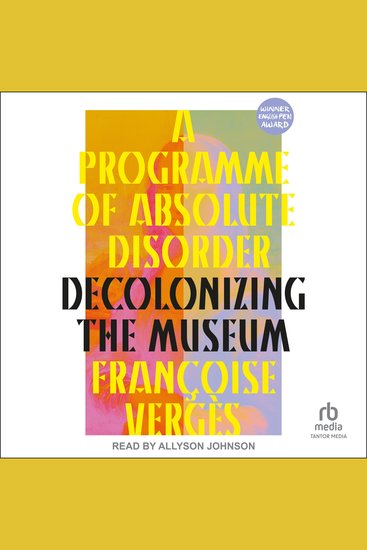
  • A Programme of Absolute Disorder - Decolonizing the Museum - cover

    A Programme of Absolute Disorder...

    Françoise Vergès, Paul Gilroy

    • 0
    • 0
    • 0
    "A complete overhaul of the Western museum tradition" —Publishers Weekly 


    "An impressive critique of the universal museum as complicit in the damages inflicted by colonial power" —Isaac Julien, artist and filmmaker 


    "Should fascinate anyone interested in social justice, post-colonialism and the arts" —Euronews 


    "Powerful and so relevant" —Diacritik 


    The Western museum is a battleground—a terrain of ideological, political, and economic contestation. Almost everyone today wants to rethink the museum, but how many have the audacity to question the idea of the universal museum itself? 


    In A Programme of Absolute Disorder, Françoise Vergès puts the museum in its place. Exploring the Louvre's history, she uncovers the context in which the universal museum emerged: as a product of colonialism, and of Europe's self-appointed claim to be the guardian of global heritage. 


    Vergès outlines a radical horizon: to truly decolonize the museum is to implement a "programme of absolute disorder", inventing other ways of apprehending the human and non-human world that nourish collective creativity and bring justice and dignity to the dispossessed.
    Ver livro
  • Improve Communication in Your Marriage - Build a Deeper Connection With Your Spouse Stop Being Defensive and Bring Back Intimacy - cover

    Improve Communication in Your...

    Amanda Bourn

    • 0
    • 0
    • 0
    Do you feel like your spouse doesn't truly hear you anymore? 
    Are you tired of conversations that quickly spiral into arguments? 
    Does it seem like you're both speaking different languages when trying to resolve conflicts? 
    Have you noticed the emotional distance growing between you and your partner? 
    Do you miss the deep connection and intimacy you once shared? 
    Do simple disagreements often escalate into hurtful exchanges? 
    Are you longing for the closeness you felt early in your relationship? 
    I understand how frustrating and lonely this can feel. Marriage shouldn't be this hard. 
    Here's what you'll discover inside: 
    •	The hidden communication patterns silently destroying your connection and how to replace them with bridges to deeper intimacy 
    •	Powerful techniques to stop defensiveness before it derails your conversations 
    •	The surprising truth about why your spouse misinterprets your words (and what to do about it) 
    •	A proven 4-step method for discussing sensitive topics without triggering arguments 
    •	How to recognize and express your emotional needs in ways your partner can truly hear 
    •	Simple daily practices that rebuild trust and strengthen your emotional bond 
    •	The art of healing conversations that repair past hurts instead of reopening old wounds 
    •	Practical intimacy exercises that reconnect you physically and emotionally 
    •	The sensate focus approach that has transformed thousands of disconnected marriagesYour marriage deserves more than just survival. Don't let another day of disconnection pass. Take the first step toward the marriage you've always dreamed of.
    Ver livro
  • What Is a Strong Man Spirit? - cover

    What Is a Strong Man Spirit?

    Pastor Philip

    • 0
    • 0
    • 0
    The strong man spirit reflect traits of Satan's character. He is ego-centric, seeks self praise and believes he is God. The song "Calling on Jesus" from the Album "Gosples & All Sorts," sung by Chey gives the listener time to reflect on Pastor Philip's message.
    Ver livro
  • 1914: The History and Legacy of World War I’s First Year - cover

    1914: The History and Legacy of...

    Editors Charles River

    • 0
    • 0
    • 0
    Needless to say, the First World War came at an unfortunate time for those who would fight in it. After an initial period of relatively rapid maneuver during which the German forces pushing through Belgium and the French and British forces attempting to stymie them made an endless series of abortive flanking movements that extended the lines to the sea, a stalemate naturally tended to develop. The infamous trench lines soon snaked across the French and Belgian countryside, creating an essentially futile static slaughterhouse whose sinister memory remains to this day. 
    If trench warfare was an inevitability during the war, it is only because the events leading up to the First Battle of the Marne were quite different. The armies at the beginning of the war moved quickly through the land, but the First Battle of the Marne devolved into a bloody pitched battle that led to the construction of trenches after the Germans retreated, blocked in their pursuit of Paris. When the aftermath disintegrated into a war between trenches, some Germans thought they had the upper hand since they were occupying French territory, but with fewer soldiers than the combined Allied nations and fewer resources and supplies, it was possibly only a matter of time before they were ultimately defeated. The commander of the German armies, General Helmuth von Moltke, allegedly said to Kaiser Wilhelm II immediately after the First Battle of the Marne, "Your Majesty, we have lost the war." Winston Churchill himself would later reference that anecdote, writing, “Whether General von Moltke actually said to the Emperor, ‘Majesty, we have lost the war,’ we do not know. We know anyhow that with a prescience greater in political than in military affairs, he wrote to his wife on the night of the 9th, ‘Things have not gone well. The fighting east of Paris has not gone in our favour, and we shall have to pay for the damage we have done.’"
    Ver livro