Junte-se a nós em uma viagem ao mundo dos livros!
Adicionar este livro à prateleira
Grey
Deixe um novo comentário Default profile 50px
Grey
Assine para ler o livro completo ou leia as primeiras páginas de graça!
All characters reduced
The Essays of Arthur Schopenhauer; the Art of Controversy - cover
LER

The Essays of Arthur Schopenhauer; the Art of Controversy

Arthur Schopenhauer

Tradutor T. Bailey Saunders

Editora: e-artnow

  • 0
  • 0
  • 0

Sinopse

The Art of Controversy (or The Art of Being Right) is a collection of debate formulas written in 1831 by the German philosopher Arthur Schopenhauer. In this book, the author presents methods of gaining an unfair advantage in a debate and thereby being right even if you are wrong. Schopenhauer is a champion in the dialectical argument; in his view, dialectics is wrongly neglected by philosophers in favor of logic.  This work is a handbook of modern debaters like Prime Minister Boris Johnson.
Disponível desde: 22/11/2023.
Comprimento de impressão: 158 páginas.

Outros livros que poderiam interessá-lo

  • How to Have Difficult Conversations About Race - Practical Tools for Necessary Change in the Workplace and Beyond - cover

    How to Have Difficult...

    Kwame Christian

    • 0
    • 0
    • 0
    Negotiation expert Kwame Christian's motto is: "The best things in life are on the other side of difficult conversations." If we want a more equitable workplace, and a more equitable world, we have to talk to each other about race. But, for so many of us, that's easier said than done. 


    Many people avoid conversations about race because of fear: fear of discomfort, damaging important relationships, being misunderstood, "canceled," ostracized. How to Have Difficult Conversations About Race equips you with the skills you need to make these crucial conversations easier and more productive. 


    Whether you're looking to create change for yourself and other BIPOC, or a white ally seeking to support your coworkers or clients, you'll learn how to: overcome your internal barriers to talking about diversity, equity, and inclusion (DEI); work around others' barriers to productive discussion; be strategic about the outcome you want, and guide the conversation accordingly; use "Compassionate Curiosity" to connect and persuade; avoid common mistakes; and communicate more effectively over email, when you can't talk face to face. If you've ever struggled to turn that passion into persuasion, or been too afraid to speak up at work (or outside of it), this book is for you.
    Ver livro
  • Rational Emotive Behavior Therapy - Thinking Rationally Living Freely - cover

    Rational Emotive Behavior...

    Vivian Westlake

    • 0
    • 0
    • 0
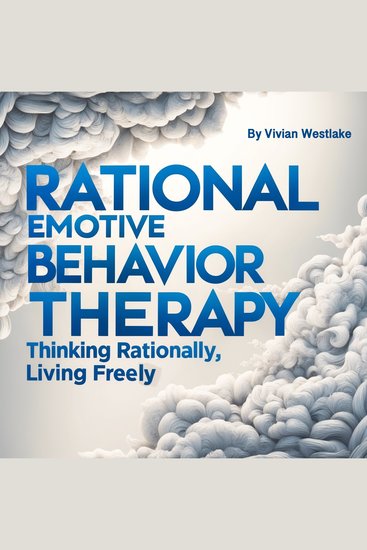
    Rational Emotive Behavior Therapy (REBT) is a cognitive-behavioral approach developed by Albert Ellis in the 1950s. It represents a revolutionary shift in the field of psychotherapy, aiming not just to alleviate symptoms, but to foster long-lasting change by helping individuals think and behave more rationally. The primary goal of REBT is to help people understand and identify irrational thoughts and beliefs that lead to emotional distress, then replace those beliefs with more rational, functional alternatives. 
    At its core, REBT rests on the idea that it is not the events themselves that disturb us, but our beliefs about those events. This concept is captured in the ABC model, a foundational element of REBT. According to the model, A stands for the activating event, or the situation that triggers a response. B represents the beliefs we hold about the activating event, which can be either rational or irrational. Finally, C stands for the emotional or behavioral consequences of those beliefs. By recognizing the link between beliefs and emotional outcomes, individuals can learn to challenge and change irrational thoughts that lead to unwanted feelings and behaviors. 
    REBT operates on the premise that people often hold onto irrational beliefs that are unrealistic, extreme, and unhelpful. These beliefs can be categorized into three core demands: the demand for approval from others, the demand for fairness or justice, and the demand for achievement and success. These irrational demands fuel negative emotions like anxiety, frustration, and depression, leading individuals to feel powerless or inadequate.
    Ver livro
  • 31 Mins - The secret to living your best life - cover

    31 Mins - The secret to living...

    Mat Steinwede

    • 0
    • 0
    • 0
    31 Mins is for anyone who feels constantly under the pump and out of control; it’s more than a book on time management, the lessons and tips in this book are raw, real and immediately actionable. Once you learn the value of 31 Mins you will realise anything is possible and make it a daily habit for the rest of your life.
    Ver livro
  • Patriots Before Revolution - The Rise of Party Politics in the British Atlantic 1714-1763 - cover

    Patriots Before Revolution - The...

    Amy Watson

    • 0
    • 0
    • 0
    The American revolutionaries—George Washington, Thomas Jefferson, John and Abigail Adams—called themselves Patriots. But what exactly did it mean to be a Patriot? Historian Amy Watson locates the origins of Patriotism in British politics of the early eighteenth century, showing that the label "Patriot" was first adopted by a network of British politicians with radical ideas about the principles and purpose of the British Empire. The early Patriots' ideological mission was not American independence but, rather, imperial reform: Patriots sought to create a British Empire that was militant, expansionist, confederal, and free.Over the course of the next half century, these British reformers used print media and grassroots mobilization efforts to build an empire-wide political party with adherents in London, Edinburgh, New York City, and the new colony of Georgia. While building this party, the Patriots' advocacy drew Britons into a series of violent political conflicts over taxes and civil liberty, as well as three expansive global wars, the War of Jenkins' Ear (1739–48), the War of the Austrian Succession (1740–48), and the Seven Years' War (1756–63). Patriot ideas and organizations came to divide Britons on increasingly sharp political lines, laying the groundwork for the revolutionary decades to come.
    Ver livro
  • Common Sense: Book Summary & Analysis - cover

    Common Sense: Book Summary &...

    Briefly Summaries

    • 0
    • 0
    • 0
    This is a concise summary and analysis of Common Sense, by Thomas Paine.
    It is not the original book and is not affiliated with or endorsed by Thomas Paine.
    Ideal those seeking a quick and insightful overview.
     
    Common Sense is a groundbreaking political pamphlet that challenges the status quo and advocates for independence, freedom, and self-governance. Written during a pivotal moment in history, this work lays out a compelling case for rejecting colonial rule and embracing democracy. With its accessible language and powerful arguments, the text has inspired generations to question authority and strive for a better society. A timeless call to action, it remains a cornerstone of revolutionary thought and an essential read for those interested in political philosophy and history.
    Ver livro
  • Defectors - How the Illicit Flight of Soviet Citizens Built the Borders of the Cold War World - cover

    Defectors - How the Illicit...

    Erik R. Scott

    • 0
    • 0
    • 0
    Defectors fleeing the Soviet Union seized the world's attention during the Cold War. Their stories were given sensational news coverage and dramatized in spy novels and films. Upon reaching the West, they were entitled to special benefits, including financial assistance and permanent residency. In contrast to other migrants, defectors were pursued by the states they left even as they were eagerly sought by the United States and its allies. Taking part in a risky game that played out across the globe, defectors sought to transcend the limitations of the Cold War world. 


    Defectors follows their treacherous journeys and looks at how their unauthorized flight via land, sea, and air gave shape to a globalized world. It charts a global struggle over defectors that unfolded among rival intelligence agencies operating in the shadows of an occupied Europe, in the forbidden border zones of the USSR, in the disputed straits of the South China Sea, on a hijacked plane 10,000 feet in the air, and around the walls of Soviet embassies. 


    Although defection all but disappeared after the Cold War, this innovative work shows how it shaped the governance of global borders and helped forge an international refugee system whose legacy and limitations remain with us to this day.
    Ver livro