Junte-se a nós em uma viagem ao mundo dos livros!
Adicionar este livro à prateleira
Grey
Deixe um novo comentário Default profile 50px
Grey
Assine para ler o livro completo ou leia as primeiras páginas de graça!
All characters reduced
The Art of Literature - cover
LER

The Art of Literature

Arthur Schopenhauer

Editora: Interactive Media

  • 0
  • 0
  • 0

Sinopse

"The Art of Literature" by Arthur Schopenhauer is a profound exploration of the power and significance of literature in the realm of human experience. In this enlightening work, Schopenhauer delves into the essence of art and the unique capacity of literature to deeply touch the hearts and minds of its readers. Schopenhauer recognizes literature as a form of artistic expression that transcends time and space, allowing individuals to connect with the thoughts, emotions, and experiences of others across different cultures and eras. He highlights the transformative potential of literature, emphasizing its ability to provide solace, insight, and catharsis in the face of life's trials and tribulations.
Disponível desde: 16/07/2023.
Comprimento de impressão: 100 páginas.

Outros livros que poderiam interessá-lo

  • From Your Head to Their Hands - How to write publish and market training manuals for historical martial arts - cover

    From Your Head to Their Hands -...

    Guy Windsor

    • 0
    • 0
    • 0
    “Our favourite writer of instructional manuals”- Neal Stephenson, from his foreword to Swordfighting, for writers, game designers, and martial artists. 
    Guy Windsor’s historical martial arts training manuals are legendary. His first was published in 2004, and he’s been producing them ever since. They generate about half his income. So he is expert in writing, publishing, and marketing books for historical martial artists, and in this book he’ll teach you how to do it. 
    The goal of training manuals is to teach skills. This one will teach you: 
    •   How to write well 
    •   How to plan your book, or write without a plan 
    •   How to get reader feedback as you go 
    •   How to avoid procrastination and imposter syndrome 
    •   What tools to use 
    •   How to write without destroying your body 
    •   How to incorporate photos and videos  
    •   How to edit your work 
    •   What should be outsourced 
    •   How to publish: commercial, indy, or something else? 
    •   What metadata you need, and how to create it 
    •   How to choose your publishing platform 
    •   How to market your book 
    •   How to find your readers 
    •   How to launch 
    •   Everything you need to know about copyright and piracy 
    •   The best book marketing strategy of all time. 
      
    Also included: Guy’s article Show Your Work: how to communicate your historical martial arts research with the historical martial arts community. 
    If you’ve ever wanted to write a training manual for historical martial arts (or anything else), this book will show you how to do it. Buy it, listen to it, and get writing! 
     
    Ver livro
  • Are You Judging Me Yet? - Poetry and Everyday Sexism - cover

    Are You Judging Me Yet? - Poetry...

    Kim Moore

    • 0
    • 0
    • 0
    Five 'lyric essays' exploring the dynamics of performing poetry as a female poet – confronting the implications of being a female on public display, with the connotations of sexual objectification, in a context that traditionally disregards the body. Kim states "With the strides and gains made through the #MeToo movement, I believe the time is right for a book like this to make an impact. As a female poet, I know there is a need for such a book to examine the intersection between writing, performing, feminism and sexism. I wish this book had been written when I first started working as a freelance writer and I've had many conversations with other female poets who have also confirmed my thinking – that female poets are navigating these things regularly, and yet nobody is really writing or talking about them."
    The book draws on her experiences of writing and performing the poems in her second collection All the Men I Never Married. It is a balance of memoir, academic treatise and poetry, though the author's emphasis is on writing in a popular way and making the subject accessible to a wide audience. To achieve this her models have been Maggie Nelson's Bluets, Claudia Rankine's Citizen and Sarah Ahmed's Living a Feminist Life. 
    The book's subjects include heckling at poetry readings and other interactions; problems with the 'male gaze' and what the 'female gaze' might look like in poetry; 'guilty for being a man': how guilt can be useful if it can bring about change; how writing poetry about sexism can shed add meaning to the term; the objectification of men and women, and 'bad faith' arguments.
    Are You Judging Me Yet?, by Kim Moore, is a remarkable collection of essays and poetry that explore, as the tagline suggests, everyday sexism. – neverintimate
    '…Moore's work becomes an even more vital tool in the work being done to challenge everyday sexism. Reading her work is not only a window into her own experiences, but may also act as a means of education, and that's something we all need to see more of.' – Wales Arts Review
    Ver livro
  • Tao Te Ching & Siddhartha - cover

    Tao Te Ching & Siddhartha

    Lao Tzu, Herman Hesse

    • 0
    • 0
    • 0
    The philosophies of the East are both complex and enlightening. Their views on human nature, society, and morality have shaped the world for thousands of years. Now, we get a chance to delve deep into the primary texts which are held close to the hearts of millions. 
    In this bundle, you’ll discover the Tao Te Ching, the world-renowned work first written in ancient China, along with the classic Siddhartha, a powerful and spiritually enlightening novel which tells the story of the Buddha. 
    Both these texts have stood the test of time, and paved the way for philosophies which continue to have impact across the ages. From the life of the Buddha and his belief in Samsara and Nirvana, to the secrets of the Tao, this book is a must-listen for anyone interested in spiritual and philosophical enlightenment.
    Ver livro
  • War of the Keys The: The History and Legacy of the Military Conflict Between the Holy Roman Empire and the Vatican - cover

    War of the Keys The: The History...

    Editors Charles River

    • 0
    • 0
    • 0
    It has been famously pointed out that the Holy Roman Empire was neither holy, nor Roman, but it was also not an empire in the sense people expect when hearing the term. In theory, the emperor was the highest prince in Christendom, and his dominion extended the length and breadth of Western Europe. The empire had been created by the papacy when Pope Leo III famously crowned the supposedly unwitting Charlemagne in Saint Peter’s Basilica, intending to recreate the Western Roman Empire. In truth, the imperial power did not extend beyond central Europe, which by the beginning of the 16th century included Germany, northern Italy, and the Netherlands. Even in these lands, however, the emperor struggled to command obedience. His dominion over northern Italy was theoretical only, the cities of the Netherlands were deeply conscious of their ancient rights and privileges, and Germany had long ceased to be compliant. The latter had become a collection of principalities, dukedoms and bishoprics which vied with each other and pursued their own agendas. They were, however, united in only one sense: denying the emperor power and resisting attempts to centralize the government. 
    The clergy occupied a privileged place in medieval society. Europe had inherited Christianity from the Roman Empire, and the concept of a united Christendom and empire were practically synonymous. Indeed, there was no real consciousness of the Roman Empire ever having ended. After the Western Roman Empire collapsed in the late 5th century, the Germanic rulers of Western Europe continued to recognize the Eastern Emperor in Constantinople until Charlemagne, and after the dissolution of the Frankish Empire, the imperial seat was transferred to Otto I, King of East Francia in modern Germany. 
    By the late 10th century, however, the emperor’s reach was rarely felt beyond Germany and northern Italy, and the question of who was supposed to be the imperial head was unresolved.
    Ver livro

  • Enemies of the Ancient Israelites The: The History of the Canaanites Philistines Babylonians and Assyrians - cover

    Enemies of the Ancient...

    Editors Charles River

    • 0
    • 0
    • 0
    Individuals who decide to take up learning about the Old Testament of the Bible are immediately faced with the difficult proposition of identifying the various peoples that the Hebrews met and sometimes came into conflict with when they entered the territory that eventually became Israel. The Moabites and Edomites were just two of the many Canaanite groups that the Hebrews dealt with, often violently, but there were dozens of other Canaanite groups, which were all for the most part identified through the names of their respective cities. In fact, before the Hebrews established a kingdom and before the Phoenicians colonized much of the Mediterranean, the Canaanites were the most important group in the Levant for much of the Bronze Age and into the early Iron Age. Although the Canaanites never created a unified nation-state or kingdom, their importance in the ancient Near East cannot be understated. It was at least partially because of that fact that the Canaanites were unable to resist their larger and more powerful neighbors that the average person today knows so little about their history, but modern studies have revealed that they developed a unique religion that influenced non-Canaanite peoples and continued to be practiced in some form centuries after the Canaanites ceased to be an identifiable people. Furthermore, during the height of the Bronze Age the Canaanites provided important resources to the Egyptian and Hittite Empires and played a key role in the geopolitical game of chess between those two kingdoms. It also goes without saying that the Canaanites were also a factor in the establishment of the Kingdom of Israel, as the battles they lost to the Hebrews later became the foundation of the Jewish kingdom.
    Ver livro
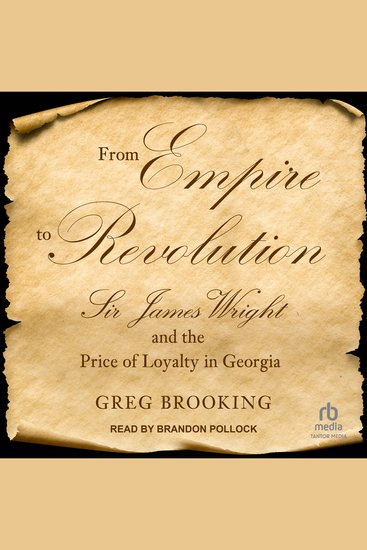
  • From Empire to Revolution - Sir James Wright and the Price of Loyalty in Georgia - cover

    From Empire to Revolution - Sir...

    Greg Brooking

    • 0
    • 0
    • 0
    From Empire to Revolution is the first biography devoted to an in-depth examination of the life and conflicted career of Sir James Wright (1716–1785). Greg Brooking uses Wright's life as a means to better understand the complex struggle for power in both colonial Georgia and the larger British Empire. 


    James Wright lived a transatlantic life, taking advantage of every imperial opportunity afforded him. He earned numerous important government posts and amassed an incredible fortune. An England-born grandson of Sir Robert Wright, James Wright was raised in Charleston, South Carolina, following his father's appointment as the chief justice of that colony. Young James served South Carolina in a number of capacities, public and ecclesiastical, prior to his admittance to London's famed Gray's Inn to study law. Most notably, he was appointed South Carolina's attorney general and colonial agent to London prior to becoming the governor of Georgia in 1761. 


    Wright's long imperial career delicately balanced dual loyalties to Crown and colony and offers a new perspective on loyalism and the American Revolution. Through this lens, Greg Brooking connects several important contexts in recent early American and British scholarship, including imperial and Atlantic history, Indigenous borderlands, race and slavery, and popular politics.
    Ver livro