Junte-se a nós em uma viagem ao mundo dos livros!
Adicionar este livro à prateleira
Grey
Deixe um novo comentário Default profile 50px
Grey
Assine para ler o livro completo ou leia as primeiras páginas de graça!
All characters reduced
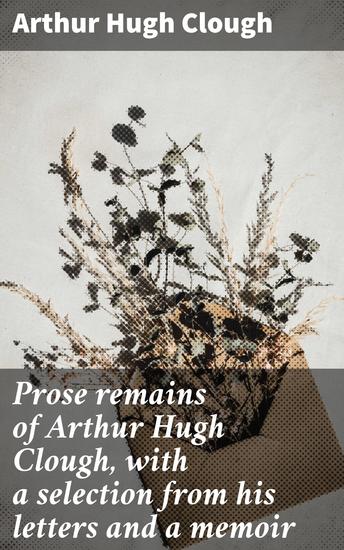
Prose remains of Arthur Hugh Clough with a selection from his letters and a memoir - Exploring faith doubt and human complexities through prose and letters - cover
LER

Prose remains of Arthur Hugh Clough with a selection from his letters and a memoir - Exploring faith doubt and human complexities through prose and letters

Arthur Hugh Clough

Editora: Good Press

  • 0
  • 0
  • 0

Sinopse

In "Prose Remains of Arthur Hugh Clough, with a Selection from His Letters and a Memoir," Clough presents a rich tapestry of thought, reflecting on profound themes of faith, doubt, and the human condition. Written in a clear yet lyrical style, the collection combines essays, critiques, and personal correspondences, inviting readers into the introspective and often turbulent world of Victorian intellectualism. Clough's prose is imbued with a sense of urgency and introspection, resonating with the complexities of his era, particularly the interplay between established religious beliefs and emerging secular views, making it an essential piece within the Victorian literary canon. Arthur Hugh Clough (1819-1861) was an English poet and educational reformer who struggled with personal and societal dilemmas throughout his life. His academic tenure at Oxford and extensive travels across Europe provided him with a unique perspective on the academic and cultural shifts of his time. Clough'Äôs commitment to moral integrity and clarity in thought reflects his own inner grapple with faith and skepticism, elements made evident in this collection. This book is highly recommended for students of literature and philosophy alike, as it provides invaluable insight into the mind of a thinker caught in the throes of change. Clough's reflections remain remarkably relevant, offering timeless wisdom that challenges contemporary readers to ponder their own beliefs and societal norms.
Disponível desde: 10/07/2023.
Comprimento de impressão: 308 páginas.

Outros livros que poderiam interessá-lo

  • Black Slaves Indian Masters - Slavery Emancipation and Citizenship in the Native American South - cover

    Black Slaves Indian Masters -...

    Barbara Krauthamer

    • 0
    • 0
    • 0
    From the late eighteenth century through the end of the Civil War, Choctaw and Chickasaw Indians bought, sold, and owned Africans and African Americans as slaves, a fact that persisted after the tribes' removal from the Deep South to Indian Territory. The tribes formulated racial and gender ideologies that justified this practice and marginalized free black people in the Indian nations well after the Civil War and slavery had ended. Through the end of the nineteenth century, ongoing conflicts among Choctaw, Chickasaw, and U.S. lawmakers left untold numbers of former slaves and their descendants in the two Indian nations without citizenship in either the Indian nations or the United States. In this groundbreaking study, Barbara Krauthamer rewrites the history of southern slavery, emancipation, race, and citizenship to reveal the centrality of Native American slaveholders and the black people they enslaved. 


    Krauthamer's examination of slavery and emancipation highlights the ways Indian women's gender roles changed with the arrival of slavery and changed again after emancipation and reveals complex dynamics of race that shaped the lives of black people and Indians both before and after removal.
    Ver livro
  • Outlines of Pyrrhonism - cover

    Outlines of Pyrrhonism

    Sextus Empiricus

    • 0
    • 0
    • 0
    Throughout history philosophers have sought to define, understand, and delineate concepts important to human well-being. One such concept is knowledge. Many philosophers believed that absolute, certain knowledge, is possible—that the physical world and ideas formulated about it could be given solid foundation unaffected by the varieties of mere opinion. 
     
    Sextus Empiricus stands as an example of the skeptic school of thought whose members believed that knowledge was either unattainable or, if a genuine possibility, the conditions necessary to achieve it were next to impossible to satisfy. In other words, in the absence of complete knowledge, one must make do with the information provided by an imperfect world and conveyed to the mind through sense impressions that can often deceive us. Throughout his life Sextus Empiricus entered into intellectual combat with those who confidently claimed to possess indubitable knowledge. For skeptics, the best one can hope to achieve is a reasonable suspension of judgment—remaining ever mindful that claims to knowledge require careful scrutiny, thoughtful analysis, and critical review if we are to prevent ourselves and others from plunging headlong into mistaken notions.
    Ver livro
  • The Greatest Generals of the Ancient World - cover

    The Greatest Generals of the...

    Editors Charles River

    • 0
    • 0
    • 0
    Over the last 2,000 years, ambitious men have dreamed of forging vast empires and attaining eternal glory in battle, but of all the conquerors who took steps toward such dreams, none were ever as successful as antiquity’s first great conqueror. Leaders of the 20th century hoped to rival Napoleon’s accomplishments, while Napoleon aimed to emulate the accomplishments of Julius Caesar. But Caesar himself found inspiration in Alexander the Great (356-323 B.C.), the Macedonian King who managed to stretch an empire from Greece to the Himalayas in Asia at just 30 years old. It took less than 15 years for Alexander to conquer much of the known world. Although his empire was quickly divided, his legacy only grew, and Alexander became the stuff of legends even in his own time.  
    	In the history of war, only a select few men always make the list of greatest generals. Napoleon. Caesar. Alexander. They are always joined by Hannibal, who has the distinction of being the only man who nearly brought Rome to its knees before its decline almost 700 years later. Rome never suffered a more horrifying defeat in its history than at Cannae, and indeed, Hannibal nearly rewrote the course of Western history during the Second Punic War. Even today there remains great debate on just how he accomplished his masterful invasion of Italy across the Alps. Since his army included war elephants, historians still argue over exactly where and how he crossed over 2,000 years after he managed that incredible feat.  
    	The ultimate conqueror, statesman, dictator, visionary, and opportunist, during his time in power Caesar expanded the borders of Rome to almost twice their previous size, revolutionized the infrastructure of the Roman state, and destroyed the Roman Republic for good, leaving a line of emperors in its place. His legacy is so strong that his name has become, in many languages, synonymous with power.
    Ver livro
  • Tao Te Ching - cover

    Tao Te Ching

    Lao Tzu

    • 0
    • 0
    • 0
    Embark on a transformative journey of self-discovery with "Tao Te Ching" by Lao Tzu, available now as an enriching audiobook experience. This timeless classic offers profound insights into the nature of existence, human behavior, and the path to inner peace. 
    Narrated with clarity and reverence, this audiobook invites listeners to explore the essence of Taoism, guiding them through verses that reveal the harmony of opposites, the power of simplicity, and the wisdom of living in accordance with the Tao, or the Way. 
    Whether you're seeking guidance on leadership, personal growth, or spiritual fulfillment, "Tao Te Ching" offers invaluable lessons that resonate across cultures and generations. Perfect for moments of reflection, meditation, or simply unwinding, this audiobook provides a serene oasis in the hustle and bustle of modern life. 
    Don't miss the opportunity to immerse yourself in the profound wisdom of Lao Tzu. Start listening to "Tao Te Ching" today and embark on a journey of enlightenment and self-discovery.
    Ver livro
  • The Huguenots - Resistance Beliefs and Persecution - cover

    The Huguenots - Resistance...

    Kelly Mass

    • 0
    • 0
    • 0
    An important chapter in history is that in which the Catholic Church was being questioned by the commoners. People were standing up against tyranny and illogical rules. They had had it with hypocrisy and double standards. The abuse in the church wasn’t representing the text in the Bible. Too much corruption had crept into the clergy, or so the narrative went about across the entire European continent. 
    The Huguenots were a spiritual group of French Protestants who complied with the Reformed, or Calvinist, Protestant custom. The expression originates from the name of a Swiss politician, Genevan burgomaster Bezanson Hugues (from about 1491 - 1532) and was commonly used in Europe by the 16th century. Huguenot was a term used throughout the Protestant Reformation to describe members of the Reformed Church of France. It came from the Dutch “huisgenoten” and was used throughout the revolution that led to the entire Reformation. 
    Today, we will explore what that meant, and how history took a turn in this important time frame.
    Ver livro
  • The Color of Civics - Civic Education for a Multiracial Democracy - cover

    The Color of Civics - Civic...

    Matthew D. Nelsen

    • 0
    • 0
    • 0
    Generations of Americans have regarded schools as essential for developing the knowledge and civic values necessary for sustaining democracy. Yet, as Matthew D. Nelsen argues in The Color of Civics, traditional approaches to civic education are not living up to their promise for many students, particularly students of color from disadvantaged communities. 


    Drawing on lessons from students and teachers in Chicago, The Color of Civics reimagines the democratic purpose of civic education. Nelsen's findings challenge some of the most widely cited civic education research, arguing that the content of traditional civic education courses privileges the political experiences of white political actors, and in turn, contributes to divergent political behaviors and participatory outcomes across racial and ethnic groups. He presents a new approach to civic education that aims to foster political empowerment by centering historically-grounded conversations about current events as well as critical categories of knowledge—those that highlight the agency of marginalized groups. This approach increases rates of political participation among young people of color and heightens political empathy among white youth. Nelsen also explores how the attitudes and lived experiences of teachers drive the implementation of more empowering civic learning environments.
    Ver livro