Junte-se a nós em uma viagem ao mundo dos livros!
Adicionar este livro à prateleira
Grey
Deixe um novo comentário Default profile 50px
Grey
Assine para ler o livro completo ou leia as primeiras páginas de graça!
All characters reduced
Russian Prisons - St Peter and St Paul; the Schlüsselburg; the Ostrog at Omsk; the story of Siberian exile; Tiumen Tomsk Saghalien - cover
LER

Russian Prisons - St Peter and St Paul; the Schlüsselburg; the Ostrog at Omsk; the story of Siberian exile; Tiumen Tomsk Saghalien

Arthur Griffiths

Editora: DigiCat

  • 0
  • 0
  • 0

Sinopse

In "Russian Prisons," Arthur Griffiths provides a riveting exploration of the Russian penal system, blending firsthand accounts, meticulous observation, and historical context to unveil the complexities of incarceration in Tsarist Russia. His prose is sharply detailed, merging vivid imagery with an analytical perspective that reflects the somber realities of life behind bars. Griffiths employs a journalistic style that not only informs but immerses readers in the stark environment of Russian prisons, scrutinizing the interplay between punishment, societal structures, and the profound psychological effects on inmates. Arthur Griffiths, a British journalist and writer, drew from his experiences in Russia and his keen interest in criminology to produce this compelling work. His background in law and social reform informed his perceptions of justice and rehabilitation, which are recurrent themes in his writings. Griffiths's unique position as a foreign observer in a tumultuous era adds authenticity to his narrative, asking important questions about morality and penology that resonate with historical and contemporary debates. "Russian Prisons" is an essential read for those intrigued by historical justice systems, penal reform, or Russian history. Griffiths's insightful analysis and evocative storytelling not only educate but also provoke critical reflection on the nature of suffering and redemption within the prison system.
Disponível desde: 16/08/2022.
Comprimento de impressão: 178 páginas.

Outros livros que poderiam interessá-lo

  • More Perfect Union A (Briefs) - Reimagining the United States as a European Union-style Federation - cover

    More Perfect Union A (Briefs) -...

    Alexander Moss

    • 0
    • 0
    • 0
    In 2021, YouGov/Bright Line Watch found that 47% of Democrats on the West coast and 66% of Republicans in Texas and the South supported breaking up the United States into new, regional unions.In this book, the author ties these trends to the current challenges facing the United States. Increased battles over life and death issues on hot topics such as abortion, gun control, immigration and many more are increasingly impossible for the federal government to manage.We explore how a Constitutional amendment to form these new nations could work. Each nation would start with a copy of the existing Constitution, and still be able to cooperate on strategic goals through a new American Union. Topics covered include a potential timeline, exploring how the current functions of the federal government would be managed, retaining the dollar & Federal Reserve, military assets, and much more.This book is a collection of quick, easy to read briefs outlining the concept.
    Ver livro
  • Body Work - The Radical Power of Personal Narrative - cover

    Body Work - The Radical Power of...

    Melissa Febos

    • 0
    • 0
    • 0
    In this bold and exhilarating mix of memoir and master class, Melissa Febos tackles the emotional, psychological, and physical work of writing intimately while offering an utterly fresh examination of the storyteller's life and the questions which run through it. 


    How might we go about capturing on the page the relationships that have formed us? How do we write about our bodies, their desires and traumas? What does it mean for an author's way of writing, or living, to be dismissed as "navel-gazing"—or else hailed as "so brave, so raw"? And to whom, in the end, do our most intimate stories belong? 


    Drawing on her own path from aspiring writer to acclaimed author and writing professor—via addiction and recovery, sex work and academia—Melissa Febos has created a captivating guide to the writing life, and a brilliantly unusual exploration of subjectivity, privacy, and the power of divulgence. Candid and inspiring, Body Work will empower readers and writers alike, offering ideas—and occasional notes of caution—to anyone who has ever hoped to see themselves in a story.
    Ver livro
  • Summary: The Laws of Human Nature - by Robert Greene: Key Takeaways Summary & Analysis - cover

    Summary: The Laws of Human...

    Brooks Bryant

    • 0
    • 0
    • 0
    Disclaimer: This is NOT the official book; this is a summary & it does NOT accompany the official book. 
    Through exploring this summary book, you will uncover:Historical examples and lessons from figures such as Queen Elizabeth I, Martin Luther King Jr., and Henry Ford that help illuminate the laws of human nature.Greene's 18 "laws" that include concepts like authority, aggression, desire, grandiosity, conformity, and mortality.How to become more attuned to the emotions, motivations, and desires of others, and use this knowledge to influence and persuade them effectively.Techniques to develop self-awareness and control over your own behavior and reactions.Strategies to protect yourself against those who might use an understanding of human nature for manipulation or deceit.The importance of understanding the social dynamics at play in various settings, from personal relationships to workplace interactions, and how to navigate them effectively. 
    In our summary of "The Laws of Human Nature", you'll gain valuable insights into the workings of the human mind and heart, and how they dictate our behavior. Greene's guide provides a comprehensive tool for self-improvement, social navigation, and understanding others.
    Ver livro
  • Death on Ireland's Eye - The Victorian Murder Trial that Scandalised a Nation - cover

    Death on Ireland's Eye - The...

    Dean Ruxton

    • 0
    • 0
    • 0
    A tragic death, a murder trial and a 170-year-old mystery – but what really happened?
    Shortly after Maria Kirwan died in a lonely inlet on Ireland's Eye, it was decided that she had drowned accidentally during a day spent with her husband on the picturesque island. This inquest verdict appeared to conclude the melancholy events that consumed the fishing village of Howth, Co Dublin, in September 1852.
    But not long afterwards, suspicion fell upon Maria's husband, William Burke Kirwan, as whispers of unspeakable cruelty, an evil character and a secret life rattled through the streets of Dublin. Investigations led to William's arrest and trial for murder.
    The story swelled into one of the most bitterly divisive chapters in the dark annals of Irish criminal history. Yet questions remain: Does the evidence stand up? What role did the heavy hand of Victorian moral outrage play? Was William really guilty of murder, or did the ever-present 'moral facts' fill in gaps where hard proof was absent?
    Now, this compelling modern analysis revisits the key evidence, asking sober questions about the facts, half-facts and fantasies buried within the yellowed pages of the Ireland's Eye case files.
    Ver livro
  • Lawyer Jailer Ally Foe - Complicity and Conscience in America's World War II Concentration Camps - cover

    Lawyer Jailer Ally Foe -...

    Eric L. Muller

    • 0
    • 0
    • 0
    It is 1942, and World War II is raging. In the months since Pearl Harbor, the US has plunged into the war overseas—and on the home front, it has locked up tens of thousands of innocent Japanese Americans in concentration camps, tearing them from their homes on the West Coast with the ostensible goal of neutralizing a supposed internal threat. 
     
    At each of these camps the government places a white lawyer with contradictory instructions: provide legal counsel to the prisoners, and keep the place running. Within that job description are a vast array of tasks, and an enormous amount of discretion they can use for good or for ill. They fight to protect the property the prisoners were forced to leave behind; they help the prisoners with their wills and taxes; and they interrogate them about their loyalties, sometimes driving them to tears. Most of these lawyers think of themselves as trying to do good in a bad system, and yet each ends up harming the prisoners more than helping them, complicit in a system that strips people of their freedoms and sometimes endangers their lives. 
     
    In Lawyer, Jailer, Ally, Foe, Eric L. Muller brings to vivid life the stories of three of these men, illuminating a shameful episode of American history through imaginative narrative deeply grounded in archival evidence. As we look through the lawyers’ sometimes-clear and sometimes-clouded eyes, what emerges is a powerful look at the day-by-day, brick-by-brick perpetration of racial injustice—not just by the system itself, but by the men struggling to do good within it.
    Ver livro
  • The Populist Wave - Understanding the Rise of Populism in Modern Politics - cover

    The Populist Wave -...

    Arlo Holders

    • 0
    • 0
    • 0
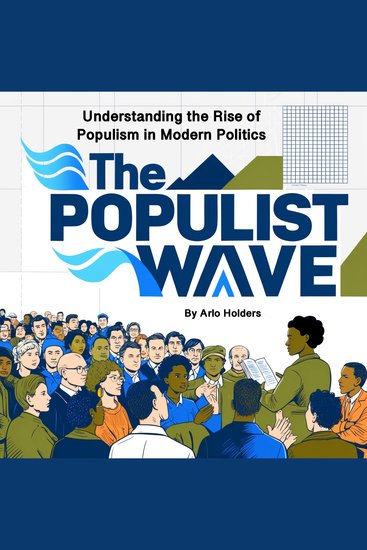
    Populism, a term often used in modern political discourse, refers to movements or ideologies that seek to represent the interests of ordinary people, often contrasting with the perceived elite or establishment. Understanding the origins of populism requires exploring both its historical roots and its evolution over time. Though its contemporary forms are often associated with charismatic leaders and mass mobilization, populism has a deep and complex history that spans several centuries. 
    Historically, populism can trace its roots back to the late 19th century, when agrarian movements in the United States and Russia first used the term. The Populist Party, founded in the U.S. in 1891, advocated for the interests of farmers who felt exploited by industrial elites and urban centers. In Russia, the narodniks, or "people's movement," emerged around the same time, focusing on the belief that Russia’s future lay in the empowerment of the peasantry. These early populist movements were fueled by economic and social inequalities, with the central grievance being the concentration of wealth and power in the hands of a few. 
    The core tenet of these early populist movements was the idea of a moral divide between the "pure" common people and the corrupt elites. This populist rhetoric resonated strongly with those who felt neglected by the political establishment, emphasizing a deep distrust of centralized political systems and economic power. Populism, then, was not simply about policy disagreements but a call for a deeper cultural and moral reckoning with societal inequalities.
    Ver livro