Join us on a literary world trip!
Add this book to bookshelf
Grey
Write a new comment Default profile 50px
Grey
Subscribe to read the full book or read the first pages for free!
All characters reduced
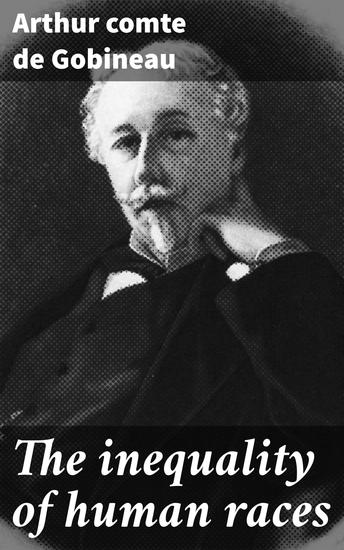
The inequality of human races - Exploring Racial Hierarchies and Cultural Criticism in the 19th Century - cover

The inequality of human races - Exploring Racial Hierarchies and Cultural Criticism in the 19th Century

Arthur Gobineau

Translator Adrian Collins

Publisher: Good Press

  • 0
  • 0
  • 0

Summary

In "The Inequality of Human Races," Arthur comte de Gobineau presents a controversial examination of racial hierarchies that posits a deterministic view on human societies. Composed in the mid-19th century, the text weaves together a combination of historical analysis, ethnography, and philosophical discourse, reflecting the emerging ideas of racial theories prevalent during that period. Gobineau's literary style is characterized by an eloquent, yet polemic tone, arguing that the supposed innate inequalities among races are foundational to the evolution of civilizations, thereby laying the groundwork for later racialist ideologies. Arthur comte de Gobineau, a French aristocrat, diplomat, and writer, was profoundly influenced by the socio-political turmoil of his time, including the upheavals of the French Revolution and rising nationalism. His extensive travels and keen observations on varying cultures enriched his perspective, leading him to articulate a vision of racial superiority that would resonate controversially for decades to come. Gobineau'Äôs erudition and social critique expose the underlying tensions of his era, exposing the dangers of pseudoscientific racial constructs. This book is essential for readers interested in the histories of race, sociology, and anthropology, as it not only provides insight into the ideological foundations of racial thought but also serves as a cautionary tale against reductionist views of human diversity. Scholars and students alike will benefit from engaging with Gobineau's work to understand the complexities and ramifications of racial theories that have shaped modern discourse.
Available since: 07/10/2023.
Print length: 214 pages.


Other books that might interest you

  • Civil War Turning Points in the East The: The Battle of Antietam and the Battle of Gettysburg - cover

    Civil War Turning Points in the...

    Editors Charles River

    • 0
    • 0
    • 0
    The bloodiest day in American history took place on the 75th anniversary of the signing of the Constitution. On September 17, 1862, Robert E. Lee’s Confederate Army of Northern Virginia fought George McClellan’s Union Army of the Potomac outside Sharpsburg along Antietam Creek. That day, nearly 25,000 would become casualties, and Lee’s army would barely survive fighting the much bigger Northern army. Although the battle was tactically a draw, it resulted in forcing Lee’s army out of Maryland and back into Virginia, making it a strategic victory for the North and an opportune time for President Abraham Lincoln to issue the Emancipation Proclamation, freeing all slaves in the rebellious states. For those reasons, Antietam is remembered as one of the major turning points of the Civil War, even as it is often overlooked that the bloody battle only represented the climactic culmination of a 3 week campaign that saw George McClellan cautiously pull a fragmented Union army together and begin tracking Lee’s army into Maryland.  
    	Without question, the most famous battle of the American Civil War took place outside of the small town of Gettysburg, Pennsylvania, which happened to be a transportation hub, serving as the center of a wheel with several roads leading out to other Pennsylvanian towns. From July 1-3, Robert E. Lee’s Confederate Army of Northern Virginia tried everything in its power to decisively defeat George Meade’s Union Army of the Potomac, unleashing ferocious assaults that inflicted nearly 50,000 casualties in all. Day 1 of the battle would have been one of the 25 biggest battles of the Civil War itself, and it ended with a tactical Confederate victory. But over the next two days, Lee would try and fail to dislodge the Union army with attacks on both of its flanks during the second day and Pickett’s Charge on the third and final day.
    Show book
  • Summary: Only the Paranoid Survives - How to Exploit the Crisis Points That Challenge Every Company by Andrew S Grove: Key Takeaways Summary & Analysis - cover

    Summary: Only the Paranoid...

    Brooks Bryant

    • 0
    • 0
    • 0
    Disclaimer: This is NOT the official book. This is a Summary book & it does NOT accompany the official book. 
    Grove identifies such moments as Strategic Inflection Points, triggered by various factors such as fierce competition, regulatory shifts, or subtle technological changes. When these points occur, conventional business rules no longer apply. However, if managed correctly, these moments of upheaval can serve as springboards to marketplace victory and an opportunity to emerge more robust than ever. 
    Our summary encapsulates Grove's wisdom, highlighting his experiences and how he dealt with significant events, such as the Pentium flaw crisis that threatened Intel's reputation in 1994 and the rapid expansion of the internet. "Only the Paranoid Survive," a lifetime's worth of work, stands as a crucial resource for managerial and leadership skills.
    Show book
  • The Paperclip Files - The Untold Story of Nazi Scientists War Criminals And The Birth of NASA - cover

    The Paperclip Files - The Untold...

    Davis Truman

    • 0
    • 0
    • 0
    This audiobook is narrated by an AI Voice.   
    In the shadowy aftermath of World War II, a secret operation launched by the U.S. government brought over 1,600 German scientists, engineers, and technicians to American soil. Among them were men who had built weapons of terror for Hitler, now tasked with crafting the rockets that would carry humanity to the Moon. 
    This is their story. Unredacted. Unforgiven. Unbelievable. 
    The Paperclip Files pulls back the veil on Operation Paperclip, the clandestine project that rewrote the rules of morality, patriotism, and science in the name of Cold War supremacy. From the sinister roots of Wernher von Braun and Arthur Rudolph in Nazi Germany to their celebrated roles at NASA, this explosive exposé explores the unsettling truth behind America's greatest technological triumph. 
    Inside, you'll discover: 
    •	How Nazi war criminals were rebranded as American heroes 
    •	The controversial rise of Von Braun and Rudolph in post-war U.S. space policy 
    •	The ethical compromises buried beneath NASA's achievements 
    •	Declassified documents, real accounts, and the disturbing choices made behind closed doors 
    If you thought you knew the space race story, think again. 
    Perfect for fans of true history, political intrigue, and moral dilemmas, The Paperclip Files is a gripping, unflinching account of the price we paid for progress.
    Show book
  • The Complete Strategy & War Collection - History’s Greatest Strategic Thinkers on Leadership Power and Warfare - cover

    The Complete Strategy & War...

    Sun Tzu, Miyamoto Musashi,...

    • 0
    • 0
    • 0
    What if you could master the art of winning conflicts, guiding your team to victory, and harnessing power with wisdom and foresight? 
    This collection features seven of the most influential treatises on warfare and statecraft. Adapted for the contemporary reader, it spans the ancient strategies of Sun Tzu and Kautilya to the insights of Napoleon and Frederick the Great—offering a panoramic view of military tactics, diplomatic finesse, and leadership philosophies that have withstood the test of time. 
    What You’ll Discover in This Modern Anthology: 
    - The Art of War – Sun Tzu – The definitive guide to strategy, deception, and tactical mastery. 
    - The Book of Five Rings – Miyamoto Musashi – Samurai wisdom on combat, discipline, and adaptability. 
    - The Commentaries of Julius Caesar – Julius Caesar – Firsthand accounts of war, leadership, and conquest. 
    - History of the Peloponnesian War – Thucydides – A study of power struggles, diplomacy, and military strategy. 
    - The Maxims of War – Napoleon Bonaparte – The strategic insights of one of history’s greatest commanders. 
    - Instructions to His Generals – Frederick the Great – Tactical guidance from the Prussian king and strategist. 
    - Arthashastra – Kautilya – An ancient Indian treatise on politics, warfare, and statecraft. 
    Imagine directing your life’s battles—whether in boardrooms or personal pursuits—with the combined wisdom of the world’s greatest strategic minds. This collection equips you with the knowledge to lead decisively and navigate conflicts with skill. 
    Step onto the path of strategic mastery. Get your copy now and learn from history’s most celebrated generals and thinkers.
    Show book
  • Psycholinguistics - A Very Short Introduction - cover

    Psycholinguistics - A Very Short...

    Fernanda Ferreira

    • 0
    • 0
    • 0
    This Very Short Introduction to psycholinguistics is an accessible and engaging description of how people use language. Talking and understanding language probably seem like simple and straightforward skills, but research in psycholinguistics has shown that complex computations take place behind the scenes when you communicate with others. Recent debates concerning how AI tools such as ChatGPT work highlight some of these core questions about the language faculty and how it is that humans comprehend, produce, and learn language. 


    The book begins with an overview of the fields of linguistics and psychology and how they have cooperated from the earliest days of psycholinguistics. Issues that are considered include: (1) How successfully do people adapt what they say to the needs of their audience when they design their phrases and sentences? (2) How do people read languages such as Chinese, which do not use an alphabetic writing system? (3) Do the size and efficiency of a person's memory affect how effectively people use language? (4) Is bilingualism cognitively advantageous, and if so, what are the mechanisms that lead to this so-called bilingual advantage? And (5) Do users of sign language gesture when they communicate? These questions and more are answered using insights from the latest research based on methods from the cognitive and neurosciences.
    Show book
  • Polio Story A: Davy Crockett Rock 'n' Roll and the Devil's Disease - cover

    Polio Story A: Davy Crockett...

    Dave Eubanks

    • 0
    • 0
    • 0
    They were part of the Baby Boomer vanguard, three boys thrown together in a 1950s Southern California subdivision looking like most other boys of that era. Under coonskin hats they ran free all summer long inventing their own games and endless challenges, fought imaginary Indians and pirates in a nearby orange grove, and on occasion battled a neighborhood bully or two. Their greatest enemy, however, was an infectious disease called polio – a paralyzing scourge that maimed and too-often killed little kids. 
    This is a coming-of-age tale based on actual events and the experiences of real people. Told chiefly through the eyes of a child, at times it will warm your soul as well as, perhaps, break your heart. Then, too, there will be plenty of twists and turns that will leave you laughing out loud. 
    So, let us journey now back to that long-ago time and see what it was really like – with hula hoops, bouffant hair and flat tops with wings; “American Bandstand,” “Ozzie and Harriet” and “Davy Crockett” on TV; Chuck Berry, Buddy Holly and Elvis electrifying the up-and-coming Boomer generation – and a nation as terrified by the threat of nuclear war with the Russians as by a crippling and deadly microscopic bug. 
    ©2024 Dave Eubanks (P)2025 Dave Eubanks
    Show book