Junte-se a nós em uma viagem ao mundo dos livros!
Adicionar este livro à prateleira
Grey
Deixe um novo comentário Default profile 50px
Grey
Assine para ler o livro completo ou leia as primeiras páginas de graça!
All characters reduced
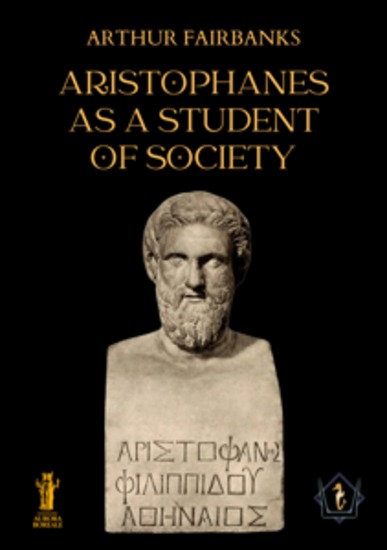
Aristophanes as a Student of Society - cover
LER

Aristophanes as a Student of Society

Arthur Fairbanks

Editora: Edizioni Aurora Boreale

  • 0
  • 0
  • 0

Sinopse

Arthur Fairbanks (1864-1944) was an American art historian, archaeologist and a great scholar of classical literature and mythology. From 1908 to 1925, he was director of the Museum of Fine Arts in Boston.
Fairbanks was born November 13, 1864, in Hanover, New Hampshire. He graduated from Dartmouth College in 1886 and attended the Yale Divinity School and the Union Theological Seminary. He also studied in Germany, receiving a Ph.D. from the University of Freiburg in 1890. He was on the faculty of Dartmouth College and Yale and Cornell Universities until 1900, when he became professor of Greek literature and Archaeology at the University of Iowa. In 1906, he was appointed professor of Greek and Greek Archaeology in the University of Michigan. He was appointed curator of Classical Art at the Boston Museum of Fine Arts in 1907, and in 1908 became director there. He supervised the museum's move to its current Fenway location. He retired in 1925. He was a member of many classical and learned societies. He died January 13, 1944, in Cambridge, Massachusetts.
Fairbanks was the author of important essays, including Introduction to Sociology (1896), The Mythology of Greece and Rome (1907), Handbook of Greek Religion (1910), and Greek Gods and Heroes (1915).
The Fairbanks’ essay Aristophanes as a Student of Society, which today we propose to modern readers, was published in 1903 in The American Journal of Sociology. It is, undoubtedly, one of the best studies that have been written on the figure of Aristophanes, his personality and his works.
Disponível desde: 24/01/2025.


Outros livros que poderiam interessá-lo

  • Declaration of the Rights of Man - The French Revolution - cover

    Declaration of the Rights of Man...

    Amara Blackwood

    • 0
    • 0
    • 0
    The French Revolution did not emerge suddenly but was the result of long-standing tensions within French society. At the heart of these tensions was the Ancien Régime, a rigid social and political system that had governed France for centuries. Under this system, society was divided into three estates: the clergy, the nobility, and the commoners. The First Estate, consisting of the clergy, and the Second Estate, made up of the nobility, enjoyed significant privileges, including exemptions from many taxes. Meanwhile, the Third Estate, which comprised the vast majority of the population, bore the heaviest tax burden despite having little political representation. This deep inequality fueled resentment and set the stage for revolutionary change. 
    Economic struggles further exacerbated the crisis. Throughout the 18th century, France faced mounting financial difficulties due to costly wars, including its involvement in the American Revolution. These expenses left the country with a massive debt, which the government attempted to resolve by increasing taxes on the already overburdened Third Estate. Additionally, poor harvests in the late 1780s led to food shortages and rising bread prices, making daily survival difficult for many commoners. Hunger and economic hardship created widespread unrest, as people began to question a system that seemed indifferent to their suffering. The monarchy, under King Louis XVI, proved incapable of addressing these issues effectively. His lavish spending and reluctance to implement financial reforms only deepened public frustration. 
    While economic and social tensions played a crucial role in the revolution’s origins, the ideas of the Enlightenment provided the ideological foundation for change. Thinkers such as John Locke, Jean-Jacques Rousseau, and Voltaire criticized absolute monarchy and promoted principles of liberty, equality, and individual rights.
    Ver livro
  • BULLSH!T - 50 Fibs That Made South Africa - cover

    BULLSH!T - 50 Fibs That Made...

    Jonathan Ancer

    • 0
    • 0
    • 0
    An outrageous miscellany of serious and light-hearted lies, myths, untruths, fibs and fabrications that tells the tall tale of South Africa.
    The fibs come thick and fast, like a burst sewerage pipe:
    • Why everything we've learnt about Shaka Zulu, 'Africa's Napoleon', is a pack of lies.
    • Back in the darkest of ages (the 1970s!), citizens were told that there were satanic messages if you played some of The Beatles songs backwards.
    • National icon Hansie Cronje was a paragon of virtue, and integrity … until he wasn't.
    • President Nelson Mandela told us that we, as a nation, were 'special'. Turns out we aren't.
    Whether a fabulous fib, an artful con, a doctor's spin, or simply a bald-faced lie, there's something for everyone.
    Ver livro
  • Edward II - The Unconventional King - cover

    Edward II - The Unconventional King

    Kathryn Warner

    • 0
    • 0
    • 0
    He is one of the most reviled English kings in history. He drove his kingdom to the brink of civil war a dozen times in less than twenty years. He allowed his male lovers to rule the kingdom. He led a great army to the most ignominious military defeat in English history. His wife took a lover and invaded his kingdom, and he ended his reign wandering around Wales with a handful of followers, pursued by an army. He was the first king of England forced to abdicate his throne. Popular legend has it that he died screaming impaled on a red-hot poker, but in fact the time and place of his death are shrouded in mystery. His life reads like an Elizabethan tragedy, full of passionate doomed love, bloody revenge, jealousy, hatred, vindictiveness, and obsession. He was Edward II, and this book tells his story. Using almost exclusively fourteenth-century sources and Edward's own letters and speeches wherever possible, Kathryn Warner strips away the myths which have been created about him over the centuries, and provides a far more accurate and vivid picture of him than has previously been seen.
    Ver livro
  • The Syrian Civil War - Conflict Humanitarian Crisis and the Struggle for Power - cover

    The Syrian Civil War - Conflict...

    Fredrich Hazelton

    • 0
    • 0
    • 0
    The Syrian Civil War, which began in 2011, stands as one of the most devastating conflicts in modern history, reshaping not only Syria but the entire Middle East and the international political landscape. The war has drawn in numerous global powers, each with their own motivations, and has sparked a humanitarian crisis of unparalleled scale. This conflict is not merely a battle between the Assad regime and opposition groups but a complex web of local, regional, and international rivalries, ideologies, and geopolitical interests. As the fighting continues, the war has resulted in staggering human loss, displacement, and destruction, leaving a country in ruins and millions of people displaced across borders. 
    At the heart of the Syrian Civil War lies a struggle for power, with multiple factions vying for control over a fractured nation. The Assad regime, backed by Russia and Iran, has maintained a firm grip on large parts of the country. Meanwhile, various opposition groups, initially united by a common goal of overthrowing the regime, soon fractured into competing factions with differing ideologies, including Islamic extremists and Kurdish forces. The conflict became a battleground for regional and global powers, each seeking to shape Syria’s future in line with their own strategic interests. The United States, Turkey, and other Western powers became deeply involved, often supporting rebel groups or fighting alongside Kurdish forces in the fight against the Islamic State (ISIS), further complicating an already volatile situation. 
    The humanitarian impact of the Syrian Civil War has been catastrophic. With over half of the pre-war population displaced and millions of civilians killed, the war has created one of the largest refugee crises in history. The fighting has destroyed critical infrastructure, making it difficult to deliver aid to those in need, while the global response has often been inadequate.
    Ver livro
  • Napoleon’s Escape from Elba: The History of the French Emperor’s Return from Exile and the Road to Waterloo - cover

    Napoleon’s Escape from Elba: The...

    Editors Charles River

    • 0
    • 0
    • 0
    Although Napoleon was exiled, he was allowed to retain the title of Emperor and was given de facto control over Elba. But it should not be surprising the man who once ruled Europe was not content with the island of Elba. Separated from his family and cast away on a small island, Napoleon attempted suicide by taking a poison pill, but he had first carried the pill with him on the retreat from Moscow, rightly concerned about an uncertain fate at the time. The aging process had fatally weakened the pill, which stopped it from fatally weakening Napoleon. 
    Though the emperor busied himself developing the island’s industries and had established a miniature army and navy, he must still have found time to brood upon his situation and could not have helped but think of himself as reduced to laughing stock. The “Emperor of Elba” was a poor title for a man who had once ruled over more than half of mainland Europe. Even some of Napoleon’s old Marshals, like Murat, now controlled more territory than the man who had raised them in the first place. To add insult to injury, the salary he had been promised in the Treaty of Fontainebleau and that was meant to keep him in relative luxury was often late and sometimes failed to arrive at all. Coupled with his deteriorating health and the express refusal of the Austrian court to let him speak or write to his wife and son, Napoleon must have felt himself well and truly slighted. Beaten, but not defeated, he resolved to show the Coalition powers he could still make Europe tremble. 
    Of all the incredible military feats Napoleon accomplished, none were more impressive than his escape from Elba and his return to France, which was literally a bloodless revolution. On February 26, 1815, Napoleon escaped from Elba, and in a desperate gamble, he landed on the French mainland with less than a thousand men and marched on Paris.
    Ver livro
  • If Women Ran the World Sh*t Would Get Done - Celebrating all the wonderful amazing stupendous inspiring butt-kicking things women do - cover

    If Women Ran the World Sh*t...

    Shelly Rachanow

    • 0
    • 0
    • 0
    Packed with little-known sheroes and empowering journaling prompts, this book and interactive journal is a must-have for those who believe the world would be a better place with women in charge. 


    Dream about the kind of world you'd run. Author Shelly Rachanow shares the many ways in which women do for others, from their families to their friends to the wider world (hint: the list goes on and on). She then asks listeners to consider how much woman power has shaped the world, and turns the question to us: what are our buttkicking ideas for changing the world around us? These empowering journal prompts ask us to look inward, at our own role as women, and decide how we will make the world a better place for our children and those who come after us.  


    Dive into this interactive journal and learn more about: 


    ● The many significant accomplishments of women throughout history 


    ● The role each of us plays in changing the world for the better 


    ● How to join the movement for female empowerment 


    If you enjoyed books like Badass Affirmations, Bad Girls Throughout History, The Book of Gutsy Women, or Made Out of Stars, then you'll love If Women Ran the World, Sh*t Would Get Done.
    Ver livro