¡Acompáñanos a viajar por el mundo de los libros!
Añadir este libro a la estantería
Grey
Escribe un nuevo comentario Default profile 50px
Grey
Suscríbete para leer el libro completo o lee las primeras páginas gratis.
All characters reduced
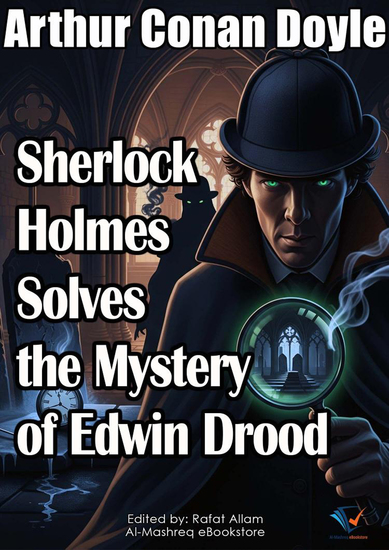
Sherlock Holmes Solves the Mystery of Edwin Drood - cover

Sherlock Holmes Solves the Mystery of Edwin Drood

Arthur Conan Doyle

Editorial: Al-Mashreq eBookstore

  • 0
  • 0
  • 0

Sinopsis

In this intriguing crossover pastiche, Sherlock Holmes Solves the Mystery of Edwin Drood, Arthur Conan Doyle's famed detective tackles the unfinished Charles Dickens novel The Mystery of Edwin Drood. The premise assumes that Holmes, at the request of Watson (an admirer of Dickens), takes it upon himself to finally unravel what happened to young Edwin Drood. The short piece is structured as Watson's account of Holmes applying his deductive genius to the clues left by Dickens. Holmes treats Dickens's text like a real case file: analyzing inconsistencies in characters' testimonies, re-examining evidence such as Edwin's last known movements and his watch and scarf found by the river. Through a series of brilliant inferences, Holmes identifies the solution that Victorian readers long speculated about – typically that John Jasper, Edwin's opium-addicted uncle, indeed murdered Edwin in a fit of mad jealousy. Holmes likely stages a re-creation or uses forensic logic to explain how Jasper could have disposed of the body (perhaps hidden in the cathedral crypt). In Doyle's hands, Holmes provides a conclusive ending: Jasper is exposed, and the motive and method made clear, thus giving literary closure to Dickens's fragment. This clever pastiche allowed Doyle to pay homage to Dickens while indulging the public's love of Holmes in an unexpected arena. The piece is sprinkled with sly humor (Holmes wryly "consulting" with Dickens's spirit or lamenting the lack of physical evidence in a book) and ends with Watson praising Holmes for succeeding where no one else could. Sherlock Holmes Solves the Mystery of Edwin Drood is a delightful what-if exercise, showcasing Holmes's powers in the realm of classic literature's greatest unsolved mystery.
Disponible desde: 01/08/2025.
Longitud de impresión: 32 páginas.

Otros libros que te pueden interesar

  • The Iliad - cover

    The Iliad

    Homer

    • 0
    • 0
    • 0
    The Iliad is one of two major ancient Greek epic poems attributed to Homer. It is one of the oldest extant works of literature still widely read by modern audiences. As with the Odyssey, the poem is divided into 24 books and was written in dactylic hexameter. It contains 15,693 lines in its most widely accepted version. Set towards the end of the Trojan War, a ten-year siege of the city of Troy by a coalition of Mycenaean Greek states, the poem depicts significant events in the siege's final weeks. In particular, it depicts a fierce quarrel between King Agamemnon and a celebrated warrior, Achilles. It is a central part of the Epic Cycle. The Iliad is often regarded as the first substantial piece of European literature.The Iliad and the Odyssey were likely written down in Homeric Greek, a literary amalgam of Ionic Greek and other dialects, probably around the late 8th or early 7th century BC. Homer's authorship was infrequently questioned in antiquity, but contemporary scholarship predominantly assumes that the Iliad and the Odyssey were composed independently and that the stories formed as part of a long oral tradition. Given widespread illiteracy,audiences were more likely to have heard the poem than read it; it was performed by professional reciters of Homer known as rhapsodes.America.
    Ver libro
  • Normal Social Life The (Unabridged) - cover

    Normal Social Life The (Unabridged)

    H. G. Wells

    • 0
    • 0
    • 0
    Herbert George Wells (21 September 1866 - 13 August 1946) was an English writer. Prolific in many genres, he wrote dozens of novels, short stories, and works of social commentary, history, satire, biography and autobiography. His work also included two books on recreational war games. Wells is now best remembered for his science fiction novels and is often called the "father of science fiction", along with Jules Verne and the publisher Hugo Gernsback.
    THE NORMAL SOCIAL LIFE: Produces an increasing surplus of energy and opportunity, more particularly under modern conditions of scientific organisation and power production; and this through the operation of rent and of usury tends to.
    Ver libro
  • War and Peace (Book Fourteen: 1812) - cover

    War and Peace (Book Fourteen: 1812)

    Leo Tolstoy

    • 0
    • 0
    • 0
    War and Peace is a literary work mixed with chapters on history and philosophy by the Russian author Leo Tolstoy. It was first published serially, then published in its entirety in 1869. It is regarded as one of Tolstoy's finest literary achievements and remains an internationally praised classic of world literature.
    Book 14: 1812: The Battle of Borodinó, with the occupation of Moscow that followed it and the flight of the French without further conflicts, is one of the most instructive phenomena in history. All historians agree that the external activity of states and nations in their conflicts with one another is expressed in wars, and that as a direct result of greater or less success in war the political strength of states and nations increases or decreases.
    Ver libro
  • Oliver Twist; or The Parish Boy's Progress - A gripping journey through the hardships and triumphs of a boy in the unforgiving streets of London - cover

    Oliver Twist; or The Parish...

    Charles Dickens

    • 0
    • 0
    • 0
    ❓ Are you ready to embark on a journey through Victorian London's darkest corners? 
     🌟 Do you long for a tale of courage, survival, and ultimate triumph? 
     💔 Have you ever wondered how hope can flourish in the most desperate circumstances? 
    If you answered YES to at least one of these questions, you MUST KEEP READING... 
    🌅 Journey Through the Streets of Victorian London in a Tale of Courage and Redemption 
    In the harsh reality of 19th century London, countless children faced unimaginable hardships and cruel treatment at the hands of a society that viewed them as nothing more than burdens. Through the eyes of one remarkable boy, we witness the dark underbelly of a city where poverty and crime reign supreme, and innocence fights daily for survival. 
    Here's What You'll Discover Inside: 🏰 Rich descriptions of Victorian London's contrasting societies 👥 Unforgettable characters that will stay with you long after the last page ⚖️ Powerful commentary on social justice and human nature 🌟 Heartwarming moments of friendship and loyalty 💪 Inspiring messages about perseverance and hope 
     And much more...! 
    Don't miss the chance to experience this transformative journey. Scroll up and click the BUY NOW button to step into a story that has captured hearts for generations! 📚
    Ver libro
  • Father Brown: The Flying Stars (Unabridged) - cover

    Father Brown: The Flying Stars...

    G. K. Chesterton

    • 0
    • 0
    • 0
    The Flying Stars" is one of Chesterton's mysteries featuring Father Brown. It's actually the first of these short stories I've read and I picked it up more because it's a Christmas mystery than to meet Father Brown, even though he is a character I'd like to read more of.
    The story takes place at an English manor home on Boxing Day. A young lady and the young man who lives next door are present, as is the girl's father, Colonel Adams, a newly arrived uncle and a quite rich godfather. Also present, in addition to the servants, simply because the Colonel likes his company is the local priest, Father Brown. The godfather has brought a gift for the young lady, a set of three gorgeous, large diamonds, which he has tucked away in his coat pocket.
    Ver libro
  • Crocker's Hole - From their pens to your ears genius in every story - cover

    Crocker's Hole - From their pens...

    R D Blackmore

    • 0
    • 0
    • 0
    Richard Doddridge Blackmore was born on 7th June, 1825 at Longworth in Berkshire (now part of Oxfordshire), where his father, John Blackmore, was Curate-in-charge of the parish. His mother died a few months after his birth the victim of an outbreak of typhus. With this loss the family moved to Bushey, Hertfordshire, then on to their native Devon.  His elder brother Richard (by a year), however, was taken by his aunt to live near Oxford. His father married again in 1831, whereupon Richard returned to live with them.  With much of his childhood spent in the lush and pastoral "Doone Country" of Exmoor, and along the Badgworthy Water, Blackmore came to love the very countryside he immortalised in Lorna Doone.  In November 1853 he married his wife Lucy.  And the following year, 1854, his literary career began with a collection of Poems and for the next 15 years he would write in the winters and garden in the summers.  In 1860 with inherited money he built a house in Teddington just outside of London and established a market garden for the cultivation of fruit.  He loved horticulture but having little business experience could never really exploit it.  However with the publication of Lorna Doone in 1869 he was catapulted to fame.  And although he continued to write extensively nothing caught the public imagination quite like Lorna Doone.  RD Blackmore died at Teddington on 20th January, 1900 after a long and painful illness, and was buried next to his wife in Teddington cemetery.
    Ver libro