¡Acompáñanos a viajar por el mundo de los libros!
Añadir este libro a la estantería
Grey
Escribe un nuevo comentario Default profile 50px
Grey
Suscríbete para leer el libro completo o lee las primeras páginas gratis.
All characters reduced
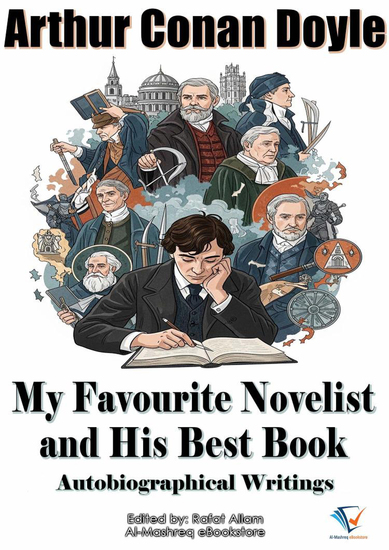
My Favourite Novelist and His Best Book - Autobiographical Writings - cover

My Favourite Novelist and His Best Book - Autobiographical Writings

Arthur Conan Doyle

Editorial: Al-Mashreq eBookstore

  • 0
  • 0
  • 0

Sinopsis

In My Favourite Novelist and His Best Book, Arthur Conan Doyle steps away from detective tales and war memoirs to pay heartfelt homage to the writer who shaped his literary vision—Sir Walter Scott. With reverence and critical insight, Doyle unveils his personal literary compass, reflecting on the life, works, and unmatched storytelling of the author he most admired. This short autobiographical essay is not merely a fan's tribute—it's a literary love letter and a window into Doyle's own creative mind. He discusses what made Scott's characters immortal, what novel he considers Scott's finest achievement, and how those stories influenced his own narrative craft. For readers curious about the books that shaped the creator of Sherlock Holmes, this essay is an essential piece of the puzzle—a thoughtful, passionate meditation on reading, writing, and literary greatness.
Disponible desde: 01/08/2025.
Longitud de impresión: 32 páginas.
Otros libros que te pueden interesar

  • Why Palestine?: Reflections From Singapore - cover

    Why Palestine?: Reflections From...

    Walid Jumblatt Abdullah

    • 0
    • 0
    • 0
    If you’ve ever wondered why people keep talking about Palestine, or the point of keeping up with a long-drawn conflict in the Middle East and what difference you could possibly make, this book is for you. Political analyst and podcaster Walid Jumblatt Abdullah takes on questions that Singaporeans have often raised about Palestine, laying out answers that clarify and inform. 
     
    Walid examines myths (“Could Gaza Have Been Singapore?”) and sheds light on the double standards of Western powers, to whom human rights seem to matter, except for where Palestine is concerned. Explaining how the Palestinians have been systematically dehumanised for decades, the book highlights how they continue to exist nevertheless, their very existence an act of resistance. 
     
    Why Palestine? is an illuminating starting point for newcomers to the issue, and a passionate primer that seasoned activists will welcome for capturing the heart and hope of a long-disenfranchised people and those who support them.
    Ver libro
  • The First Hellcat Ace - cover

    The First Hellcat Ace

    Hamilton McWhorter, Jay A Stout

    • 0
    • 0
    • 0
    Hamilton McWhorter III's service to family and country make him a standout among America's Greatest Generation. A Georgia native whose family roots date from that region's settlement during the 1700s, McWhorter was a naval aviation cadet undergoing training when Pearl Harbor was attacked by Japan on December 7, 1941. After earning his Wings of Gold in early 1942, Ensign McWhorter was trained as a fighter pilot in the robust but technologically outmoded F4F Wildcat. Initially assigned to VF-9, he saw first combat in November 1942 against Vichy French forces in North Africa. 


    After returning to the United States, VF-9 became the first unit to convert to the new Grumman F6F Hellcat. This was the fighter the U.S. Navy would use to crush Japanese air power during the long offensive from the Southwest Pacific to the shores of Japan. From mid-1943, McWhorter was engaged in the aerial warfare that characterized the battles against Imperial Japan. His fifth aerial victory, in November 1943 off Tarawa Atoll, made him the first ace in the Hellcat, and seven subsequent victories ensured his place in the annals of air-to-air combat. 


    McWhorter's combat service, from the beginning of the war to the last campaign off the shores of Okinawa, makes his story a must-listen for the serious student of the Pacific air war.
    Ver libro
  • Delhi Sultanate The: The History and Legacy of the Medieval Islamic Dynasty in India - cover

    Delhi Sultanate The: The History...

    Editors Charles River

    • 0
    • 0
    • 0
    India has been the location of many different empires throughout its long history. The Indus Valley Civilization was home to one of the world’s first civilizations more than 5,000 years ago, which was followed by the Aryan-Vedic culture and then a host of other kingdoms that flourished across the Sub-Continent. India has also been the birthplace of many religions. The Vedic religion of the Aryans evolved into the Hindu religion, and Buddhism and Jainism were also born in India. By the Middle Ages, India was home to many different religions and ethnic groups, with dozens of languages being spoken, making India less of a single, unified country and more of a land of many countries. Despite India’s tradition of cultural and political pluralism, several rulers attempted to place the entire Sub-Continent under the rule of one dynasty or government with a dominant religion. Most of these would-be rulers were far from successful, although a few came close, setting the template for later conquerors.  
    	The Delhi Sultanate was comprised of five dynasties that expanded their borders, and Islam, at sword point, but also through diplomacy and trade. The Delhi Sultanate became known as a state that welcomed the expertise of foreigners, no matter their religion, and promoted the welfare of its citizens through a host of social programs. Eventually, the Delhi Sultanate grafted ideas and inspiration from India’s pre-Islamic past with those of Islam to create a state that was quite unique and powerful. The Delhi sultans were themselves descended from Turks and brought with them ideas from Persia. Furthermore, as their empire grew, they invited scholars from throughout the Islamic world to their country, and as Muslim scholars, scientists, and administrators from the Near East made their way into India, the Delhi sultans also incorporated some of the cultural ideas of the native Hindu Indians to create a state that was as unique as any the world had ever seen.
    Ver libro
  • PowerNomics - The National Plan to Empower Black America - cover

    PowerNomics - The National Plan...

    Dr. Claud Anderson

    • 0
    • 0
    • 0
    In PowerNomics: The National Plan to Empower Black America, Dr. Claud Anderson dismantles the myths and illusions surrounding Black progress. He exposes how racial monopolies and an unending influx of self-proclaimed minorities threaten to relegate Black Americans to a permanent underclass within a decade. The choice to prevent this looming crisis is yours: the cure or the placebo. 
    PowerNomics is a transformative, mind-altering guide that, for the first time, offers actionable solutions to turn impoverished and powerless Black communities into a truly competitive group. It teaches a revolutionary way to see, think, and act in racial matters. 
    The decision is clear: Will you take the "all-is-well" placebo and remain complacent, or will you embrace the PowerNomics cure, confront the truth, and take action to solve the nation's race problem? The choice is yours.
    Ver libro
  • Kublai Khan: The Life and Legacy of the Legendary Mongolian Emperor of China - cover

    Kublai Khan: The Life and Legacy...

    Editors Charles River

    • 0
    • 0
    • 0
    Aside from Genghis, the most famous of the Mongolian rulers was Genghis’s grandson, Kublai Khan, who was raised as Mongolian in the traditional way, but also exposed to Chinese culture. Kublai’s father Tolui made sure all of his sons could ride and hunt, but he was apparently also concerned that they understood the characteristics and possibilities of the more settled regions under Mongolian rule. Thus, while Kublai and his brothers were still boys, his grandfather Genghis arranged a great Mongolian hunt. This traditional event involved many thousands of riders starting in a great circle and gradually moving into the center, driving the game in front of them. It was a hunt, but it was also a traditional kind of practice military exercise. Kublai killed a couple of small animals, and Genghis is reported to have been pleased with his grandsons.  
    	As Great Khan, Kublai Khan ruled the Mongolian Empire from his capital in modern-day Beijing, with a court that included Mongolians, Arabs, and Persians from throughout his empire. While Genghis may have been a warrior, Kublai was a man of culture, intellect and curiosity, and his court was a luxurious one rich in art, music, and goods. Under his reign, trade along the Silk Road was both easier and more efficient than ever before. Toll gates were removed, and traders could move freely from place to place. It was said that even women could travel safely with goods without fear of harm.  
    	Kublai was clearly an influential ruler, but what helped his legacy endure was that he hosted the famous Italian traveler Marco Polo, who stayed in China for years and described what he saw in detail. When Marco Polo’s travelogue was published back in Europe, it immediately became one of the most famous works on the continent, and while modern historians still debate which parts were factual and fictional, there can be no question that Kublai Khan was a monumental leader in Asia. 
    Ver libro
  • Living Resistance - An Indigenous Vision for Seeking Wholeness Every Day - cover

    Living Resistance - An...

    Kaitlin B Curtice

    • 0
    • 0
    • 0
    In an era in which "resistance" has become tokenized, popular Indigenous author Kaitlin Curtice reclaims it as a basic human calling. Resistance is for every human who longs to see their neighbors' holistic flourishing. We each have a role to play in the world right where we are, and our everyday acts of resistance hold us all together. 


    Curtice shows that we can learn to practice embodied ways of belonging and connection to ourselves and one another through everyday practices, such as getting more in touch with our bodies, resting, and remembering our ancestors. She explores four "realms of resistance"—the personal, the communal, the ancestral, and the integral—and shows how these realms overlap and why all are needed for our liberation. Listeners will be empowered to seek wholeness in whatever spheres of influence they inhabit.
    Ver libro