Begleiten Sie uns auf eine literarische Weltreise!
Buch zum Bücherregal hinzufügen
Grey
Einen neuen Kommentar schreiben Default profile 50px
Grey
Jetzt das ganze Buch im Abo oder die ersten Seiten gratis lesen!
All characters reduced
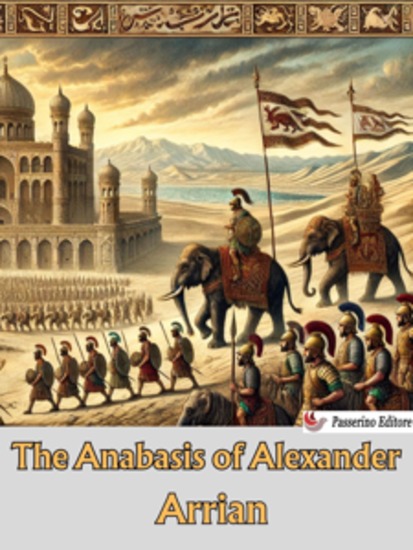
The Anabasis of Alexander - cover

The Anabasis of Alexander

Arrian

Verlag: Passerino

  • 0
  • 0
  • 0

Beschreibung

The Anabasis of Alexander was composed by Arrian of Nicomedia in the second century AD, most probably during the reign of Hadrian. The Anabasis (which survives complete in seven books) is a history of the campaigns of Alexander the Great, specifically his conquest of the Persian Empire between 336 and 323 BC.Both the unusual title "Anabasis" (literally "a journey up-country from the sea") and the work's seven-book structure reflect Arrian's emulation (in structure, style, and content) of the Greek historian Xenophon, whose own Anabasis in seven books concerned the earlier campaign "up-country" of Cyrus the Younger in 401 BC.Arrian of Nicomedia  (c. 86/89 – c. after 146/160 AD) was a Greek historian, public servant, military commander, and philosopher of the Roman period.
Verfügbar seit: 23.04.2025.

Weitere Bücher, die Sie mögen werden

  • Revisiting the Titanic: The Exploration of the Wreck and Current Controversies Surrounding the World’s Most Famous Ship - cover

    Revisiting the Titanic: The...

    Editors Charles River

    • 0
    • 0
    • 0
    In the over 100 years since it sank on its maiden voyage, the Titanic has been the subject of endless fascination, as evidenced by the efforts to find its final resting spot, the museums full of its objects, and the countless books, documentaries, and movies made about the doomed ocean liner. Thanks to the dramatization of the Titanic’s sinking and the undying interest in the story, millions of people are familiar with various aspects of the ship’s demise, and the nearly 1,500 people who died in the North Atlantic in the early morning hours of April 15, 1912. The sinking of the ship is still nearly as controversial now as it was over 100 years ago, and the drama is just as compelling.  
    	In the century since the Titanic sank, public interest in the ship and its history has waxed and waned on a regular basis. There was a flurry of activity right after it went down, as people tried to wrap their minds around what happened, but the World Wars pushed attention elsewhere. Then, during the 1950s, scientists had the time and money to become interested in it again. While there were numerous attempts to find that ship during the 1970s, the mighty ship still kept her secrets, her dead and their possessions safely at the bottom of the sea, where only strange creature comfortable in the depths could disturb them. 
    	As it turned out, the most famous wreck in the world would not be located until 1985, over 70 years after the ship sank that fateful April night. The discovery ignited a new flurry of interest in Titanic, including an interest in what the wreck still held, who those items belonged, to and what should be done with them. The 1997 blockbuster movie about the ship only stirred up more interest and controversy, both of which continue to this day. 
    Zum Buch
  • Blindness by José Saramago (Book Analysis) - Complete Summary and Book Analysis - cover

    Blindness by José Saramago (Book...

    Bright Summaries

    • 0
    • 0
    • 0
    In this clear and detailed reading guide, we've done all the hard work for you!Blindness tells the story of a group of people who, for some unknown reason, suddenly lose their sight. They are all sent to an asylum where the inmates quickly turn to violence and force to get what they want. As tensions grow and people become increasingly dehumanised, everybody wants to escape. But without knowing what caused the blindness epidemic, how can anybody stop it?Find out everything you need to know about Blindness in just a few minutes!This practical and insightful reading guide includes:• A complete plot summary• Character studies• Key themes and symbols• Questions for further reflectionWhy choose BrightSummaries.com?Available in print and digital format, our publications are designed to accompany you in your reading journey. The clear and concise style makes for easy understanding, providing the perfect opportunity to improve your literary knowledge in no time.See the very best of literature in a whole new light with BrightSummaries.com!
    Zum Buch
  • How to Analyze People: Learn How to Master Dark Psychology and Forbidden Manipulation - cover

    How to Analyze People: Learn How...

    Christopher Rothchester

    • 0
    • 0
    • 0
    Do you want to control people? Do you want to analyze people and figure out all that you want to know? 
    Human behavior is a simple and extensive concept. There are plenty of loopholes in the human psyche that can be used for the purpose of influencing others. Want to learn more about such loopholes? There is nothing to worry about, as you are at the right place. 
    Controlling the audience or making people agree with what you say is not a new concept. It is called manipulation. Most people who have had the most impact on world history managed to sway others to do their bidding. You might think that such people have been born with the talent of persuasion at high levels that it feels like mind control. But it is not. Human behavior might seem to be quite unpredictable, but there are certain foundations that can be mastered. 
    As you master the core foundations, you can get all that you want from others without creating the impression of being controlling or manipulative. 
    If you want to learn more about human psychology and behavior, you can with the help of How to Analyze People with Dark Psychology: Learn How to Master Dark Psychology and Forbidden Manipulation. 
    Using the techniques used by advertisers, politicians, and other masters of their universe, you can easily analyze anyone who is present around you. It can be done to have a profound influence on how others think. In case you are done with the world pushing you around and want to start pushing back, you have come to the right place. The aim of this guidebook is to provide you with all the basics of human psychology so that you can use the same for your best interest.
    Zum Buch
  • Ultimate Shadow Work Journal & Workbook The - 2 Books in 1 - A Comprehensive Collection of Exercises Journal Prompts and Affirmations for Profound Self-Discovery Emotional Healing and Personal Growth - cover

    Ultimate Shadow Work Journal &...

    Leigh W. Hart

    • 0
    • 0
    • 0
    This COMPREHENSIVE 2-IN-1 BUNDLE combines the foundational insights from Self-Guided Shadow Work for Beginners with the more advanced practices in Advanced Self-Guided Shadow Work.What unexpected and even amazing secrets does your shadow side hide? It’s time to forget the fear and shine a light on a hidden part of you that could be one of your absolute strengths! 
    The word shadow is dark and mysterious – something that you want to be cautious of and possibly even avoid. When you think about your own shadow side, you may feel a little fear and trepidation. So many questions arise, such as:Can I honestly not be aware of some deep, dark side of myself?If I step onto this path will I discover something I truly don’t want to face?Is this something I can really do on my own? 
    Shadow work is not something to be afraid of – in fact, it is all about shining the light of self-awareness and self-compassion into the dark so that you can embrace your whole self. It is a key step for anyone who wants to reach their full life potential.In this practical and supportive guide, you will discover:Strategies for handling overwhelming emotions and knowing if shadow work is effectiveEmotional mastery techniques to transform intensity into strength and resilienceCognitive reframing and confidence-building to overcome negative thoughts and create healthier habitsEnhanced relationship dynamics, including empathy, forgiveness, and effective communication skillsBeginners and Advanced self-reflection strategies to reveal the profound truths of your subconsciousTools for transforming past traumas and achieving a healed self
    Zum Buch
  • Colonialism: A Moral Reckoning - cover

    Colonialism: A Moral Reckoning

    Nigel Biggar

    • 0
    • 0
    • 0
    The Sunday Times Bestseller 
    A new assessment of the West’s colonial record 
    In the wake of the dissolution of the Soviet empire in 1989, many believed that we had arrived at the ‘End of History’ – that the global dominance of liberal democracy had been secured forever. 
    Now however, with Russia rattling its sabre on the borders of Europe and China rising to challenge the post-1945 world order, the liberal West faces major threats. 
      
    These threats are not only external. Especially in the Anglosphere, the ‘decolonisation’ movement corrodes the West’s self-confidence by retelling the history of European and American colonial dominance as a litany of racism, exploitation, and massively murderous violence. 
      
    Nigel Biggar tests this indictment, addressing the crucial questions in eight chapters: Was the British Empire driven primarily by greed and the lust to dominate? Should we speak of ‘colonialism and slavery’ in the same breath, as if they were identical? Was the Empire essentially racist? How far was it based on the theft of land? Did it involve genocide? Was it driven fundamentally by the motive of economic exploitation? Was undemocratic colonial government necessarily illegitimate? and, Was the Empire essentially violent, and its violence pervasively racist and terroristic? 
      
    Biggar makes clear that, like any other long-standing state, the British Empire involved elements of injustice, sometimes appalling. On occasions it was culpably incompetent and presided over moments of dreadful tragedy. 
      
    Nevertheless, from the early 1800s the Empire was committed to abolishing the slave trade in the name of a Christian conviction of the basic equality of all human beings. It ended endemic inter-tribal warfare, opened local economies to the opportunities of global trade, moderated the impact of inescapable modernisation, established the rule of law and liberal institutions such as a free press, and spent itself in defeating the murderously racist Nazi and Japanese empires in the Second World War. 
      
    As encyclopaedic in historical breadth as it is penetrating in analytical depth, Colonialism offers a moral inquest into the colonial past, forensically contesting damaging falsehoods and thereby helping to rejuvenate faith in the West’s future. 
    In his latest work, Biggar, the Sunday Times bestselling author, offers a new perspective on the era of colonialism. His bestselling book provides a comprehensive analysis of the ethics and philosophy of colonial rule in Britain and Europe during the Georgian era (1714-1837). 
    For fans of Tod E. Bolsinger (Tempered Resilience), Patrick J. Deneen (The Democratic Soul), Richard B. Hays (The Moral Vision of the New Testament), Michael D. Coogan (The Ten Commandments), and Matthew J. Goodwin (Values, Voice and Virtue). 
    HarperCollins 2023
    Zum Buch
  • America’s Deadliest Hurricanes: The History of the Three Worst Hurricanes in American History - cover

    America’s Deadliest Hurricanes:...

    Editors Charles River

    • 0
    • 0
    • 0
    Hurricanes have been devastating communities for thousands of years, bringing about various combinations of rain and wind that can do everything from taking down some dead limbs to wiping out houses. They are also common enough that people who live for any length of time in a region prone to having hurricanes are inclined to accept them as something of a periodic nuisance rather than a serious danger. Modern construction styles allow houses to withstand winds in excess of 100 miles an hour, and early warning systems allow people to evacuate. Thus, most hurricanes of the 21st century take fewer lives than a serious highway accident. 
    As a result, the world watched in horror as Hurricane Katrina decimated New Orleans in August 2005, and the calamity seemed all the worse because many felt that technology had advanced far enough to prevent such tragedies, whether through advanced warning or engineering. Spawning off the Bahamian coast that month, Katrina quickly grew to be one of the deadliest natural disasters in American history, killing more than 1,800 people and flooding a heavy majority of one of America’s most famous cities. At first, the storm seemed to be harmless, scooting across the Floridian coast as a barely noticeable Category 1 storm, but when Katrina reached the warm waters of the Gulf of Mexico, its winds grew exponentially before slamming into the southern Louisiana coast as a massive Category 5 hurricane. In addition to the deadly nature of the hurricane, it was also incredibly destructive as a result of failed levees around the New Orleans area. By the time the storm had passed, it had wreaked an estimated $108 billion of damage across the region, and the human suffering, with nearly 2,000 deaths and a million people displaced, was available for viewing across the world.
    Zum Buch