¡Acompáñanos a viajar por el mundo de los libros!
Añadir este libro a la estantería
Grey
Escribe un nuevo comentario Default profile 50px
Grey
Suscríbete para leer el libro completo o lee las primeras páginas gratis.
All characters reduced
On Generation and Corruption - cover

On Generation and Corruption

Aristotle

Editorial: Bu Classics Books

  • 0
  • 0
  • 0

Sinopsis

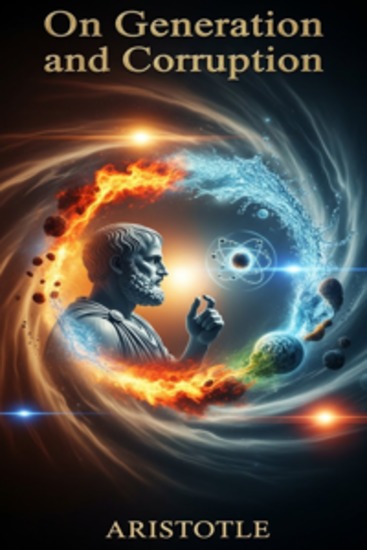
The processes of coming into being and passing away are analyzed in this scientific exploration of change in the natural world. Aristotle distinguishes generation from simple alteration, proposing that the four elements—earth, air, fire, and water—transform into one another through the exchange of qualities. The text examines the cyclical nature of life and matter, rejecting the idea of a void and focusing on the continuity of physical substance. It lays the groundwork for understanding growth, decay, and the perpetual transformation of the material universe.
Disponible desde: 29/01/2026.
Longitud de impresión: 105 páginas.

Otros libros que te pueden interesar

  • The Last Shah - America Iran and the Fall of the Pahlavi Dynasty - cover

    The Last Shah - America Iran and...

    Ray Takeyh

    • 0
    • 0
    • 0
    The surprising story of Iran's transformation from America's ally in the Middle East into one of its staunchest adversaries 


    Offering a new view of one of America's most important, infamously strained, and widely misunderstood relationships of the postwar era, this book tells the history of America and Iran from the time the last shah, Mohammad Reza Pahlavi, was placed on the throne in 1941 to the 1979 revolution that brought the present Islamist government to power. This revolution was not, as many believe, the popular overthrow of a powerful and ruthless puppet of the United States; rather, it followed decades of corrosion of Iran's political establishment by an autocratic ruler who demanded fealty but lacked the personal strength to make hard decisions and, ultimately, lost the support of every sector of Iranian society. Esteemed Middle East scholar Ray Takeyh provides new interpretations of many key events—including the 1953 coup against Prime Minister Mohammad Mossadeq and the rise of Ayatollah Ruhollah Khomeini—significantly revising our understanding of America and Iran's complex and difficult history.
    Ver libro
  • Dark Shadow Golden Shadow - Magickal Tools and Tarot to Confront Your Fears and Free Your Potential - cover

    Dark Shadow Golden Shadow -...

    Shannon Knight

    • 0
    • 0
    • 0
    Embark on a journey of self-discovery and healing with the help of tarot and other magickal tools. Gently explore the depths of the psyche—both the challenging (the dark) and the positive (the golden)—through practices designed to empower and transform.Author Shannon Knight’s approach to shadow work is deeply rooted in secular, therapeutic, and psychological principles, but she recognizes the valuable role that magick, archetypes, and symbolism play in this process. Dark Shadow, Golden Shadow is unique to other books on the subject, incorporating the use of tarot as a prominent tool that serves as a method of self-reflection, offering a portal to our subconscious and helping us access parts of ourselves previously unavailable to us. The imagery and archetypes help facilitate a dialogue with our shadow, making it easier to converse with the repressed and hidden parts of ourselves.Knight reveals that to create harmony and reduce tension between the logical and mystical aspects of ourselves, we need to be curious about multiple ways of being. We learn by experimenting with how these impact us—for better or for worse—and then we figure out what to do with this information.Through exercises, various techniques, and insights, Dark Shadow, Golden Shadow allows you to navigate the path toward greater self-acceptance. It’s the ultimate process of “looking in the mirror.”
    Ver libro
  • Boer War The: A Captivating Guide to Its Causes Battles and Legacy in South Africa - cover

    Boer War The: A Captivating...

    Captivating History

    • 0
    • 0
    • 0
    Dive into the heart of conflict with The Boer War. 
    This riveting narrative unfolds a tumultuous chapter in history where ambition, resilience, and tragedy collide on the sun-scorched plains of South Africa. Embark on a journey through time where the indomitable spirit of the Boer farmers clashed with the might of the British Empire, driven by dreams of expansion and the glittering allure of gold and diamonds. 
    Discover the roots of a conflict that reshaped the landscape of a nation and foreshadowed the brutal warfare of the 20th century. Here are just some of the things you will accomplish by listening to this audiobook:Unearth the origins of a fierce community determined to preserve their land against an empire’s reach.Witness the spark of the conflict, fueled by imperial demands that provoked a nation to war.Explore the tactical evolution on the battlefield, where guerrilla warfare and modern tactics foretold the future of combat.Experience the dramatic sieges and the resilience of besieged towns, embodying the unyielding human spirit amidst adversity.Follow the adventurous saga of Winston Churchill, from captivity to daring escapes.Marvel at the tactical ingenuity of the Boers, whose mastery of the land and hit-and-run tactics bewildered a traditional military power.Confront the dark legacy of the conflict, including the creation of concentration camps and the heavy toll on civilian lives. 
    The Boer War not only offers a window into the past but also presents timeless lessons on resilience, strategy, and the human cost of ambition.  
    Click the “add to cart” button and witness the epic saga of the Boer War.
    Ver libro
  • Phoney War The: The History of the Uneasy Calm along the Western Front at the Start of World War II - cover

    Phoney War The: The History of...

    Editors Charles River

    • 0
    • 0
    • 0
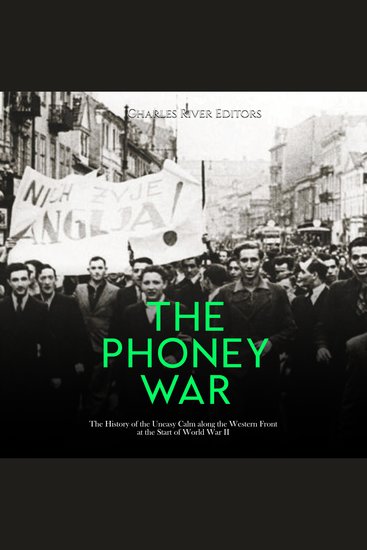
    Though the French would be decisively defeated soon after the Nazi invasion of Belgium and France in early 1940, they had not sat on their hands. As the power of Nazi Germany grew alarmingly during the 1930s, the French sought means to defend their territory against the rising menace of the Thousand Year Reich. As architects of the most punitive measures in the Treaty of Versailles following World War I, France was the most natural target for German retribution, so the Maginot Line, a series of interconnected strongpoints and fortifications running along much of France's eastern border, helped allay French fears of invasion.  
    	The popular legend of the Maginot Line portrays the frontier defenses as a useless “white elephant” project that was prompted by a gross misapprehension of warfare's new realities in the mid-20th century and quickly overwhelmed by the forceful advance of the German blitzkrieg. English idiom today invokes this vision of the Maginot Line as a metaphor for any defensive measure strongly believed in but actually useless. Indeed, usages such as “Maginot Line mentality,” describing an overly defensive, reactive mindset, perpetuate the legend. As a French author and military liaison with the British, Andre Maurois, wrote about his disillusionment with the defensive line he originally enthusiastically supported: “We know now that the Maginot line-complex was a dangerous disease of the mind; but I publish this as it was written in January, 1940.”  
    This was what brought about the stasis along the Western Front near the end of 1939, a short period of time now referred to as the Phoney War, during which the Western Allies awaited some sort of action by the Nazis. Ultimately, the Allies had not expected the Germans would be able to move armored units through the Ardennes Forests, a heavily wooded region spanning parts of Belgium, France and the Netherlands. 
    Ver libro
  • How To Write Publish And Sell Your Book On Amazon - Pratical Guide To Mastering Ebook And Paperback Book Creation - cover

    How To Write Publish And Sell...

    David Akpovi

    • 0
    • 0
    • 0
    This audiobook is narrated by an AI Voice.   
    Amazon is one of the most visited websites in the world, generating billions in revenue every quarter. But beyond the big brands, independent authors are thriving on its Kindle Direct Publishing (KDP) platform—turning their ideas into books that reach readers everywhere. 
    Do you dream of becoming an author but don’t know where to start? With Amazon KDP, millions of writers have already published their work—and now it’s your turn. 
    In this audiobook, David Akpovi shares his personal journey as an independent author who has successfully published more than ten books on Amazon KDP. Inside, you’ll learn step by step how to format your manuscript, publish your ebook and print book, calculate royalties, and promote your work effectively. You’ll also discover the tools that make writing easier, and how to decide if AI can help you save time along the way. 
    Whether you’re a complete beginner or simply looking for a clear roadmap to self-publishing, this guide gives you everything you need to launch your first book and start earning from your writing. 
    Simple. Practical. Actionable. Press play, and let this audiobook guide you through every step of publishing your book on Amazon.
    Ver libro
  • Reading Confederate Monuments - cover

    Reading Confederate Monuments

    Maria Seger, Joanna...

    • 0
    • 0
    • 0
    Contributions by Danielle Christmas, Joanna Davis-McElligatt, Garrett Bridger Gilmore, Spencer R. Herrera, Cassandra Jackson, Stacie McCormick, Maria Seger, Randi Lynn Tanglen, Brook Thomas, Michael C. Weisenburg, and Lisa Woolfork
    
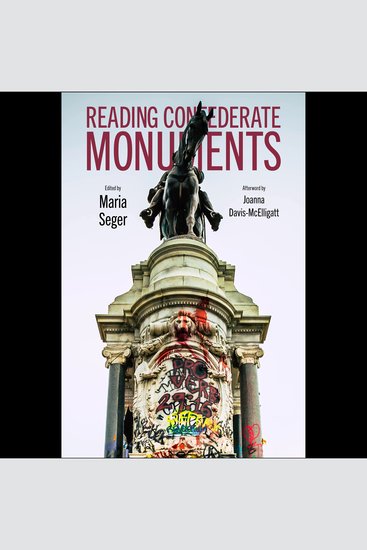
    Reading Confederate Monuments addresses the urgent and vital need for scholars, educators, and the general public to be able to read and interpret the literal and cultural Confederate monuments pervading life in the contemporary United States.  
    
    The literary and cultural studies scholars featured in this collection engage many different archives and methods, demonstrating how to read literal Confederate monuments as texts and in the context of the assortment of literatures that produced and celebrated them. They further explore how to read the literary texts advancing and contesting Confederate ideology in the US cultural imaginary—then and now—as monuments in and of themselves. On top of that, the essays published here lay bare the cultural and pedagogical work of Confederate monuments and counter-monuments—divulging how and what they teach their readers as communal and yet contested narratives—thereby showing why the persistence of Confederate monuments matters greatly to local and national notions of racial justice and belonging. In doing so, this collection illustrates what critics of US literature and culture can offer to ongoing scholarly and public discussions about Confederate monuments and memory.
    
    Brought to audio through new AI narrative technology, Reading Confederate Monuments teaches us that even as we remove, relocate, and recontextualize the physical symbols of the Confederacy dotting the US landscape, the complicated histories, cultural products, and pedagogies of Confederate ideology remain embedded in the national consciousness. To disrupt and potentially dismantle these enduring narratives alongside the statues themselves, we must be able to recognize, analyze, and resist them in US life. The pieces in this collection position us to think deeply about how and why we should continue that work.
    Ver libro