

¡Acompáñanos a viajar por el mundo de los libros!
Añadir este libro a la estantería
Grey
Escribe un nuevo comentario Default profile 50px
Grey
Suscríbete para leer el libro completo o lee las primeras páginas gratis.
All characters reduced
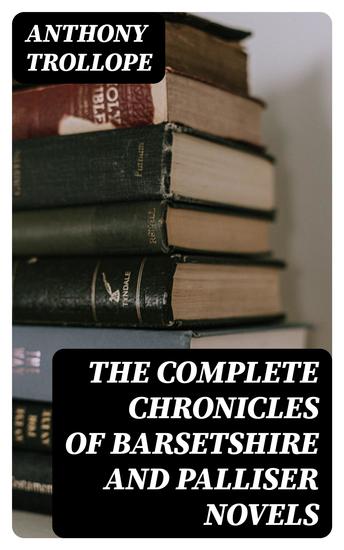
The Complete Chronicles of Barsetshire and Palliser Novels - cover

The Complete Chronicles of Barsetshire and Palliser Novels

Anthony Trollope

Editorial: DigiCat

  • 0
  • 0
  • 0

Sinopsis

In "The Complete Chronicles of Barsetshire and Palliser Novels," Anthony Trollope masterfully weaves a rich tapestry of Victorian society, offering readers an in-depth exploration of both the ecclesiastical and political landscapes of England. Through his intricate narrative style, which blends acute social commentary with well-rounded characterizations, Trollope invites readers into the lives of the inhabitants of Barsetshire and the intricate webs of the Palliser family. The work showcases his remarkable ability to capture the nuances of human ambition, morality, and class struggle, enveloped in a blend of irony and warmth that defines his literary prowess. Anthony Trollope, a prominent figure of 19th-century English literature, wrote these novels during a time of great social upheaval and change. His personal experiences, including his extensive travels and varied career in the Post Office, lent him unique insights into British society. Trollope's keen observations of the church and politics informed his narratives, allowing him to critique and illuminate his contemporary world, providing readers with an authentic portrayal of life's complexities. This comprehensive collection is highly recommended for readers seeking a thorough understanding of Victorian societal dynamics and a deep appreciation for character-driven storytelling. Trollope's nuanced portrayals and intricate plotting make this a must-read for anyone interested in the intricacies of human relationships shaped by societal expectations.
Disponible desde: 13/11/2022.
Longitud de impresión: 800 páginas.

Otros libros que te pueden interesar

  • Twenty-Six Men and a Girl - From their pens to your ears genius in every story - cover

    Twenty-Six Men and a Girl - From...

    Maxim Gorky

    • 0
    • 0
    • 0
    Alexei Maximovich Peshkov was born on 28th March 1868, in Nizhny Novgorod, Russia. 
    Better known as Maxim Gorky he was orphaned at 11 and ran away from home at 12.  At 19 he had already attempted suicide and thereafter travelled, by foot, across the Russian Empire for 5 years. 
    His first book ‘Essays & Stories’ in 1898 was a sensation and so began a long career as an author of short stories, novels and plays.  Gorky saw writing as a moral and political act that would help to change the unjust world around him.  He was an ardent early advocate of the emerging Marxist movement and publicly opposed the Tsarist regime leading several times to his arrest.  
    In 1904 he began his own theatre but the censor banned every play and Gorky was forced to abandon the project. 
    But Gorky was a financially successful author, editor, and playwright and gave monies to political parties as well as for civil rights and social reform.  The brutal shooting of workers, which set in motion the Revolution of 1905, pushed Gorky more decisively toward radical solutions.  
    In 1906 he went to the United States to raise funds for the Bolsheviks. Those experiences including a scandal over travelling with his lover and not his wife deepened his contempt for the ‘bourgeois soul.’ 
    Gorky now moved to Capri in Italy, both for health reasons and to escape the increasingly repressive times in Russia.  
    An amnesty for the 300th anniversary of the Romanov dynasty saw him return to Russia in 1914. His politics remained close to the Bolshevik cause.  But soon, after the 1918 revolution, his essays referred to Lenin as a tyrant for his senseless arrests and repression.  He was soon appealing to the outside world for food aid after the catastrophic crop failure. 
    In October 1921 Gorky returned to Italy, now in Fascist hands, and settled in Sorrento until 1932.  His health worsened with the onset of tuberculosis. 
    He wrote several successful books there but now decided to find an understanding with the communist regime. Stalin invited him home and his return was hailed as a major propaganda victory.  He was decorated with the Order of Lenin, and a province, a park, and various streets re-named in his honour. 
    But he had his faults too.  In 1933, Gorky co-edited a book on the White Sea-Baltic Canal and denied even a single prisoner died during its construction, but thousands had. As well, knowing that some Nazis were homosexual, a phrase was attributed to him that said ‘exterminate all homosexuals and fascism will vanish’.  Although he was himself was quoting another he was decidedly homophobic. 
    With the increase of Stalinist repression in 1935 Gorky was placed under unannounced house arrest. 
    Maxim Gorky died on the 18th June 1936 from pneumonia.  He was 68. 
    Stalin and Molotov were among those who carried Gorky's urn of ashes at his funeral.
    Ver libro
  • Mr Britling Sees It Through - Book 2: Matching's Easy at War (Unabridged) - cover

    Mr Britling Sees It Through -...

    H. G. Wells

    • 0
    • 0
    • 0
    Herbert George Wells (21 September 1866 - 13 August 1946) was an English writer. Prolific in many genres, he wrote dozens of novels, short stories, and works of social commentary, history, satire, biography and autobiography. His work also included two books on recreational war games. Wells is now best remembered for his science fiction novels and is often called the "father of science fiction", along with Jules Verne and the publisher Hugo Gernsback.
    MATCHING'S EASY AT WAR: On that eventful night of the first shots and the first deaths Mr. Britling did not sleep until daylight had come. He sat writing at this pamphlet of his, which was to hail the last explosion and the ending of war.
    Ver libro
  • A Hunger Artist - cover

    A Hunger Artist

    Franz Kafka

    • 0
    • 0
    • 0
    A Hunger Artist is a short story by Franz Kafka first published in 1922. The protagonist, a hunger artist who experiences the decline in appreciation of his craft, is typically Kafkaesque: an individual marginalized and victimized by society at large. A Hunger Artist explores themes such as death, art, isolation, asceticism, spiritual poverty, futility, personal failure and the corruption of human relationships.
    Ver libro
  • A Journey to the Center of the Earth - cover

    A Journey to the Center of the...

    Jules Verne

    • 0
    • 0
    • 0
    Embark on an extraordinary expedition in this timeless science fiction masterpiece by Jules Verne. A Journey to the Center of the Earth takes you deep below the Earth's surface on a thrilling adventure filled with wonder, danger, and discovery. 
    Follow Professor Lidenbrock, his nephew Axel, and their intrepid guide, Hans, as they navigate mysterious caverns, encounter prehistoric creatures, and uncover ancient secrets hidden beneath the Earth's crust. With vivid descriptions and relentless excitement, this audiobook brings Verne's visionary imagination to life, offering a story that will captivate listeners of all ages. 
    Perfect for fans of exploration, science, and daring escapades, A Journey to the Center of the Earth is a voyage you won't soon forget.
    Ver libro
  • The Body Snatcher and Olalla - Two Haunting Classic Tales - cover

    The Body Snatcher and Olalla -...

    Robert Louis Stevenson

    • 0
    • 0
    • 0
    The Body Snatcher follows a young medical student, Fettes, who becomes entangled in grave-robbing under the influence of his superior, the sinister Dr. Macfarlane, as they supply bodies for anatomical study. Years later, Fettes is haunted by the memory of a corpse they recognize as someone they had supposedly already buried—raising chilling questions about murder and morality. 
    In Olalla, a wounded British soldier recovering in a remote Spanish estate becomes captivated by the mysterious and beautiful Olalla, whose noble family harbors a dark and supernatural secret. As he uncovers their eerie past and Olalla’s internal struggle, he is forced to confront themes of heredity, self-denial, and the haunting power of ancestral sin. 
    Robert Louis Stevenson (1850-1894) was a Scottish novelist, poet, and travel writer known for his significant contributions to world literature. Through his stories, Stevenson commented on Victorian society, often critiquing its hypocrisies and moral ambiguities, making his work relevant to discussions on ethics, identity, and the human condition. Stevenson's legacy lies in his ability to entertain while subtly challenging readers to ponder deeper societal and personal issues. His works continue to be studied, adapted, and celebrated for their storytelling prowess and thematic depth. 
    Frank Marcopolos lives in Florida with his dog, Sparky. He served as a U.S. paratrooper in the 82nd Airborne Division during the war.
    Ver libro
  • The Dunwich Horror — Part 7 of 10 - cover

    The Dunwich Horror — Part 7 of 10

    H. P. Lovecraft

    • 0
    • 0
    • 0
    Welcome to Timeless Terrors No. 62, continuing H. P. Lovecraft’s nightmarish journey into cosmic terror: The Dunwich Horror. 
    The nightmare can no longer be contained. What was once hidden in the upper rooms of the Whateley farmhouse has broken free, spilling into the countryside of Dunwich as a vast, invisible force. The earth trembles beneath its passage, farms are crushed in the dark of night, and witnesses speak in terrified whispers of air that ripples and twists around an unseen, colossal mass. 
    Wilbur’s desperate search for forbidden knowledge has given way to consequences no human mind can fully grasp. The hills groan, the trees splinter, and the land itself recoils as something ancient and alien moves through the valley, driven by instincts far older than mankind. 
    Narrated by Amazon-bestselling horror author Jonathan Dunne, this chapter draws you into the most destructive phase of Lovecraft’s vision — where reality fractures, sanity falters, and the fragile world of men bends beneath the weight of inhuman powers. 
    This is Part 7 of a 10-part complete audiobook. Stay tuned — the horror now walks free.
    Ver libro
