Join us on a literary world trip!
Add this book to bookshelf
Grey
Write a new comment Default profile 50px
Grey
Subscribe to read the full book or read the first pages for free!
All characters reduced
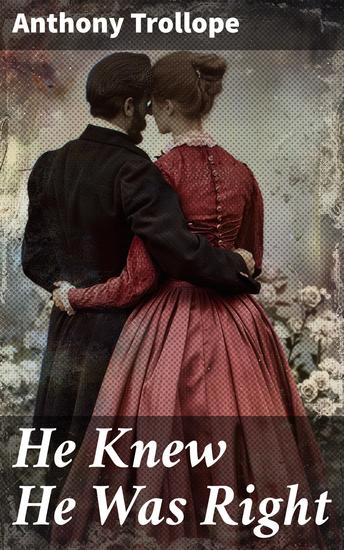
He Knew He Was Right - Victorian Romance Novel - cover

He Knew He Was Right - Victorian Romance Novel

Anthony Trollope

Publisher: Good Press

  • 0
  • 0
  • 0

Summary

Anthony Trollope's "He Knew He Was Right" is a compelling exploration of marriage, jealousy, and societal norms within Victorian England. The novel intricately weaves together the lives of its characters, primarily focusing on the obsessive relationship between the protagonist, Louis Trevelyan, and his wife, Emily. Trollope's writing style is characterized by its psychological depth and keen social insight, employing a narrative technique that oscillates between omniscient commentary and intimate character perspectives. The novel's rich, descriptive prose not only captures the moral dilemmas faced by the characters but also critiques the rigid social conventions of the time. Trollope, a prominent figure in the Victorian literary scene, had firsthand experience of the complexities of marriage and relationships, having navigated multiple personal challenges in his own life. His relentless dedication to his writing and his keen observation of human behavior shine through in this work. Drawing upon his own experiences and keen social awareness, Trollope delves into the darker facets of love and possession, elevating the narrative to a profound commentary on the nature of trust and autonomy in marriage. This thought-provoking novel is highly recommended for readers interested in Victorian literature, psychological drama, and social commentary. Trollope's nuanced character studies and rich narrative will resonate with anyone looking to understand the intricacies of human relationships. "He Knew He Was Right" remains a timeless lesson on love, trust, and the perils of obsession that continues to captivate audiences today.
Available since: 12/12/2023.
Print length: 836 pages.

Other books that might interest you

  • A Doll's House - cover

    A Doll's House

    Henrik Ibsen

    • 0
    • 0
    • 0
    Ibsen's "A Doll's House," written two years after "The Pillars of Society," became a sensation and is now widely considered his most famous play. Required reading in many secondary schools and universities, the play was highly controversial upon its release due to its sharp criticism of 19th Century marriage norms. Despite following the structure of a traditional well-made play, the play breaks convention by ending with a discussion instead of an unraveling in its final act. Although Ibsen himself denied it, "A Doll's House" is often referred to as the first true feminist play.
    Show book
  • War and Peace Book 1 - cover

    War and Peace Book 1

    Leo Tolstoy

    • 0
    • 0
    • 0
    "War and Peace," an epic novel by Leo Tolstoy, unfolds during the Napoleonic era in Russia. The narrative intertwines five aristocratic families amidst the tumult of war and societal change. Amidst political intrigue and military campaigns, Pierre Bezukhov inherits a vast fortune, embarking on a quest for meaning and spiritual fulfillment. Prince Andrei Bolkonsky, disillusioned by the futility of war after severe injury, grapples with love, despair, and the search for purpose. Natasha Rostova, a vivacious young woman, experiences passionate love, heartbreak, and personal growth. The novel masterfully juxtaposes individual destinies against the sweeping backdrop of history, exploring themes of free will versus historical determinism, the human capacity for change, and the timeless questions of war's destructive nature and peace's elusive pursuit.
    Show book
  • A Portrait of the Artist - cover

    A Portrait of the Artist

    Stephen Dedalus

    • 0
    • 0
    • 0
    A Portrait of the Artist as a Young Man tells the story of Stephen Dedalus, a boy growing up in Ireland at the end of the nineteenth century, as he gradually decides to cast off all his social, familial, and religious constraints to live a life devoted to the art of writing. As a young boy, Stephen's Catholic faith and Irish nationality heavily influence him. He attends a strict religious boarding school called Clongowes Wood College. At first, Stephen is lonely and homesick at school, but as time passes he finds his place among the other boys. He enjoys his visits home, even though family tensions run high after the death of the Irish political leader Charles Stewart Parnell. This sensitive subject becomes the topic of a furious, politically charged argument over the family's Christmas dinner. This is James Joyce's first novel, the semi-autobiographical story of a young Irish boy who struggles with family, country, and religion to become an artist and a man.Stephen Dedalus is James Joyce's literary alter ego, appearing as the protagonist and antihero of his first, semi-autobiographic novel of artistic existence A Portrait of the Artist as a Young Man and an important character in Joyce's 1922 novel Ulysses.
    Show book
  • War and Peace - Book 8: 1811-12 (Unabridged) - cover

    War and Peace - Book 8: 1811-12...

    Leo Tolstoy

    • 0
    • 0
    • 0
    War and Peace is a literary work mixed with chapters on history and philosophy by the Russian author Leo Tolstoy. It was first published serially, then published in its entirety in 1869. It is regarded as one of Tolstoy's finest literary achievements and remains an internationally praised classic of world literature.
    Book 8: 1811-12: After Prince Andrew's engagement to Natásha, Pierre without any apparent cause suddenly felt it impossible to go on living as before. Firmly convinced as he was of the truths revealed to him by his benefactor, and happy as he had been in perfecting his inner man, to which he had devoted himself with such ardor-all the zest of such a life vanished after the engagement of Andrew and Natásha and the death of Joseph Alexéevich.
    Show book
  • Antigone - Full Cast Drama - cover

    Antigone - Full Cast Drama

    Sophocles

    • 0
    • 0
    • 0
    "Antigone" is a Greek tragedy written by Sophocles in the 5th century BCE. The play is part of a trilogy, but only "Antigone," the third installment, has survived. The narrative revolves around Antigone, the daughter of Oedipus, who defies the king's decree and buries her brother Polynices, in defiance of the law. The king, Creon, orders that Polynices' body should remain unburied as punishment for his rebellion against the city. 
     
    Antigone's act of burial is not only an expression of familial loyalty but also an assertion of divine laws over human laws. She believes in the moral duty to honor her brother, even in death and is willing to face the consequences. Creon, however, sees her actions as an affront to his authority and issues a decree that anyone attempting to bury Polynices will be put to death. 
     
    As the plot unfolds, the clash between divine and human laws intensifies. Antigone is caught and brought before Creon, where she staunchly defends her actions. Creon remains resolute in his decision to punish her, regardless of her familial ties. The play explores themes of morality, duty, and the consequences of pride and authoritarian rule. 
     
    Tragedy unfolds as Antigone is sentenced to be entombed alive. The narrative weaves the fates of various characters, including Antigone, Haemon (Creon's son and Antigone's fiancé), and Eurydice (Creon's wife). The play culminates in a series of tragic events, leading to Creon's realization of his own tragic flaw and the devastating consequences of his decisions.
    Show book
  • Little Peasant The - Story Time Episode 39 (Unabridged) - cover

    Little Peasant The - Story Time...

    Brothers Grimm

    • 0
    • 0
    • 0
    A poor peasant and his wife did not even have a cow. They had a woodworker make them a calf of wood and brought it to the pasture. When the cowherd returned without it, they found it had been stolen and took him to court for his carelessness, and the judge made him give them a cow.
    Show book