

¡Acompáñanos a viajar por el mundo de los libros!
Añadir este libro a la estantería
Grey
Escribe un nuevo comentario Default profile 50px
Grey
Suscríbete para leer el libro completo o lee las primeras páginas gratis.
All characters reduced
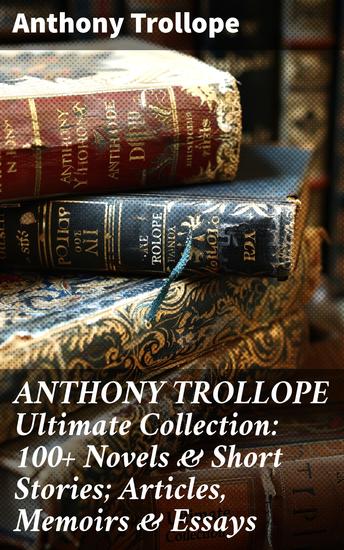
ANTHONY TROLLOPE Ultimate Collection: 100+ Novels & Short Stories; Articles Memoirs & Essays - Exploring Victorian Society: A Collection of Masterful Works - cover

ANTHONY TROLLOPE Ultimate Collection: 100+ Novels & Short Stories; Articles Memoirs & Essays - Exploring Victorian Society: A Collection of Masterful Works

Anthony Trollope

Editorial: Good Press

  • 0
  • 0
  • 0

Sinopsis

In the expansive compilation, "ANTHONY TROLLOPE Ultimate Collection: 100+ Novels & Short Stories; Articles, Memoirs & Essays," readers are invited to delve into the rich tapestry of Victorian life as depicted through Trollope's prolific writing. This ultimate collection not only highlights his masterful storytelling and nuanced character development but also showcases his keen sociopolitical observations. With an engaging prose style that intertwines wit and profound insights, Trollope's work reflects the intricacies of class, politics, and gender, providing a comprehensive view of 19th-century British society. Anthony Trollope, an astute chronicler of his times, was influenced by his personal experiences and extensive travels through the English countryside. Coming from a background of fluctuating fortunes, he draws upon both his public service in the Post Office and his literary pursuits, yielding a distinctive perspective that resonates throughout his narratives. Trollope'Äôs dedication to capturing the human condition, along with his unyielding work ethic, prompted him to produce an oeuvre that is both extensive and enduring. This ultimate collection is a must-read for anyone seeking a holistic understanding of Victorian literature or a comprehensive introduction to Trollope'Äôs works. Whether a seasoned Trollope enthusiast or a newcomer, readers will find themselves captivated by the depth of his narratives and the timeless themes that echo across his writings.
Disponible desde: 12/12/2023.
Longitud de impresión: 24851 páginas.
Otros libros que te pueden interesar

  • The Beauty and the Beast - cover

    The Beauty and the Beast

    Gabrielle-Suzanna Barbot de...

    • 0
    • 0
    • 0
    The Beauty & the Beast (Dramatized) is a captivating retelling of the timeless fairy tale, brought vividly to life through a full-cast performance. This version preserves the heartwarming story of Beauty, a kind and selfless young woman, who comes to live in the enchanted castle of a mysterious Beast in order to save her father. As the tale unfolds, themes of inner beauty, compassion, and transformation take center stage. This dramatized edition, performed by Jason Damron and a talented voice cast, enhances the classic narrative with expressive dialogue, character-driven performances, and immersive soundscapes, making it a perfect listen for audiences of all ages.
    Ver libro
  • Horror at Sea - 15 Nautical Nightmares - cover

    Horror at Sea - 15 Nautical...

    William Hope Hodgson, H. P....

    • 0
    • 0
    • 0
    HorrorBabble's complete "Horror at Sea" collection. 15 nautical nightmares: from the discovery and subsequent investigation of a mysterious vessel in The Derelict; to the terrifying ordeal of a lighthouse keeper stationed at the remote, Three Skeleton Key. 
    "There’ll be restless nights for thee, upon these seven seas…" 
    Contents: 
    The Derelict by W. H. Hodgson (Red Magazine, Dec 1912) 
    The Ocean Ogre by D. Carroll (Weird Tales, July 1937) -- A stranded ship. 
    Ghouls of the Sea by J. B. S. Fullilove (WT, March 1934) -- Death aboard the "Kay Marie". 
    The Voice in the Night by W. H. Hodgson (Blue Book Magazine, Nov 1907) -- A schooner, approached in the night. 
    The Black, Dead Thing by F. B. Long (WT, Oct 1933) -- A dreadful thing came aboard the ship. 
    The Temple by H. P. Lovecraft (WT, Sep 1925) -- A submarine on a strange descent. 
    The Lure of Atlantis by J. M. Nichols, Jr. (WT, April 1925) -- An expedition into a lost city. 
    The Uncharted Isle by C. A. Smith (WT, Nov 1930) -- A sailor lost at sea. 
    The Night Ocean by H. P. Lovecraft (Californian, Winter 1936) -- An artist, unsettled by the ocean. 
    Fire in the Galley Stove by W. Outerson (Atlantic, May 1937) -- An attack on the "Unicorn". 
    The Black Kiss by R. Bloch (WT, June 1937) -- The thing that swam in black waters. 
    Lost by A. M. Schnirring (WT, July 1943) -- A tale of the marshes. 
    The Thing in the Weeds by W. H. Hodgson (Story-teller, Jan 1913) -- A Sargasso Sea story. 
    The Brain-Eaters by F. B. Long (WT, June 1932) -- A horror from four-dimensional space. 
    Three Skeleton Key by G. G. Toudouze (Esquire, Jan 1937)
    Ver libro
  • Silver Key The (Unabridged) - cover

    Silver Key The (Unabridged)

    H. P. Lovecraft

    • 0
    • 0
    • 0
    "The Silver Key" is a fantasy short story by American writer H. P. Lovecraft. Written in 1926, it is considered part of his Dreamlands series. It was first published in the January 1929 issue of Weird Tales. It is a continuation of "The Dream-Quest of Unknown Kadath", and was followed by a sequel, "Through the Gates of the Silver Key", co-written with E. Hoffmann Price. The story and its sequel both feature Lovecraft's recurring character of Randolph Carter as the protagonist.
    Ver libro
  • Love and Friendship - cover

    Love and Friendship

    Ralph Waldo Emerson

    • 0
    • 0
    • 0
    "A friend is a person with whom I may be sincere," wrote Ralph Waldo Emerson in Love and Friendship, a collection of essays on relationships. "Before him, I may think aloud. I do then with my friends as I do with my books. I would have them where I can find them, but I seldom use them."
    Ver libro
  • The Death of Ivan Ilyich - cover

    The Death of Ivan Ilyich

    Leo Tolstoy

    • 0
    • 0
    • 0
    "In the end, it is love alone that matters, the love that we give and receive."
    
    Considered one of the masterpieces of Tolstoy's later fiction, The Death of Ivan Ilyich tells the story of Ivan Ilyich Golovin, a high-ranking judge in the Russian judicial system. His life appears successful by societal standards: he has a respectable job, a family, and a comfortable lifestyle until he is diagnosed with a terminal condition which eventually confines him to his bed. Here, he reflects on his life and the relationships around him and comes to realise that he has not truly lived and has instead followed a path dictated by society that has not brought him happiness or contentment. Brought face to face with his mortality, he experiences a revelation about the importance of authentic love and human connection.
    Leo Tolstoy (1828–1910) was a Russian novelist, philosopher, and social reformer, widely regarded as one of the greatest writers of all time. He is best known for his epic novels War and Peace and Anna Karenina, both celebrated for their intricate character development and profound exploration of moral dilemmas and human nature. In his later years, Tolstoy experienced a spiritual awakening which led him to reject materialism and embrace a life of simplicity, seeking to align his life with his beliefs about non-violence and compassion. Tolstoy's legacy endures not only through his literary masterpieces but also through his profound impact on literature and philosophy.
    Ver libro
  • The Picture of Dorian Gray - cover

    The Picture of Dorian Gray

    Oscar Wilde

    • 0
    • 0
    • 0
    "It is your best work, Basil, the best thing you have ever done," said Lord Henry, languidly. "You must certainly send it next year to the Grosvenor. The Academy is too large and too vulgar. The Grosvenor is the only place."    "I don't think I will send it anywhere," he answered, tossing his head back in that odd way that used to make his friends laugh at him at Oxford. "No: I won't send it anywhere."    Lord Henry elevated his eyebrows, and looked at him in amazement through the thin blue wreaths of smoke that curled up in such fanciful whorls from his heavy opium-tainted cigarette. "Not send it anywhere? My dear fellow, why? Have you any reason? What odd chaps you painters are! You do anything in the world to gain a reputation. As soon as you have one, you seem to want to throw it away. It is silly of you, for there is only one thing in the world worse than being talked about, and that is not being talked about. A portrait like this would set you far above all the young men in England, and make the old men quite jealous, if old men are ever capable of any emotion."    "I know you will laugh at me," he replied, "but I really can't exhibit it. I have put too much of myself into it."    Lord Henry stretched his long legs out on the divan and shook with laughter.  "Yes, I knew you would laugh; but it is quite true, all the same."    "Too much of yourself in it! Upon my word, Basil, I didn't know you were so vain; and I really can't see any resemblance between you, with your rugged strong face and your coal-black hair, and this young Adonis, who looks as if he was made of ivory and rose-leaves. Why, my dear Basil, he is a Narcissus, and you--well, of course you have an intellectual expression, and all that.    But beauty, real beauty, ends where an intellectual expression begins. Intellect is in itself an exaggeration, and destroys the harmony of any face. The moment one sits down to think, one becomes all nose, or all forehead, or something horrid. Look at the successful men in any of the learned professions. How perfectly hideous they are! Except, of course, in the Church. But then in the Church they don't think. A bishop keeps on saying at the age of eighty what he was told to say when he was a boy of eighteen, and consequently he always looks absolutely delightful. Your mysterious young friend, whose name you have never told me, but whose picture really fascinates me, never thinks. I feel quite sure of that. He is a brainless, beautiful thing, who should be always here in winter when we have no flowers to look at, and always here in summer when we want something to chill our intelligence. Don't flatter yourself, Basil: you are not in the least like him."
    Ver libro
