Junte-se a nós em uma viagem ao mundo dos livros!
Adicionar este livro à prateleira
Grey
Deixe um novo comentário Default profile 50px
Grey
Assine para ler o livro completo ou leia as primeiras páginas de graça!
All characters reduced
A Man of Mark - cover
LER

A Man of Mark

Anthony Hope

Editora: DigiCat

  • 0
  • 0
  • 0

Sinopse

In "A Man of Mark," Anthony Hope crafts a captivating narrative that intertwines elements of adventure, romance, and social commentary, emblematic of the late 19th-century literary style. The novel follows the journey of its protagonist, an aspiring artist, who navigates the complexities of ambition and moral quandaries within a society marked by class disparities. Hope's prose is both incisive and witty, employing vivid imagery and sharp dialogue that illuminate the characters' inner lives while also critiquing the societal norms of his time, reminiscent of the works of Dickens and Thackeray. Anthony Hope, an English novelist and playwright, is perhaps best known for his seminal work "The Prisoner of Zenda," which established him as a master of adventure fiction. Drawing from his own experiences in a rapidly changing Victorian society, Hope's writing reflects an understanding of the struggles for identity and self-determination. His extensive travels and diverse cultural encounters inform the rich tapestry of characters in "A Man of Mark," showcasing his keen ability to explore the human condition across various social strata. This delightful novel is highly recommended for readers who appreciate tightly woven narratives that blend thrills with incisive social observations. Hope's compelling storytelling and richly developed characters provide a profound reflection on the aspirations and moral dilemmas that define the human experience. "A Man of Mark" invites readers not only to enjoy a riveting tale but also to ponder the deeper meanings of success and integrity in their own lives.
Disponível desde: 16/09/2022.
Comprimento de impressão: 93 páginas.


Outros livros que poderiam interessá-lo

  • Les Misérables - Volume 4: The Idyll in the Rue Plumet and the Epic in the Rue St Denis (Unabridged) - cover

    Les Misérables - Volume 4: The...

    Victor Hugo

    • 0
    • 0
    • 0
    Victor-Marie Hugo (26 February 1802 - 22 May 1885) was a French poet, novelist, essayist, playwright, and dramatist of the Romantic movement. During a literary career that spanned more than sixty years, he wrote abundantly in an exceptional variety of genres: lyrics, satires, epics, philosophical poems, epigrams, novels, history, critical essays, political speeches, funeral orations, diaries, and letters public and private, as well as dramas in verse and prose.
    VOLUME 4: THE IDYLL IN THE RUE PLUMET AND THE EPIC IN THE RUE ST. DENIS: 1831 and 1832, the two years which are immediately connected with the Revolution of July, form one of the most peculiar and striking moments of history. These two years rise like two mountains midway between those which precede and those which follow them. They have a revolutionary grandeur. Precipices are to be distinguished there. The social masses, the very assizes of civilization, the solid group of superposed and adhering interests, the century-old profiles of the ancient French formation, appear and disappear in them every instant, athwart the storm clouds of systems, of passions, and of theories.
    Ver livro
  • Not to Be Taken - cover

    Not to Be Taken

    Anthony Berkeley

    • 0
    • 0
    • 0
    In the comfortable English Dorsetshire village of Anneypenny in the 1930s, fruit farmer Douglas Sewell – narrator of the story – sees his friend John die in agony. The death certificate states gastric ulcers but the post mortem’s revealing of poison punctures Anneypenny’s idyllic backdrop. Soon every friend and neighbour seems to harbour something suspicious. Douglas challenges his readers, or listeners, to answer the key questions before throwing out several scenarios and turning them upside-down in a tantalising path to the truth. 
    A journalist as well as a novelist, Anthony Berkeley was a founding member of the Detection Club and one of crime fiction’s greatest innovators. He was one of the first to predict the development of the ‘psychological’ crime novel.
    Ver livro
  • Jack and Jill - cover

    Jack and Jill

    Louisa May Alcott

    • 0
    • 0
    • 0
    “Jack and Jill” by Louisa May Alcott is a children’s book originally published in 1880. The story takes place in a small New England town after the Civil War. It tells the story of two good friends, Jack Minot and Janey Pecq, who are always seen together. Janey gets the nickname of Jill, to mimic the old rhyme. One winter day, they go up a hill and then suffer a serious accident. They are seriously injured in a sledding accident, and they recover from their physical injuries, while learning life lessons along with their many friends. They are helped along their journey to recovery by various activities created by their mothers.
    Ver livro
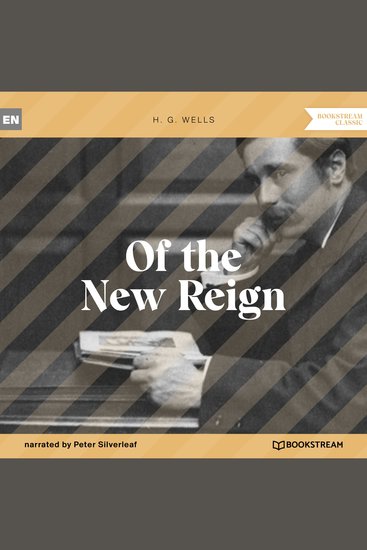
  • Of the New Reign (Unabridged) - cover

    Of the New Reign (Unabridged)

    H. G. Wells

    • 0
    • 0
    • 0
    Herbert George Wells (21 September 1866 - 13 August 1946) was an English writer. Prolific in many genres, he wrote dozens of novels, short stories, and works of social commentary, history, satire, biography and autobiography. His work also included two books on recreational war games. Wells is now best remembered for his science fiction novels and is often called the "father of science fiction", along with Jules Verne and the publisher Hugo Gernsback.
    OF THE NEW REIGN: The bunting and the crimson vanish from the streets. Already the vast army of improvised carpenters that the Coronation has created set themselves to the work of demolition, and soon every road that converges upon Central London will be choked again with great loads of timber-but this time going outward-as our capital emerges from this unprecedented inundation of loyalty. The most elaborately conceived, the most stately of all recorded British Coronations is past.
    Ver livro
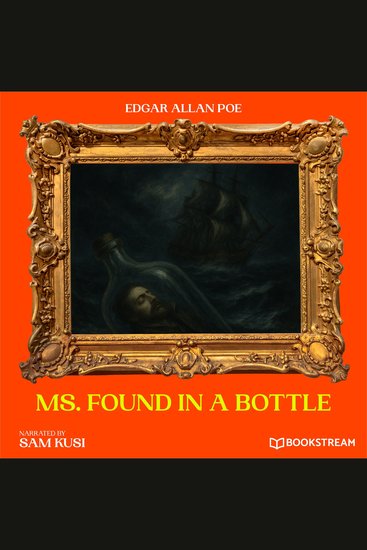
  • The MS Found in a Bottle - cover

    The MS Found in a Bottle

    Edgar Allan Poe

    • 0
    • 0
    • 0
    "MS. Found in a Bottle" is an 1833 short story by American writer Edgar Allan Poe. The plot follows an unnamed narrator at sea who finds himself in a series of harrowing circumstances. As he nears his own disastrous death while his ship drives ever southward, he writes an "MS.", or manuscript, telling of his adventures which he casts into the sea. Some critics believe the story was meant as a satire of typical sea tales.
    An unnamed narrator, estranged from his family and country, sets sail as a passenger aboard a cargo ship from Batavia (now known as Jakarta, Indonesia). Some days into the voyage, the ship is first becalmed, then hit by a simoom (a combination of a sand storm and hurricane) that capsizes the ship and sends everyone except the narrator and an old Swede overboard. Driven southward by the magical simoom towards the South Pole, the narrator's ship eventually collides with a gigantic black galleon, and only the narrator manages to scramble aboard. Once aboard, the narrator finds outdated maps and useless navigational tools throughout the ship, the timbers of which seem somehow to have grown or expanded over time. Also, he finds it to be manned by elderly crewmen who are unable to see him; he obtains writing materials from the captain's cabin to keep a journal (the "manuscript" of the title), which he resolves to cast into the sea. This ship too continues to be driven southward, and he notices the crew appears to show signs of hope at the prospect of their destruction as it reaches Antarctica. The ship enters a clearing in the ice, where it is caught in a vast whirlpool and begins to sink into the sea.
    Ver livro
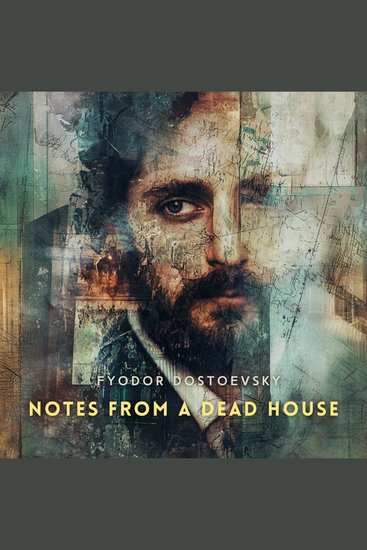
  • Notes from a Dead House - cover

    Notes from a Dead House

    Fyodor Dostoevsky

    • 0
    • 0
    • 0
    Dostoevsky draws on his own imprisonment to depict life in a Siberian labor camp. Through vivid detail and poignant reflection, he explores the harsh realities of incarceration—the brutality, monotony, and small moments of humanity among prisoners. Dostoevsky delves into the psychological and spiritual resilience of individuals stripped of freedom, highlighting their diverse backgrounds and shared suffering. The work transcends memoir, offering a profound meditation on justice, redemption, and the enduring strength of the human spirit. With compassion and insight, Dostoevsky reveals the capacity for dignity and hope even in the darkest circumstances.
    Ver livro