¡Acompáñanos a viajar por el mundo de los libros!
Añadir este libro a la estantería
Grey
Escribe un nuevo comentario Default profile 50px
Grey
Suscríbete para leer el libro completo o lee las primeras páginas gratis.
All characters reduced
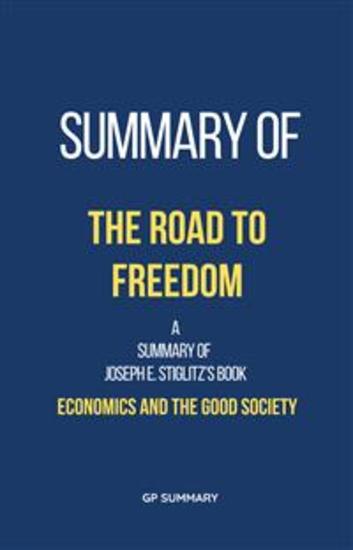
Summary of The Road to Freedom by Joseph E Stiglitz: Economics and the Good Society - cover

Summary of The Road to Freedom by Joseph E Stiglitz: Economics and the Good Society

Anónimo

Editorial: BookRix

  • 0
  • 0
  • 0

Sinopsis

DISCLAIMER

Please note that this book contains a summary of the original content, which is a condensation of the key ideas and information found in the original book.

Therefore, it is recommended to read the original book for a comprehensive and detailed understanding of the topics discussed.

This summary is provided for informational purposes only and is not intended to infringe upon the intellectual property rights of the original book.

Summary of The Road to Freedom by Joseph E. Stiglitz: Economics and the Good Society

IN THIS SUMMARIZED BOOK, YOU WILL GET:

	Chapter provides an astute outline of the main contents.
	Fast & simple understanding of the content analysis.
	Exceptionally summarized content that you may skip in the original book


Nobel prize winner Joseph E. Stiglitz critiques America's economic system and political ideology, highlighting its failures. He argues that "free" markets have led to crises like the financial and opioid crises, fueling populist movements. Stiglitz suggests reimagining systems and embracing collective action for a more inclusive society.
Disponible desde: 29/04/2024.
Longitud de impresión: 73 páginas.


Otros libros que te pueden interesar

  • Bound by the Flight Attendants (Gay Group Erotica) - cover

    Bound by the Flight Attendants...

    Archer Vale

    • 0
    • 0
    • 0
    Something’s wrong with this airplane. What’s happening to me…? 
    I’ve always been targeted by bullies, but I’m finally starting to understand why. They can see through me. They can smell weakness. 
    I own the airline, but my newest flight attendants are giving me an education in employee management. They’ve made me commit unspeakable acts in the onboard restroom. They’ve made me wear a skirt and serve them drinks. 
    But now that I’m naked and bound in the cockpit, I finally understand my place. 
    I work for them now. 
    Pleasure is my salary. Pain is my bonus. 
    --- 
    CONTAINS EXPLICIT GAY SEXUAL CONTENT. 
    For exclusive stories, visit www.ArcherVale.com.
    Ver libro
  • They Called Us River Rats - The Last Batture Settlement of New Orleans - cover

    They Called Us River Rats - The...

    Macon Fry

    • 0
    • 0
    • 0
    They Called Us River Rats: The Last Batture Settlement of New Orleans is the previously untold story of perhaps the oldest outsider settlement in America, an invisible community on the annually flooded shores of the Mississippi River. This community exists in the place between the normal high and low water line of the Mississippi River, a zone known in Louisiana as the batture. 


    Until now the stories of this way of life have existed only in the memories of those who have lived here. They Called Us River Rats also explores the troubled relationship between people inside the levees, the often-reviled batture folks, and the river itself. It traces the struggle between batture folks and city authorities, the commercial interests that claimed the river, and Louisiana's most powerful politicians. 


    Today Fry is among the senior generation of "River Rats" living in a vestigial colony of twelve "camps" on New Orleans's river batture, a fragment of a settlement that once stretched nearly six miles and numbered hundreds of homes. It is the last riparian settlement on the Lower Mississippi and a contrarian, independent life outside urban zoning, planning, and flood protection. This book is for everyone who ever felt the pull of the Mississippi River or saw its towering levees and wondered who could live on the other side.
    Ver libro
  • Lopsided - How a 50 50 Common Sense Nation Drifted into a Progressive Dystopian Cartoon and How we Might Claw our way Back - cover

    Lopsided - How a 50 50 Common...

    Dave Martin

    • 0
    • 0
    • 0
    America today is lopsided. Although there are millions of Americans who disagree with the prevailing progressive orthodoxy, they nevertheless tolerate it to avoid heated debate. Meanwhile, progressives push their agenda relentlessly and passionately and have achieved dominance over many American institutions including the News Media, Big Tech, Education, entertainment, bureaucracy, and big business. These institutions operate outside the confines of the U.S. Constitution and Bill of Rights. This book describes the who, what, how, and why of the progressive agenda and suggests ways to slow down the deterioration of America.
    Ver libro
  • Camus - Absurdism and the Search for Meaning - cover

    Camus - Absurdism and the Search...

    Hector Davidson

    • 0
    • 0
    • 0
    Albert Camus, a prominent French philosopher and writer, is renowned for his exploration of Absurdism, a philosophical perspective addressing the inherent conflict between human beings' quest for meaning and the indifferent universe that provides none. Born in Mondovi, Algeria, in 1913, Camus’s early experiences with poverty and colonialism profoundly influenced his worldview. His intellectual journey was marked by his involvement in the French Resistance during World War II and his role as a public intellectual, shaping his distinctive approach to existentialist themes. 
    Absurdism, at the heart of Camus's philosophy, highlights the tension between our innate desire for meaning and the universe's inherent indifference. Camus posits that this conflict gives rise to what he terms "the absurd." This condition reflects the realization that our search for purpose clashes with the chaotic and meaningless nature of existence. 
    In his seminal essay, The Myth of Sisyphus, Camus introduces the figure of Sisyphus as an emblem of the absurd hero. Sisyphus, condemned to roll a boulder up a hill for eternity only to see it roll back down, symbolizes the human struggle against the absurd. Camus famously concludes that “one must imagine Sisyphus happy,” suggesting that the very act of persevering in the face of eternal struggle can become a source of triumph and personal fulfillment.
    Ver libro
  • Sardar Bhagat Singh Di Nastikta Ik Parchol - Sardar Bhagat Singh Di Nastikta Ik Parchol - cover

    Sardar Bhagat Singh Di Nastikta...

    Kanwar Ajit Singh

    • 0
    • 0
    • 0
    Sardar Bhagat Singh Di Nastikta - Ik Parchol is a book authored by Kanwar Ajit Singh that delves into an essential aspect of Bhagat Singh's ideology. This book provides an in-depth analysis of Bhagat Singh's atheism and his philosophical and intellectual dimensions. The book discusses Bhagat Singh's views on religion, atheism, and social transformation, which were integral to his broader struggle. 
    You can order it from Sikh Siyasat and get it delivered anywhere in the world.
    Ver libro
  • How to Do the Right Thing - An Ancient Guide to Treating People Fairly - cover

    How to Do the Right Thing - An...

    Seneca, Robert A. Kaster

    • 0
    • 0
    • 0
    How ancient Stoicism can help teach us to treat others—and ourselves—more fairly and mercifully 


    There are times when we've all felt that we haven't been treated as we deserve—that we've been misjudged, shortchanged, or given a raw deal. And, at one time or another, other people have probably felt that we've treated them just as unfairly. How to Do the Right Thing draws on the principles of ancient Stoicism as articulated by the Roman statesman and philosopher Seneca to help listeners better navigate one of the most important practical questions of daily life—how to do right by others. 


    Starting from the virtue of magnanimity—the opposite of small-mindedness—How to Do the Right Thing draws together lessons from Seneca's writings that stress the importance of calm and clear thinking, of judging oneself fairly before judging others, and of cutting people slack, with a bias toward mercy—all delivered in crisp and lively new translations.
    Ver libro