Junte-se a nós em uma viagem ao mundo dos livros!
Adicionar este livro à prateleira
Grey
Deixe um novo comentário Default profile 50px
Grey
Assine para ler o livro completo ou leia as primeiras páginas de graça!
All characters reduced
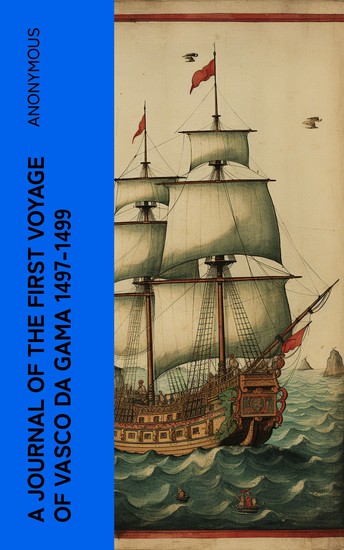
A Journal of the First Voyage of Vasco da Gama 1497-1499 - cover
LER

A Journal of the First Voyage of Vasco da Gama 1497-1499

Anônimo

Tradutor Ernest Georg Ravenstein

Editora: e-artnow

  • 0
  • 0
  • 0

Sinopse

"A Journal of the First Voyage of Vasco da Gama 1497-1499" by Anonymous (translated by Ernest Georg Ravenstein). Published by e-artnow. e-artnow publishes a wide range of titles that encompasses every genre. From well-known classics & literary fiction and non-fiction to forgotten−or yet undiscovered gems−of world literature, we issue the books that need to be read. Each e-artnow edition has been meticulously edited and formatted to boost readability for all e-readers and devices. Our goal is to produce eBooks that are user-friendly and accessible to everyone in a high-quality digital format.
Disponível desde: 30/11/2023.
Comprimento de impressão: 1049 páginas.

Outros livros que poderiam interessá-lo

  • Charmides - cover

    Charmides

    Plato

    • 0
    • 0
    • 0
    "Charmides" is a dialogue written by Plato that delves into the nature of wisdom and self-knowledge. The conversation takes place between Socrates and Charmides, a young man renowned for his beauty and noble heritage. Socrates challenges Charmides' claim to possess self-control or temperance, arguing that true self-knowledge requires an examination of one's own nature. This leads to a discussion on the nature of wisdom and how it is cultivated through inquiry and self-examination, rather than being possessed as a physical object. Read in English, unabridged.
    Ver livro
  • World War II in 1945 - The History of the Battles Fought During the War’s Final Year - cover

    World War II in 1945 - The...

    Editors Charles River

    • 0
    • 0
    • 0
    After resisting the German attack during the Battle of the Bulge, the Allied armies began advancing, and with that, the race to Berlin was truly on. While much has been written of the Battle of the Bulge, Okinawa, Midway, Stalingrad, and many other conflicts of the Second World War, the Battle for Berlin has remained in the shadows for many historians. Its importance in toppling Hitler cannot be denied, despite the fact that some thought its strategic value unnecessary to the war itself. The capture of the city and the red Soviet banner hanging victorious over the Reichstag is one of history’s most famous (an ominous) images. In the weeks it took for the Battle of Berlin to be fought, an American president passed away, a British Prime Minister had to make concessions he did not desire, a Russian leader fought his way into Western Europe to stay, and a German one took his own life. The battle’s implications would be felt for the next 50 years. 
    The Battle of Iwo Jima, code name “Operation Detachment,” is more of a misnomer than anything. It was fought as part of a large American invasion directed by steps toward the Japanese mainland, and it was more like a siege that lasted 36 days from February-March 1945, with non-stop fighting every minute. In fact, the iconic flag-raising photo was taken just four days into the battle, and as that picture suggests, the battle was not a pristine tactical event but an unceasing horror with no haven for protection.  
    Okinawa witnessed every conceivable horror of war both on land and at sea. American ground forces on Okinawa had to deal with bad weather (including a typhoon), anti-tank moats, barbed wire, mines, caves, underground tunnel networks, and fanatical Japanese soldiers who were willing to use human shields while fighting to the death. Allied naval forces supporting the amphibious invasion had to contend with Japan’s notorious kamikazes, suicide pilots who terrorized sailors.
    Ver livro
  • Letters From Everest: Unpublished Letters from Mallory’s Life and Death in the Mountains - cover

    Letters From Everest:...

    George Mallory

    • 0
    • 0
    • 0
    ‘An extraordinary treasure trove’ Andrew Marr 
    A unique collection of unpublished letters from the climbing legend George Mallory to his family, revealing his innermost thoughts about people, places and mountains. 
    On the 8th of June, 1924, George Mallory and Sandy Irvine were seen through a telescope on the upper slopes of Mount Everest. They were never seen alive again. In 1999, Mallory’s body was found below the ridge where he was last seen. In the 100 years since his disappearance, many words have been written about Mallory, but very little has ever been published of his own thoughts. 
    Letters from Everest is an eye opening set of personal letters from Mallory to his family, collected and published for the first time by his great-nephew. In the letters, Mallory is completely open about his life, his climbing and especially the three Everest Expeditions he was a part of – 1921, 1922 and the last in 1924. His writing is full of extraordinary insights – most of which have never been published in any form. They are a unique collection – an actual reflection, possibly the one and only, of the thoughts of a climbing legend who walked into history a century ago. 
    In this non-fiction biography, Mallory's letters reveal the raw and unfiltered thoughts of a man who dared to challenge nature. His experiences, his fears, his triumphs, all laid bare in this literary collection, make Letters from Everest a must-read for anyone fascinated by the world of mountaineering and exploration. 
    nan 
    HarperCollins 2024
    Ver livro
  • State of the Union 1982 - cover

    State of the Union 1982

    Ronald Reagan

    • 0
    • 0
    • 0
    In the 1982 State of the Union address on January 26, 1982, Reagan invokes his self-deprecating humor and calls for “a new spirit of partnership between this Congress and this administration”. Reagan cites the “stagflation” of the 1970s: double digit inflation, interest rates over 21%, and over 8 million unemployed.  
    Reagan notes economic improvement and calls for reduced federal spending, further tax reductions, and fewer regulations, saying our economic problems “are the inheritance of decades of tax and tax and spend and spend.”  
    Reagan calls for dismantling the Departments of Energy and Education but keeping a reliable safety net for those in need by rooting out waste and fraud in the food stamp, Medicare, and Medicaid programs. Reagan decries the growth in federal grant programs to state and local governments and calls for major reforms. 
    A short paragraph was lost at 23:15 of the Ronald Reagan presidential library recording. The missing words can be seen in the text version. 
    In meetings with foreign leaders, Reagan “spoke of the strength of the free marketplace system and how that system could help them realize their aspirations for economic development and political freedom.” Reagan endorses sanctions against the Soviet Union for its actions in Poland and Afghanistan, and urges “that we rebuild our defenses.”  
    Reagan concludes with a call to work together to preserve “the sacred flame of liberty -- this last, best hope of man on Earth.” This address followed the assassination attempt and the applause at the start and end was extensive.
    Ver livro
  • Third Eye Spies - Learn Remote Viewing from the Masters - cover

    Third Eye Spies - Learn Remote...

    Russell Targ, Paul H. Smith

    • 0
    • 0
    • 0
    Russell Targ has been successfully teaching people how to get in touch with their psychic abilities for more than fifty years. This began in 1972 when he cofounded the CIA sponsored ESP research program at Stanford Research Institute. 


    Third Eye Spies will introduce listeners to the most successful and gifted remote viewers in the world, some of whom had never done anything like this before, along with the evidence of their psychic abilities. Remote viewing is the opportunity to describe and experience objects and events in the distance, past, and future. 


    Targ shares the simple techniques the masters of remote viewing used to be able to expand your mind's eye beyond your physical location. Misconceptions have abounded that ESP is weak and unreliable. On the contrary, in the SRI laboratory experiments and classified operational tasks, ESP was found to be surprisingly reliable, accurate, and useful. In data from laboratories all over the world, we have seen that the accuracy and reliability of remote viewing is not in any way degraded by distance. 


    With Third Eye Spies, you will be able to step beyond the boundaries of your physical body and learn to live with psychic abilities.
    Ver livro
  • Lenin Lives? - cover

    Lenin Lives?

    Christopher Read

    • 0
    • 0
    • 0
    Lenin's work and influence have often been written off as no longer relevant, and many today consider this to be so. Lenin has, they claim, had his day, even though he is still revered in China, the world's most populous country. However, Lenin, like his mentor Marx, has had a tendency to rise from apparent decline and oblivion to renewed force and influence. 


    This study examines the key elements of Lenin's life and career, the consolidation of his ideas into the doctrines of "Leninism," the influence of Leninism in promoting revolutionary movements around the globe, and the currently disputed issue of whether his ideas still have any relevance today. In particular, while considering his views on the role of the revolutionary party, often seen as the centerpiece of his theory and practice, this account identifies the root of Lenin's global influence in his opposition to capitalist imperialism and as a bedrock foundation for the opposition of many to fascism and associated ideologies. While recognizing that Lenin's reputation has reached its lowest point, not least in his home country where his legacy is reviled by Vladimir Putin and other contemporary leaders, the book concludes by weighing up the contemporary arguments of those who believe that Lenin still lives.
    Ver livro