Junte-se a nós em uma viagem ao mundo dos livros!
Adicionar este livro à prateleira
Grey
Deixe um novo comentário Default profile 50px
Grey
Assine para ler o livro completo ou leia as primeiras páginas de graça!
All characters reduced
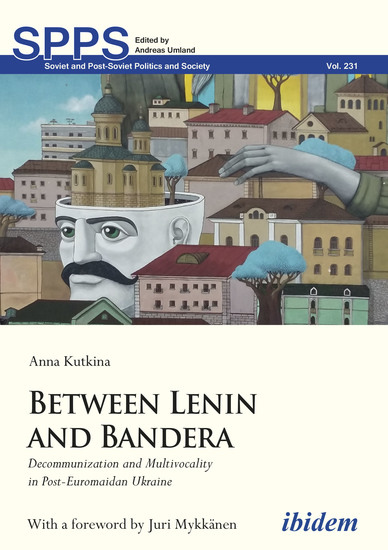
Between Lenin and Bandera - Decommunization and Multivocality in Post-Euromaidan Ukraine - cover
LER

Between Lenin and Bandera - Decommunization and Multivocality in Post-Euromaidan Ukraine

Anna Kutkina

Editora: ibidem

  • 0
  • 0
  • 0

Sinopse

This book examines the evolution of post-Euromaidan de-Sovietization beyond the issues of toppling of old statues and implementation of new anti-totalitarian laws.
Disponível desde: 22/11/2021.
Comprimento de impressão: 328 páginas.

Outros livros que poderiam interessá-lo

  • Princess Countess Socialite Spy - True Stories of High-Society Ladies Turned WWII Spies - cover

    Princess Countess Socialite Spy...

    Elise Baker

    • 0
    • 0
    • 0
    The Second World War changed the course of modern history. It is filled with incredible stories of daring risks and exceptional struggles, but these stories are more often than not the stories of men. 
    There is, however, a hidden treasure trove of untold stories of heroic women who have risked their lives in the monumental battle against fascism. 
    We’ve heard of women who became nurses treating soldiers with battlefield injuries, partisans who fought occupying armies, and skilled laborers who worked in wartime industries. 
    But in the shadows, as part of a secret war against the Nazis, women served as intelligence agents who risked their lives to collect and relay information vital to the war effort. Danger lurked at every turn. 
    These courageous women spies worked in secret, but their stories, which are finally coming to light today, offer a significant and unique perspective on the history of World War II. 
    You'll learn the thrilling stories of five high-society ladies (Virginia Hall, Christine Granville, Noor Inayat Khan, Nancy Wake and Aline Griffith) who went behind enemy lines to aid the war effort, what motivated them to take such risks, and how these women heroes of WWII helped shape the course and outcome of the most significant war in modern history. 
    You’ll gain insights into why some high-society ladies chose to give up a life of comfort to fight against global tyranny and live under constant threat of exposure and imprisonment or death. 
    If you’re looking for a unique and enlightening view of the Second World War and are interested in women’s historically overshadowed roles in international espionage, then look no further than Princess, Countess, Socialite, Spy.
    Ver livro
  • The Trafficker Next Door - How Household Employers Exploit Domestic Workers - cover

    The Trafficker Next Door - How...

    Rhacel Salazar Parreñas

    • 0
    • 0
    • 0
    "Kaya mo ba?" Can you take it? An instructor asks a group of migrant workers in the Philippines, as they prepare for domestic work in wealthier countries. Can you take the grueling work? "Kaya," the women say. "We can." 


    The phrase "human trafficking" often conjures nightmarish images of sexual exploitation, but Rhacel Salazar Parreñas reveals that the vast majority of trafficking victims are domestic workers who suffer abuse not at the hands of crime lords but rather "ordinary" family employers. 


    Drawing on twenty years of groundbreaking research across three continents, Parreñas exposes the grim realities faced by migrant workers ensnared in forced labor due to poverty and debt bondage. She uncovers how entrenched social and legal norms, coupled with a patronizing "employer savior complex," foster a troubling sense of ownership among employers over "their" domestic workers. 


    Through powerful firsthand accounts, Parreñas illustrates the migrants' desperation, and the power dynamics that lead to a global network of exploitation. Parreñas's narrative challenges listeners to confront uncomfortable truths about everyday household arrangements and calls for justice and fair treatment for all workers.
    Ver livro
  • Summary of Edward Bernays’s Propaganda - cover

    Summary of Edward Bernays’s...

    Falcon Press

    • 0
    • 0
    • 0
    Buy now to get the main key ideas from Edward Bernays’s Propaganda 
      
    People talk about “propaganda” all the time. Although the word seems to have negative connotations, whether it is good or bad depends entirely on the cause behind it and the correctness of the information it carries. 
    In Propaganda (1928), Edward Bernays explores the structure of systems that control the public mind and public opinion, and examines how propaganda affects all political and social practices. He explains how people are controlled by hidden governments that try to achieve public acceptance of certain concepts. Bernays also attempts to establish the role of intelligent propaganda in society.
    Ver livro
  • Disciples of White Jesus - The Radicalization of American Boyhood - cover

    Disciples of White Jesus - The...

    Angela Denker

    • 0
    • 0
    • 0
    White boys and men are dangerous. 
    White boys and men are struggling. 
    Both of these statements are staggeringly true in America today. By far, most large-scale mass shooters are white men. White men also die by suicide more often than any other demographic. In this sensitive, searing, and unsparing look at American boyhood, journalist, mother, and pastor Angela Denker investigates the sometimes-tragic stories of boyhood across the United States. 
    Disciples of White Jesus is a comprehensive look at the rise in radicalization among young white men in America, especially focused on the role of right-wing Christianity in the increase of religious-based hatred and violence. Denker goes deep into the online rabbit holes of right-wing Christian influencers and conservative Christian ideology to understand how the preaching of "traditional gender roles" and "submission of women" has led to anger, outrage, loneliness, depression, and limiting identities for young white Christian men across America. 
    Casting her journalist's eye across the US, Denker retraces the steps of a racist South Carolina mass shooter and a Phoenix skinhead turned Evangelical pastor, interviews middle school teachers and coaches in the Midwest, and introduces us to young men across the country who will both confirm and confound our ideas about American boyhood--stories about boys and men who are forging new identities grounded in kindness, grace, respect, and even joy. A must-read for parents, grandparents, educators, coaches, faith leaders, researchers, and all who care about the state of American families, boys themselves, and the safety of American society at large.
    Ver livro
  • Hidden Agendas - Secret Motives behind Outward Behavior or Actions - cover

    Hidden Agendas - Secret Motives...

    Cito Harder

    • 0
    • 0
    • 0
    Hidden agendas exist in nearly every aspect of life, shaping decisions, influencing behavior, and often determining the outcomes of interactions without those involved fully realizing it. A hidden agenda refers to a concealed motive or underlying intention that differs from what is outwardly expressed. Unlike open and transparent objectives, hidden agendas operate beneath the surface, often serving personal, financial, or strategic interests that are not explicitly stated. 
    At their core, hidden agendas stem from the fundamental human need for control, advantage, or self-preservation. People may withhold their true intentions out of fear of rejection, loss of power, or diminished influence. In many cases, hidden agendas are not inherently malicious; they can be driven by self-interest, strategic planning, or the need to protect sensitive information. However, when used manipulatively, they can undermine trust, deceive others, and lead to unethical or harmful consequences. 
    One of the key characteristics of a hidden agenda is deception or misdirection. A person or group may present one set of intentions while secretly pursuing another. This is common in politics, business, and even personal relationships, where individuals may disguise their true motivations to gain support, manipulate outcomes, or secure an advantage. For example, a corporate leader advocating for a policy change may claim it is for the benefit of employees, while in reality, it serves to increase profits or consolidate power.
    Ver livro

  • The War Ledger - cover

    The War Ledger

    A.F.K. Organski, Jacek Kugler

    • 0
    • 0
    • 0
    The War Ledger provides fresh, sophisticated answers to fundamental questions about major modern wars: Why do major wars begin? What accounts for victory or defeat in war? How do victory and defeat influence the recovery of the combatants? Are the rules governing conflict behavior between nations the same since the advent of the nuclear era? The authors find such well-known theories as the balance of power and collective security systems inadequate to explain how conflict erupts in the international system. Their rigorous empirical analysis proves that the power-transition theory, hinging on economic, social, and political growth, is more accurate; it is the differential rate of growth of the two most powerful nations in the system—the dominant nation and the challenger—that destabilizes all members and precipitates world wars. Predictions of who will win or lose a war, the authors find, depend not only on the power potential of a nation but on the capability of its political systems to mobilize its resources—the "political capacity indicator." After examining the aftermath of major conflicts, the authors identify national growth as the determining factor in a nation's recovery. With victory, national capabilities may increase or decrease; with defeat, losses can be enormous. Unexpectedly, however, in less than two decades, losers make up for their losses and all combatants find themselves where they would have been had no war occurred. Finally, the authors address the question of nuclear arsenals. They find that these arsenals do not make the difference that is usually assumed. Nuclear weapons have not changed the structure of power on which international politics rests. Nor does the behavior of participants in nuclear confrontation meet the expectations set out in deterrence theory.
    Ver livro