Junte-se a nós em uma viagem ao mundo dos livros!
Adicionar este livro à prateleira
Grey
Deixe um novo comentário Default profile 50px
Grey
Assine para ler o livro completo ou leia as primeiras páginas de graça!
All characters reduced
The Progress of the Century - Exploring the Century's Transformative Vision - cover
LER

The Progress of the Century - Exploring the Century's Transformative Vision

Andrew Lang, Alfred Russel Wallace, Goldwin Smith, A. T. Mahan, Edward Caird, James Gibbons, W. M. Flinders Petrie, William Ramsay, Thomas Curtis Clarke, William Osler, Charles Wentworth Dilke, Norman Lockyer, Thomas C. Mendenhall, Alexander V. G. Allen, Richard J. H. Gottheil, William W. Keen, Elihu Thomson

Editora: Good Press

  • 0
  • 0
  • 0

Sinopse

The anthology, *The Progress of the Century*, offers a sweeping exploration of intellectual and cultural advancement at the dawn of the 20th century. It compiles works that reflect the period's burgeoning curiosity and innovation across scientific, philosophical, and historical domains. Readers will encounter an impressive range of literary styles, from incisive essays and thought-provoking lectures to groundbreaking scientific treatises. The collection'Äôs diversity of topics highlights humanity'Äôs insatiable quest for understanding and betterment, and its most notable pieces range from contemplations on the evolution of scientific thought to reflections on the socio-political implications of industrial progress. The contributors to this anthology are luminaries of their time, including notable figures such as William Osler and Andrew Lang, who have made significant strides in their respective fields. These authors collectively engage with major intellectual movements of their era, such as Darwinism, Enlightenment thought, and the beginnings of modern social theory. Through their varied perspectives, the anthology not only charts the trajectory of human thought but also illumines the complex interplay between cultural forces and individual brilliance during a period of significant transformation. *The Progress of the Century* presents a rare opportunity to immerse oneself in the disparate yet interconnected views of a pivotal era. Readers are invited to explore the anthology'Äôs rich tapestry of ideas, which provides both an education in history's most transformative period and an intellectual dialogue that transcends its time. This collection, replete with insights from eminent figures, serves not only as a compendium of progress but as a catalyst for reflection and understanding of our shared past and its impact on the present.
Disponível desde: 25/10/2023.
Comprimento de impressão: 449 páginas.

Outros livros que poderiam interessá-lo

  • The Pocket Book of Nietzsche - A Concise Introduction to Nietzsche's Writings and Ideas - cover

    The Pocket Book of Nietzsche - A...

    Aaron Ridley

    • 0
    • 0
    • 0
    Friedrich Nietzsche has had an extraordinary impact on modern philosophy, but what did he really mean when he talked about the 'death of God'? What are we to make of the idea of the 'superman'? And what should be the guiding light for our morality? 
     
    In this volume, the author answers these questions and more as he breaks down Nietzsche's key ideas into easily accessible chunks. With each chapter featuring famous quotes from the philosopher and a broader discussion of the general theories they convey, The Pocket Book of Nietzsche provides an ideal introduction to one of the world's great thinkers.
    Ver livro
  • Multipolarity After Ukraine - Old Wine in New Bottles? - cover

    Multipolarity After Ukraine -...

    Aldo Ferrari, Eleonora Tafuro...

    • 0
    • 0
    • 0
    One year after the full-scale invasion of Ukraine, the war has exacerbated the rift between Russia and the "collective West".
    While Western governments have been steadfast in punishing Russia for the invasion, other countries around the world have been more ambiguous, at times even choosing to side with Moscow politically or economically. These dynamics have revived the idea of a shift towards
    multipolarity along an anti-Western trajectory. Are we really heading in that direction? Are we facing increasing fragmentation due to the war or a re-consolidation of longstanding alliances? What principles underlie the formation of these blocs? What are the consequences of these dynamics for global security and the global economy?
    This Report aims to shed light on these questions, while also outlining the war's possible future implications for the Russian Federation, the "West", and the international order.
    Ver livro
  • Always Trust Your Cape - How I Lived the American Dream - cover

    Always Trust Your Cape - How I...

    Donald Eugene Moore

    • 0
    • 0
    • 0
    I have an enormous amount of respect for people who consider themselves entrepreneurs. 
     
    People who, in most cases, take tremendous risks in hopes of experiencing tremendous rewards. Not only for themselves but for the world at large. 
     
    Entrepreneurs hire the most people, drive the economy, create innovation, promote research and development, while shaping new products and services. They solve problems with existing solutions, and technologies, while in most cases utilizing existing resources more effectively and more times than not on shoestring budgets. 
     
    I consider entrepreneurs to be the great pioneers of today's business world. If you are considering launching your own entrepreneurial journey, are well on your way, or anywhere in between, my passion and purpose in writing this book is to give you confidence!
    Ver livro
  • Community as Rebellion - A Syllabus for Surviving Academia as a Woman of Color - cover

    Community as Rebellion - A...

    Lorgia García Peña

    • 0
    • 0
    • 0
    Weaving personal narrative with political analysis, Community as Rebellion offers a meditation on creating liberatory spaces for students and faculty of color within academia.  Much like other women scholars of color, Lorgia García Peña has struggled against the colonizing, racializing, classist, and unequal structures that perpetuate systemic violence within universities. Through personal experiences and analytical reflections, the author invites listeners—in particular Black, Indigenous, Latinx, and Asian women—to engage in liberatory practices of boycott, abolition, and radical community-building to combat the academic world's tokenizing and exploitative structures. 


    García Peña argues that the classroom is key to freedom-making in the university, urging teachers to consider activism and social justice as central to what she calls "teaching in freedom": a progressive form of collective learning that prioritizes the subjugated knowledge, silenced histories, and epistemologies from the Global South and Indigenous, Black, and brown communities. By teaching in and for freedom, we not only acknowledge the harm that the university has inflicted on our persons and our ways of knowing since its inception, but also create alternative ways to be, create, live, and succeed through our work.
    Ver livro
  • The Truht Is in Love - cover

    The Truht Is in Love

    Sergiy Zhuravlov

    • 0
    • 0
    • 0
    The narrative is based on real events during the unification of Spain. Spain, led by Ferdinand the Second and Isabella of Castile, soared to the height of its power. The policy of the cunning king bore rich fruit. The whole country was taken away from the king of Portugal. By deceit the southern fiefdoms were cut off from France. The master of southern Europe and northern Africa he - King Ferdinand, or rather by his hands and the instruction of Isabella, brought out of slumber and made all-powerful "Manu interpida" - the Inquisition. And now this mechanism was bringing into the king's treasury, first one-third, and now more than two-thirds of all the confiscated goods. And henceforth no one, whether grandee, marquis, or prince, could feel safe. Forsaken, beware - they are coming for you! Young Merinda, who did not wish to become Esteban Junior's mistress, was thrown into prison. Esteban the elder - the second man after the king - so wished. The sentence is ready, all that is left is to disfigure the maiden and then burn her at the stake. But something goes wrong. Fernando, an incorruptible knight of the Hospitaller Order, is in charge of the case. An obvious lie, not proof of guilt. All turn against Fernando the Inquisitor. Fernando has no choice but to save the girl at the cost of his career and even his life. He flees from pursuit along with Merinda. The couple is put on the wanted list. Whoever shelters or helps the fugitives ends up behind bars himself. The new inquisitor hires an assassin to find and kill the fugitives without publicity. The former favourite of the King of Spain, the Countess of Alba, writes a letter to his Highness and admits that she bore his daughter in secret. She asks the King for help in finding her daughter who has disappeared. The King entrusts his confidant, the Marquis Diego, with the task. The Marquis finds the trail - the King and Countess´ daughter is none other than Merinda! The King dismisses the false accusation. But the Inquisition's Purgatory flywheel is unwound. Merinda and Fernando are driven into the mountains and their doom is certain. The pair stand on a precipice above a precipice. The crossbowmen have them in their sights. The Marquis gets there in time. He stops the execution. He untwists the chain of false witnesses. This leads him to plot against the king. He writes a letter to the king and sends it with a messenger. On the way the messenger stops for a drink of water and water for his horse. He is killed by an assassin hired by the Inquisition. He reads the letter and sells it to the conspirators. He then sells the information to the Marquis that the conspirators have intercepted the letter. The Marquis learns through his agents that Admiral Esteban and his goons have followed the trail of Merinda and Fernando and wish to kill everyone. The plot is averted. The King accepts a payoff from the repentant accomplices. It turns out the murderer is not dead from the poison, seeking a meeting with the Marquis for revenge. Such a moment arrives. The Marquis is stunned. A lung is punctured. Merinda dismisses the court physicians. She saves the Marquis´ life herself with the help of herbal infusions and extracts of mould. Merynda is slandered by the physicians as a sorceress. The Queen throws the young Countess into prison. The King himself is powerless against the Queen. Merinda´s death is imminent. But then, passing through the cheering crowd of the townspeople, the King is tried to be killed by his old hater. The wound seems trifling. But after twenty-four hours, the king is taken ill and falls into unconsciousness. The queen realises that the court physicians are powerless, and so are the prayers. She decides to enlist Merinda's help. Nothing is more important to the king's daughter than saving her father's life. Two weeks later, the king is back on his feet. The queen is pleased with the king's recovery, but still wants to get rid of Merinda...
    Ver livro
  • A Rare Recording of Gertrude Stein Reading Her Own Writing - cover

    A Rare Recording of Gertrude...

    Gertrude Stein

    • 0
    • 0
    • 0
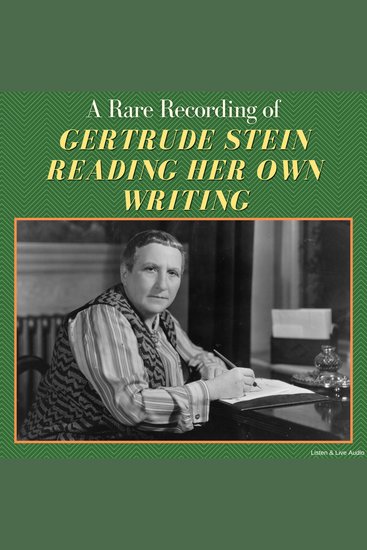
    Gertrude Stein (February 3, 1874 - July 27, 1946) was an American novelist, poet, playwright, and art collector. Born in Allegheny, Pennsylvania, and raised in Oakland, California, Stein moved to Paris in 1903, and made France her home for the remainder of her life. She hosted a Paris salon, where the leading figures of modernism in literature and art, such as Pablo Picasso, Ernest Hemingway, F. Scott Fitzgerald, Sinclair Lewis, Ezra Pound, Sherwood Anderson and Henri Matisse, would meet. The following three recordings are from Stein's novel, The Making of Americans (1925), and her poems, How She Bowed to her Brother (1931) and If I Told Him - A Completed Portrait of Picasso (1923)
    Ver livro