Junte-se a nós em uma viagem ao mundo dos livros!
Adicionar este livro à prateleira
Grey
Deixe um novo comentário Default profile 50px
Grey
Assine para ler o livro completo ou leia as primeiras páginas de graça!
All characters reduced
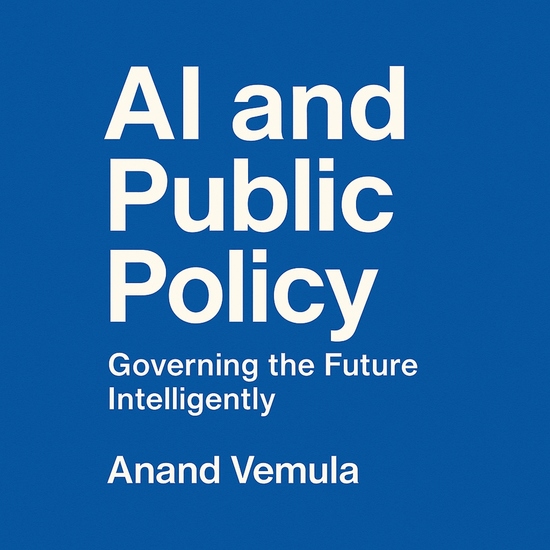
AI and Public Policy - Governing the Future Intelligently - cover
LER

AI and Public Policy - Governing the Future Intelligently

Anand Vemula

Editora: Publishdrive

  • 0
  • 0
  • 0

Sinopse

In AI and Public Policy: Governing the Future Intelligently, Anand Vemula presents a forward-looking, globally relevant blueprint for navigating the intersection of artificial intelligence and public governance. The book offers a deep, structured, and uniquely current perspective on how democratic institutions, global alliances, and local communities must co-create the rules that govern intelligent systems.
 
The work spans critical domains—from AI’s role in reshaping labor markets and economic inequality, to its influence on geopolitical dynamics, public health, sustainability, and democratic resilience. Vemula goes beyond conventional regulation and ethics discourse to emphasize underexplored dimensions such as public participation, AI literacy, and eco-centric governance.
 
The book advocates treating AI not merely as a tool, but as infrastructure—integral to national sovereignty and public good. It also explores new regulatory frontiers like algorithmic impact assessments, AI-specific procurement standards, and anticipatory governance frameworks. Vemula highlights often overlooked but vital policy zones such as open-source AI, civic assemblies for AI policy, and the integration of AI in treaties and trade.
 
What sets this work apart is its commitment to justice, transparency, and participatory design in shaping AI's future. The chapters are rich with global case studies, emerging policy mechanisms, and actionable proposals. With clarity and urgency, the book speaks to policymakers, technologists, academics, and citizens alike.
 
Ultimately, this book is not just about regulating AI—it’s about imagining and building a society where intelligent systems enhance human dignity, democracy, and planetary well-being.
Disponível desde: 01/06/2025.
Comprimento de impressão: 60 páginas.

Outros livros que poderiam interessá-lo

  • Calm in the Storm: A Woman's Guide to Managing Anger - Effective Tools for Emotional Peace and Control - cover

    Calm in the Storm: A Woman's...

    AHMED MUSA

    • 0
    • 0
    • 0
    "Calm in the Storm: A Woman's Guide to Managing Anger : Effective Tools for Emotional Peace and Control." is a revolution manual for women to understand, control, and transform their fury into a calm, emotional, and powerful standpoint. 
    Society's tendency often discourages women from expressing feelings of anger, and this book is there to help with a gentle but useful guide to teaching women to tackle one of the most misconstrued emotions. "Calm in the Storm" teaches women to accept anger as a strong sign that could be for transformation and personal growth rather than something to avoid or fear. 
    This book, using psychological, emotional intelligence, and mindfulness techniques, takes the reader through the causes of anger, what makes it happen, and these deeper feelings that too often lie just beneath the surface. It provides a myriad of skills in breathing exercises, mindfulness practices, cognitive restructuring, and enhanced communication, all to help women manage anger positively and healthfully. 
    It helps you get rid of anger with finesse, awareness, and mastery instead of wiping it out. Be it petty grudges, unrequited resentment, or your everyday frustrations, "Calm in the Storm" helps you get anger as power and emotional clarity. This is an inventory as well as a personal guide for women who want to achieve emotional balance, serenity, and the strength to face the world's obstacles in poise and composure.
    Ver livro
  • ACT - Elevate ACT studying! Dive into dynamic audio lessons designed for peak test performance - cover

    ACT - Elevate ACT studying! Dive...

    Dorian Blakewood

    • 0
    • 0
    • 0
    ACT:  
    ⭐⭐Simplified Guide & Explanations Included⭐⭐ 
    Are you looking to advance in your academic journey and solidify your knowledge by successfully passing the ACT Exam 2024-2025? 
    Seeking a comprehensive guide that provides all necessary elements to pass the ACT Exam 2024-2025? 
    Your search ends here! 
    This guide serves as your definitive companion for deepening your understanding, applying your skills, and engaging in hands-on exercises. With this, you're geared for success. 
    Updated for the ACT 2024-2025 Exam Structure. 
    Key features of this enriched guide: 
    - Profound insights about the ACT Exam 2024-2025 Certification 
    - Detailed explanation of the American College Testing (ACT) 
    - Fruitful strategies for exam preparation and tackling 
    Our guide distinguishes itself through comprehensive coverage, which is essential for your exam victory. Concepts aren't merely skimmed; they are delved into with precision. 
    Please note that this guide is not affiliated with any official ACT entity and is purely an independent resource for your benefit. 
    Designed with a clear structure and easy-to-understand language, our ACT Exam Guide 2024-2025 ensures smooth transitions between topics. Say goodbye to dense jargon and welcome clear, precise, and technically accurate content. 
    So, why wait? Click the BUY NOW button, secure your guide, and begin your journey to ACT Exam 2024-2025 success!
    Ver livro
  • Mind Control - Techniques to Influence or Dominate Someone's Thoughts - cover

    Mind Control - Techniques to...

    Cito Harder

    • 0
    • 0
    • 0
    Mind control is the practice of influencing, manipulating, or dominating an individual’s thoughts, behaviors, or perceptions, often without their conscious awareness. Throughout history, different societies have employed various forms of psychological influence to control groups and individuals, from religious indoctrination to political propaganda and media conditioning. While some forms of persuasion are ethical and openly acknowledged, mind control often operates in subtle, deceptive ways, making it difficult for individuals to recognize or resist. 
    At its core, mind control exploits human cognitive vulnerabilities. The mind is naturally susceptible to suggestion, repetition, and emotional influence. When exposed to specific messages or ideas repeatedly, a person may begin to internalize them as truth, even in the absence of logical evidence. This principle is used in advertising, politics, religious movements, and personal relationships to shape opinions and behaviors. Whether through fear, guilt, reward, or isolation, those seeking control can manipulate their targets into conforming to specific beliefs or actions. 
    One of the most effective tools of mind control is misinformation. By distorting reality or presenting selective facts, individuals or institutions can shape perceptions to suit their own agendas. Governments have historically used propaganda to maintain control over populations, while corporations use psychological tactics to influence consumer behavior. In personal relationships, emotional abusers use manipulation techniques such as gaslighting to make their victims question their own perceptions and reality.
    Ver livro
  • Ely Samuel Parker: The Life and Legacy of the Seneca Grand Chief Who Fought in the Civil War and Became Commissioner of Indian Affairs - cover

    Ely Samuel Parker: The Life and...

    Editors Charles River

    • 0
    • 0
    • 0
    Despite their own cultural differences, the nations that comprised the Iroquois Confederacy established their political dominance across much of America’s East Coast and Midwest through conquest, and it is that aspect which has perhaps best endured among Americans in terms of the Iroquois’ legacy. European settlers who came into contact with the Mohawks in the Northeast certainly learned to respect their combat skills, to the point that there were literally bounties on the Mohawks’ heads, with scalps fetching money for colonists who succeeded in slaying them and carrying away the “battle prize”. 
    	One of the best known of the six nations is the Seneca, and arguably the most famous Seneca chief was Ely Samuel Parker. Over the course of his life, he was a Seneca chief, a civil engineer, a close friend and adjutant to General Ulysses S. Grant, an advocate for the Indian peoples, and the first Native American Commissioner of the Department of Indian Affairs. His marriage to a much younger socialite scandalized Washington, and he made a fortune on Wall Street and lost it all. He ended his life in genteel poverty, working for nearly 20 years in an obscure position for the New York City Police Department.  
    Parker was a largely self-taught engineer, who worked on various canal projects, and was hired by the Department of the Treasury to supervise the construction of several buildings in Galena, Illinois, where he met a shy salesclerk named Ulysses S. Grant. At the age of 18, he dined with President Polk, later talked with President Lincoln, and had the commanding general of the U.S. Army as the best man at his wedding. He was the principal source for the first serious ethnological work by one of the first American ethnologists, who dedicated the book to Parker. He was a plaintiff before the U.S. Supreme Court when he was in his teens and was so important in the Seneca’s struggle to retain their Tonawanda reservation that he was made grand sachem.
    Ver livro
  • Football Mom & Bathroom Whore - cover

    Football Mom & Bathroom Whore

    Kathrin Pissinger

    • 0
    • 0
    • 0
    A story about a young and devious lesbian mistress and her older slaves 
    At a football game, I tried to get some distraction and go to the bathroom just to freshen myself up a little bit, when I encounter a young woman there shamelessly sitting on the toilet in plain view. Without a word, something about her was drawing me in and before I knew it, I found myself kneeling on the floor between her legs, pleasing her eagerly with my tongue. 
    Even though I tried to do my best, I wasn't sure if it was good enough for my younger mistress, but when I finally got my own reward right then and there, it was more than I had ever expected.
    Ver livro
  • Capitalism and Inequality - Exploring the Economic Divide in a Capitalist Society - cover

    Capitalism and Inequality -...

    Arlo Holders

    • 0
    • 0
    • 0
    Capitalism, as an economic system, is based on private ownership of the means of production and the creation of goods or services for profit. In capitalist societies, market forces—supply and demand—determine the distribution of resources and wealth. This system is characterized by competition, limited government intervention, and the pursuit of profit. Over time, capitalism has evolved in response to global events, technological advancements, and changes in social and political structures. However, a fundamental aspect of capitalism that persists is the inherent inequality it creates. 
    Inequality in capitalist societies can be understood in several forms: wealth inequality, income inequality, and social inequality. Wealth inequality refers to the uneven distribution of assets like property, stocks, and savings, where a small percentage of the population controls a large share of the wealth. Income inequality, on the other hand, concerns the differences in wages and salaries among workers, managers, and capital owners. Social inequality arises from disparities in access to resources like education, healthcare, and housing, which are often shaped by economic factors. 
    At the heart of capitalist inequality is the idea that economic success is determined by individual effort, entrepreneurship, and market performance. While this promotes competition and innovation, it also leads to stark divides between the wealthy and the poor. Those who control capital—such as land, factories, or intellectual property—are in a position to accumulate wealth far faster than those who rely solely on their labor. This uneven accumulation of wealth deepens the divide between rich and poor, creating a cycle where the wealthy continue to grow their resources, while those at the bottom struggle to access basic needs.
    Ver livro