¡Acompáñanos a viajar por el mundo de los libros!
Añadir este libro a la estantería
Grey
Escribe un nuevo comentario Default profile 50px
Grey
Suscríbete para leer el libro completo o lee las primeras páginas gratis.
All characters reduced
Statue Facts - cover

Statue Facts

Amelia Khatri

Traductor A AI

Editorial: Publifye

  • 0
  • 0
  • 0

Sinopsis

Statue Facts explores the captivating stories behind the world's most iconic statues, revealing their profound cultural and historical significance. It examines why civilizations invested vast resources in these large-scale representations and uncovers the evolution of sculpting techniques, from ancient bronze casting to modern concrete construction. The book highlights that statues are powerful reflections of the societies that created them, offering insights into their values, beliefs, and technological capabilities.

 
The book presents information through a synthesis of historical, artistic, and archaeological perspectives, providing a holistic understanding of each statue. It begins with fundamental concepts like symbolism and construction methods and then progresses to specific case studies such as the Statue of Liberty, the Terracotta Army, and Christ the Redeemer, detailing their origins and design.

 
The book culminates in an analysis of their impact on subsequent generations, exploring their continuing relevance in contemporary society.
Disponible desde: 18/02/2025.
Longitud de impresión: 55 páginas.

Otros libros que te pueden interesar

  • Reluctant Conquest - American Wealth Power and Science in the Arctic - cover

    Reluctant Conquest - American...

    Kathryn C. Lavelle

    • 0
    • 0
    • 0
    What drives American foreign relations in the Arctic? It is difficult to give a unified answer to this question because most histories of the region are divided between the Atlantic and Pacific coasts, Asian and European strategic interests, or federal government and Indigenous peoples' concerns, making it difficult to understand the connections among the environmental challenges, scientific understandings, strategic calculations, and governance relationships. Most Americans do not think of their country as an Arctic power, yet it is a region where the United States has had important ties throughout its history.In this sweeping study, from the founding of the country through the acquisition of Alaska to the present, Kathryn C. Lavelle considers American relations across the circumpolar North, incorporating discussions of economics, national security, and science that are conventionally separated. Lavelle argues that it is impossible to understand United States policy without a knowledge of American political development and of how scientific understandings have grown alongside studies of climate and other environmental issues. This history has important implications for future American policy regarding traditional national security and political economy, in addition to climate change and environmental cooperation.
    Ver libro
  • Surveillance - A Very Short Introduction - cover

    Surveillance - A Very Short...

    David Lyon

    • 0
    • 0
    • 0
    Surveillance permeates every aspect of our lives today. Every click on the keyboard, every call, text or email, every purchase, every contact with a doctor or the police or a government department, each time you walk under a video camera or pass through a security check, and in many other ways, you are recorded, identified, traced, and tracked. Who processes this free-flowing data, how, and with what consequences, is a critical question affecting everyone. 


    Surveillance is not inherently good or bad but neither is it neutral. It urgently needs to be understood better because people's lives and life-chances depend on it. Today surveillance is central to doing business, meeting friends, organizing governance, maintaining security, and being entertained. Surveillance requires not just exploration and understanding but ethical guidance and political debate. How you get credit or welfare benefits or get on a no-fly list or are ranked as a consumer depends on surveillance. This Very Short Introduction investigates how surveillance makes people visible, how it grew to its present size and prevalence, how it came to rely on technologies of data-handling, and how it developed its own cultural features. Throughout, David Lyon also considers the ethics of surveillance, and explores its potential in prompting political struggles.
    Ver libro
  • Fatal Conceit The: Book Summary & Analysis - cover

    Fatal Conceit The: Book Summary...

    Briefly Summaries

    • 0
    • 0
    • 0
    This is a concise summary and analysis of The Fatal Conceit, by Friedrich A. Hayek.
     
    It is not the original book and is not affiliated with or endorsed by Friedrich A. Hayek.
    Ideal those seeking a quick and insightful overview.
     
    The Fatal Conceit delves into the origins and evolution of human society, exploring how spontaneous order and cultural norms emerge organically to create complex systems of cooperation and progress. Challenging the belief that central planning and rational design can surpass the adaptive efficiencies of free markets and traditional practices, the book argues that such "fatal conceit" undermines the very foundations of civilization. This work presents a compelling critique of collectivism, advocating for the preservation of decentralized systems as the key to human flourishing.
    Ver libro
  • KERI 7 - The Original Child Abuse True Story - cover

    KERI 7 - The Original Child...

    Kat Ward

    • 0
    • 0
    • 0
    VOLUME 7 OF KAT WARD'S SENSATIONAL AUTOBIOGRAPHY! 
    After nearly a million words, three thousand pages, and countless nights of blood, sweat and tears, this truly is the book that needs no introduction! 
    Kat Ward, the perennial survivor, has taken readers on a rollercoaster journey throughout her first six books, in which she lays bare the horrific events of her early life. 
    Now, in this penultimate chapter, she stares down the barrel of a mature existence, and realises that if she's ever going to live a normal life, she'll have to shed herself of her past completely, and start all over again. 
    But after all the baggage is dumped, is there even anything left of the little girl within? 
    DISCLAIMER: This is a true story of child abuse. Reader discretion is advised.
    Ver libro
  • United Kingdom - History of Scotland and England - cover

    United Kingdom - History of...

    Kelly Mass

    • 0
    • 0
    • 0
    This is a book with 10 different subjects, all related to the history of Great Britain. The subjects are the following: 
    Horatio Nelson 
    The British Raj 
    The Cathars 
    The Great Fire of London 
    Ghosts of Scotland 
    Scottish History 
    Wars of Scottish Independence 
    William Wallace
    Ver libro
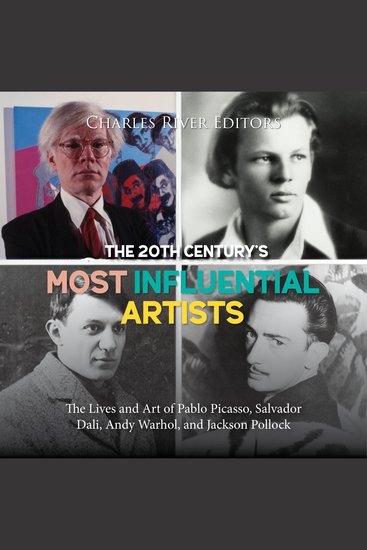
  • 20th Century’s Most Influential Artists The: The Lives and Art of Pablo Picasso Salvador Dali Andy Warhol and Jackson Pollock - cover

    20th Century’s Most Influential...

    Editors Charles River

    • 0
    • 0
    • 0
    In their biography of Pablo Picasso, Hans Ludwig and Chris Jaffe note that “for him, art was always adventure: ‘To find is the thing.’” Indeed, there is perhaps no artist who produced more art than Picasso, whose enormous oeuvre (which spanned most of his 91-year life) contained a countless number of paintings and drawings. Picasso also worked in other mediums as well, notably sculpture and lithography, and his constant experimentation with form makes him a useful case study through which to chart the growth of Modernism as an artistic movement and many of the artistic trends that would dominate the 20th century. At the same time, one of the challenges involved in examining Picasso’s body of work is the sheer breadth of it all.  
    	In his review of Salvador Dali’s first autobiography, George Orwell declared that “One ought to be able to hold in one’s head simultaneously the two facts that Dali is a good draughtsman and a disgusting human being.” Whether or not one agrees with the famous author’s assessment, Orwell captures the polarizing nature of Salvador Dali, and the extent to which his undeniable technical virtuosity often brushed against his penchant for provoking his audiences (not to mention provoking long-entrenched standards of “proper” taste).  
    	To truly grasp the significance of Jackson Pollock in 20th century art, it’s necessary to understand the dramatic departure he initiated away from the straightforward compositions associated with the social realist art of the 1930s, a Depression-era period in which political art offered readily comprehensible narratives that were grasped by viewers with little artistic training.  
    Few artists of the 20th century were as enigmatic as Andy Warhol, who once remarked, “If you want to know all about Andy Warhol, just look at the surface of my paintings and films and me, there I am. There’s nothing behind it.” This statement is hardly out of character for the famous artist.
    Ver libro