¡Acompáñanos a viajar por el mundo de los libros!
Añadir este libro a la estantería
Grey
Escribe un nuevo comentario Default profile 50px
Grey
Suscríbete para leer el libro completo o lee las primeras páginas gratis.
All characters reduced
Shatt al Arab Faith - cover

Shatt al Arab Faith

Amelia Khatri

Traductor A AI

Editorial: Publifye

  • 0
  • 0
  • 0

Sinopsis

Shatt al Arab Faith examines the profound religious and historical importance of the Shatt al Arab waterway, formed by the Tigris and Euphrates rivers, within Islamic history. It argues that the river is more than a geographical feature; it embodies the interwoven nature of faith, history, and geography. The book highlights how this region, central to the cradle of civilization in Mesopotamia, became a critical point for the evolution of Islamic beliefs and identity.

 
Intriguingly, the Shatt al Arab is not merely a physical location but a living testament embedded in the collective memory of the Islamic world. The book explores the river's significance through historical narratives, diverse religious practices, and its modern-day importance to Islamic identity. It traces the river's presence in early Islamic texts, examines rituals and beliefs associated with it, and investigates its role in contemporary geopolitical challenges.

 
The approach combines historical analysis with contemporary relevance, offering insights into how the past shapes the present. The book progresses from introducing the geographical and religious context to delving into specific historical periods, religious practices, and the river's symbolic role, drawing from diverse sources like historical texts, travelogues, and oral histories.
Disponible desde: 14/02/2025.
Longitud de impresión: 58 páginas.


Otros libros que te pueden interesar

  • Warrior Life - Indigenous Resistance and Resurgence - cover

    Warrior Life - Indigenous...

    Pamela Palmater

    • 0
    • 0
    • 0
    In a moment where unlawful pipelines are built on Indigenous territories, the RCMP make illegal arrests of land defenders on unceded lands, and anti-Indigenous racism permeates on social media; the government lie that is reconciliation is exposed. Renowned lawyer, author, speaker and activist, Pamela Palmater returns to wade through media headlines and government propaganda and get to heart of key issues lost in the noise.
    		 
    Warrior Life: Indigenous Resistance and Resurgence is the second collection of writings by Palmater. In keeping with her previous works, numerous op-eds, media commentaries, YouTube channel videos and podcasts, Palmater’s work is fiercely anti-colonial, anti-racist, and more crucial than ever before.
    		 
    Palmater addresses a range of Indigenous issues — empty political promises, ongoing racism, sexualized genocide, government lawlessness, and the lie that is reconciliation — and makes the complex political and legal implications accessible to the public.
    		 
    From one of the most important, inspiring and fearless voices in Indigenous rights, decolonization, Canadian politics, social justice, earth justice and beyond, Warrior Life is an unflinching critique of the colonial project that is Canada and a rallying cry for Indigenous peoples and allies alike to forge a path toward a decolonial future through resistance and resurgence.
    Ver libro
  • Study Boost: Brown Noise for Students to Stay Focused - Stay in the Zone with Deep Soothing Sound Waves for Enhanced Focus - cover

    Study Boost: Brown Noise for...

    STUDY BOOST LABS

    • 0
    • 0
    • 0
    ***** Maximize your concentration and stay on top of your studies with "STUDY BOOST"This collection of brown noise is specifically designed to block out distractions, calm your mind, and help you dive deep into focused work. Perfect for students, this sound therapy offers the ideal background for studying, reading, or working in noisy environments. The steady, subtle vibrations of brown noise enhance cognitive function, allowing you to absorb information and retain it more effectively. Say goodbye to distractions and hello to productive study sessions!***** With 9 carefully curated soundscapes and a total running time of 10 hours, "STUDY BOOST" is your key to sustained focus and academic success.Brown noise, Study sounds, Focus noise, Noise for concentration, Student study aid, Sound therapy for studying, Background noise for focus, White noise alternative, Noise for deep focus, Study environment sounds, Productivity sounds, Cognitive enhancement noise, Focus-enhancing soundscapes, Distraction-free study, Noisy environment study solution, Academic focus noise, Study session optimization, Sound for memory retention, Study boost sound therapy, Long play study noise
    Ver libro
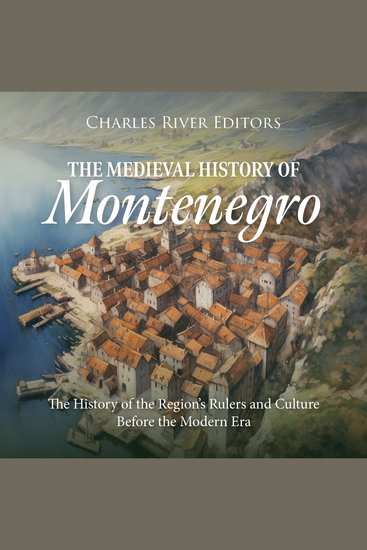
  • Medieval History of Montenegro The: The History of the Region’s Rulers and Culture Before the Modern Era - cover

    Medieval History of Montenegro...

    Editors Charles River

    • 0
    • 0
    • 0
    Much has been written about Western intervention during the breakup of Yugoslavia, and whether it made matters worse, prevented worse atrocities, or was simply ineffective. In early 1992, however, what was clear was that Europe was hopelessly divided over the best course of action to take towards Yugoslavia, and after several years of fighting, the Bosnian War was one of the most violent conflagrations in Europe since the end of World War II.  
    	That war had been the byproduct of centuries of tensions in the Balkans, and an attempt in the wake of World War I to redraw the political boundaries of Europe and the Middle East. That included forming the Kingdom of Yugoslavia, initially known as the Kingdom of Serbs, Croats and Slovenes, a particularly fragile enterprise, and there was almost constant tension between the majority Serbs and the other Yugoslav nationalities, especially the Croats. As a result, the Kingdom was a land of political assassinations, underground terrorist organizations, and ethnic animosities. In 1929, King Alexander I suspended democracy and ruled as a dictator until he himself was assassinated in 1934.  
    	Depending on the source, many authors have focused on different catalysts for Yugoslavia’s demise, but Vesna Drapac may have succinctly summed the situation up when he wrote that by the end, the state “lacked a reason to exist.” There is certainly something in this sentiment, but the disintegration came at an enormous cost. 
    	Given what happened in Yugoslavia, it should be little surprise the area that eventually became the modern nation of Montenegro has had a turbulent history for millennia, with shifting borders, different degrees of autonomy, and various conflicts occurring within it.  
    	  
      
    Ver libro
  • The Sound of Many Waters - A Journey along the River Tay - cover

    The Sound of Many Waters - A...

    Robin A. Crawford

    • 0
    • 0
    • 0
    With the widest catchment area of any river in Britain, the Tay drains much of the lower Highlands of Scotland. A vast network of lochs and smaller bodies of water feed the Isla, Garry, Tummel, Almond and Earn, which all flow into this mighty river.
    As Robin Crawford walks along the banks of the Tay, we delve into the history of this landscape and his personal connection with it, from hill walks with friends into the mountains of the Tay's source to his student days in Dundee, where the Tay eventually spills out into the North Sea.
    Along the route we dip into the river's story: the gold-panners on the river Cononish, the Earthquake House outside Comrie, Beatrix Potter's holiday home near Dunkeld. Throughout, the river is our constant companion, connecting the small moments on which events turn and lives are changed forever.
    Ver libro
  • Alien Goddess - UFOs AI and the Goddesses of Ascension - cover

    Alien Goddess - UFOs AI and the...

    Dr. Joanna Kujawa

    • 0
    • 0
    • 0
    What if the beings we call "aliens" are not invaders, but messengers from higher realms of consciousness, warning us against the dead-end path we are racing toward? What if the true threat to humanity is not an alien invasion, but rather our surrender to machines? And what if the antidote resides in wisdom we abandoned long ago? 
     
    Alien Goddess enters this urgent conversation with a perspective no one else is offering. Drawing on contemporary accounts of contact phenomena, esoteric texts, and ancient mythologies, it asks what happens when a civilization replaces the sacred with the synthetic. Who becomes the architect of human destiny when the soul is written out of the equation? 
     
    Part I—The Messengers: UFOs investigates the possibility that UFO phenomena are visitations from consciousness realms within the liminal spaces of multidimensional realities. 
     
    Part II—The Message: AI critiques the promises of transhumanism and artificial intelligence (AI), exposing the confusion between artificial experiences and true spiritual evolution. 
     
    Part III—The Goddesses of Ascension offers an alternative in the initiatory wisdom of Goddess traditions. 
     
    Alien Goddess is both a warning and a map.
    Ver libro
  • The Roman Empire and Its Enemies - Conquests and Conflicts - cover

    The Roman Empire and Its Enemies...

    Rogan Fish

    • 0
    • 0
    • 0
    The rise of Rome is a story of resilience, military strength, and strategic diplomacy. Emerging from a small settlement along the Tiber River, Rome transformed into a dominant power that would shape the ancient world for centuries. The foundation of Rome’s success lay in its political adaptability, disciplined military, and ability to integrate conquered peoples into its expanding empire. 
    Rome began as a monarchy, but after the expulsion of its last king in 509 BCE, it became a republic governed by elected officials and a system of checks and balances. This new structure allowed Rome to expand without being solely reliant on a single ruler. The Roman Republic was marked by a strong Senate, magistrates, and popular assemblies, which provided a balance of power. However, as Rome grew, internal conflicts between the patrician elite and the plebeian class led to significant social and political reforms, further strengthening the state’s stability. 
    The backbone of Rome’s expansion was its formidable military. The Roman legions, composed of disciplined and well-trained soldiers, were unmatched in organization and adaptability. Unlike other ancient armies that relied heavily on individual heroism, Rome’s military success stemmed from its ability to fight as a cohesive unit. Roman soldiers were rigorously trained, equipped with superior weapons, and organized into flexible formations such as the manipular system, which allowed them to adapt to various battle conditions. This military efficiency enabled Rome to conquer neighboring territories, including the Latin League, the Etruscans, and the Samnites, solidifying its control over central Italy.
    Ver libro