Rejoignez-nous pour un voyage dans le monde des livres!
Ajouter ce livre à l'électronique
Grey
Ecrivez un nouveau commentaire Default profile 50px
Grey
Abonnez-vous pour lire le livre complet ou lisez les premières pages gratuitement!
All characters reduced
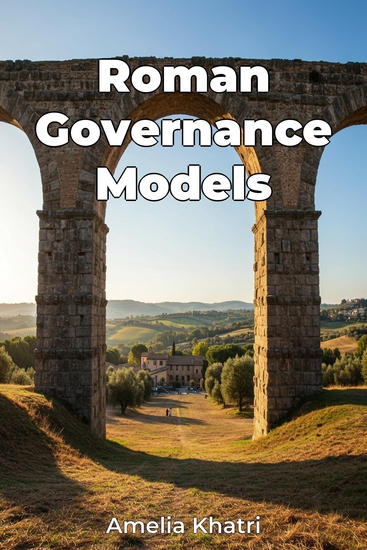
Roman Governance Models - cover

Roman Governance Models

Amelia Khatri

Traducteur A AI

Maison d'édition: Publifye

  • 0
  • 0
  • 0

Synopsis

Roman Governance Models examines how a small republic rose to control a vast empire through sophisticated systems of law, infrastructure, and leadership. The book argues that Rome's lasting influence stemmed from its ability to balance centralized control with local autonomy, fostering economic integration and providing a framework for social order. For instance, Roman law dynamically adapted to manage diverse populations, while infrastructure like roads and aqueducts facilitated trade and military control.

 
The book progresses through three parts, starting with the foundational principles of Roman law and its evolution, then exploring Rome's impressive infrastructure and its strategic impact. Finally, it investigates Roman leadership, tracing the evolution of political institutions from the Republic to the emperors.

 
The narrative emphasizes factual accuracy, balanced interpretation, and rigorous documentation, making it valuable for those interested in history and governance.
Disponible depuis: 05/05/2025.
Longueur d'impression: 65 pages.

D'autres livres qui pourraient vous intéresser

  • He’s Alive! - SERGEANT JAMES I MESTROVITCH (1243675) - cover

    He’s Alive! - SERGEANT JAMES I...

    Zivojin Petrovic

    • 0
    • 0
    • 0
    THREE TIMES DECLARED DEAD IN WWI – AND THREE TIMES HE CAME BACK. 
    THE TRUE STORY OF AN AMERICAN MEDAL OF HONOR HERO HISTORY TRIED TO FORGET. 
    A gripping account of a young man from a small Montenegrin village who crossed the ocean in search of freedom, carrying only his mother’s blessing and a vow to guard honor above all. In America, he found a new homeland and became James I. Mestrovitch – a man who loved his adopted country as deeply as the one in which he was born. 
    When the Great War erupted, he was among the first to march to Europe under the American flag. On the blood-soaked fields of France, he became a symbol of courage and brotherhood. Soldiers, officers, even entire regiments spoke of his deeds, turning his bravery into stories and battlefield performances that boosted morale. 
    Wounded and unable to lift a rifle, he fought on with the only weapon he could still raise – a pistol. For his extraordinary valor, the United States Congress posthumously awarded him the Medal of Honor, placing him among the nation’s immortal heroes and forever inscribing his name in American history. 
    Based on extensive historical research, archival materials, and documented military records, this documentary narrative reconstructs the life of Sergeant James I. Mestrovitch — one of the most extraordinary yet forgotten heroes of World War I. 
    He's Alive! – a documentary work that brings an American hero back among the living.
    Voir livre
  • Army Letters from an Officer's Wife 1871-1888 - cover

    Army Letters from an Officer's...

    Frances M. A. Roe

    • 0
    • 0
    • 0
    "There appeared from the bushes in front of me, and right in the path, two immense gray wolves . . .  Rollo saw them and stopped instantly, giving deep sighs, preparing to snort, I knew . . .  To give myself courage, I talked to the horse, slowly turning him around . . . when out of the bushes in front of us, there came a third wolf!  The situation was not pleasant and without stopping to think, I said ‘Rollo, we must run him down -  now do your best’ and taking a firm hold of the bridle, and bracing myself in the saddle, I struck the horse with my whip and gave an awful scream. . .” Thus, the spunky and resourceful Frances Roe recounts one of her many adventures.  Frances was the young wife of a West Point Army officer, whose career took them both to frontier garrisons in what are now the states of  Kansas, Colorado, Oklahoma, Utah, Montana, and Wyoming. Her letters home to her family in upstate New York, written between 1871 and 1888, and published in book form in 1909, are a fascinating chronicle of life on the frontier.  Despite the grittiness of  keeping house in tent-and-log-cabin quarters,  Frances took to Western  life, learning to shoot and ride (side saddle), fly fish for trout and hunt buffalo.  Her letters, chatty and detailed, open windows on varied aspects of frontier and army life: army protocol (including the right of senior officers to bump subordinates out of their housing ); the Indian tribes--Arapahoe, Cheyenne, Apache, Kiowa (ceremonial visits from chiefs as well as Indian warfare); the  black cavalry troops (at Camp Supply in Indian Territory); Chinese cooks (also Polish, Irish, and enlisted men doing kitchen duty).  Her letters span years of rapid change in the West.  They touch on  the disappearance of the buffalo herds, the decline of the Indian tribes and the coming of the railroads.  Even Yellowstone Park, established in 1872, gets a mention: “Now that the park can be reached by railroad, all of the generals, congressmen, and judges are seized with a desire to inspect it--in other words, it gives them a fine excuse for an outing at Uncle Sam’s expense.”Her emotions run deep when she writes: “I love army life here in the West, and I love all the things that it brings to me--the grand mountains, the plains, and the fine hunting.”    But, Frances’ husband, Fayette Washington Roe, is eventually promoted to a headquarters desk job.  Frances tries to evinse enthusiasm for town life: “since I cannot return to the plains, I might as well go to the city, where we will meet people of culture.”   But even shopping for the necessary clothes distresses her: “Parasols have bothered me.  I would forget to open them in the street, and would invariably leave them in the stores when shopping and then have to go about looking them up.”   She then utters a timeless cry of urban angst: “It is the feeling of loneliness I mind here--of being lost and no one to search for me.” (written at a hotel in Omaha, Nebraska in August 1888)  Anyone with  nostalgia for or curiosity about the Old American West will certainly enjoy this book. (Summary by Sue Anderson)
    Voir livre
  • Americanism - cover

    Americanism

    Theodore Roosevelt

    • 0
    • 0
    • 0
    Immerse yourself in the powerful words of Theodore Roosevelt as he delivers his iconic 1915 speech, Americanism. In this stirring address, Roosevelt passionately advocates for the principles of true Americanism, emphasizing the importance of national unity, loyalty, and the responsibilities of citizenship. With a focus on upholding American values amidst the challenges of the early 20th century, Roosevelt’s speech is a timeless reminder of the strength and resilience that define the American spirit. This audio recording brings his fervent message to life, making it a must-listen for anyone interested in the ideals that have shaped the nation. 
    Voir livre
  • We Uyghurs Have No Say - An Imprisoned Writer Speaks - cover

    We Uyghurs Have No Say - An...

    Ilham Tohti

    • 0
    • 0
    • 0
    The words of China's most famous political prisoner 


    In Xinjiang, the large northwest region of China, the government has imprisoned more than a million Uyghurs in reeducation camps. One of the incarcerated—whose sentence, unlike most others, has no end date—is Ilham Tohti, an intellectual and economist, a prolific writer, and formerly the host of a website, Uyghur Online. In 2014, Tohti was arrested; accused of advocating separatism, violence, and the overthrow of the Chinese government; subjected to a two-day trial; and sentenced to life. Nothing has been heard from him since. 


    Here are Tohti's own words, a collection of his plain-spoken calls for justice, scholarly explanations of the history of Xinjiang, and poignant personal reflections. While his courage and outspokenness about the plight of China's Muslim minorities is extraordinary, these essays sound a measured insistence on peace and just treatment for the Uyghurs. 


    Winner of the PEN/Goldsmith Freedom to Write Award and the Sakharov Prize for Freedom of Thought while imprisoned, this book is the only way to hear from a man who has been called "a Uyghur Mandela."
    Voir livre
  • Narcissistic Abuse Recovery - Everything the Victims Need to Know to Healing After Hidden Abuse and Breaking Down Narcissism Empaths and Codependency - cover

    Narcissistic Abuse Recovery -...

    Dr. Theresa J. Covert

    • 0
    • 0
    • 0
    DO THE FOLLOWING SYMPTOMS SOUND FAMILIAR? 
    - Doubting yourself and your sanity 
    - Feeling like you’re losing your mind 
    - Feeling like you’re always apologizing 
    - You’re second-guessing your memory 
    - Feeling like you aren’t good enough 
    - Feeling misunderstood 
    - Feeling lonely 
    - Ruined self confidence 
    - Extreme weight loss or weight gain 
    - Uncharacteristic jealousy/ insecurity 
    - Feeling like you don’t know the difference between right and wrong 
    - Extreme paranoia (being turned into an obsessive detective) 
    - Endless, repetitive obsessive thinking about your ex 
    - Constantly trying to find explanations for what has happened 
    - Feelings of helplessness and despair 
    - A desire to self isolate 
    - Feeling desperately misunderstood 
    - Overwhelming feelings of loss and grief 
    - Extreme bouts of rage 
    - An inability to be comfortable with yourself 
    - Strange dreams 
    The list goes on…. 
    “NOBODY UNDERSTANDS!” 
    I hear this frustrated cry from abused people a lot. 
    I felt the same way when I was recovering from emotional abuse at the hands of a narcissistic/borderline psychopath. If you try and tell people who have NO EXPERIENCE with a narcissist (there is no experience like being with a narcissist, its not their fault they can’t understand) about it they will either deny your experience, tell you you are exaggerating or look at you like you were crazy. 
    I can’t promise you that reading to this book is going to be a “total cure”, but I can promise that if you APPLY YOURSELF DILLIGENTLY, take notes, read and re-read the chapters, follow all instructions to the letter, with a tenacious resolve to get better you will feel an instant decrease in anxiety within the first 24 hours and should see huge improvements within the first 3 days.
    Voir livre
  • Human Rights - A Universal Fight for Dignity Justice and Equality (5 in 1) - cover

    Human Rights - A Universal Fight...

    Marcus Klein

    • 0
    • 0
    • 0
    This is a bundle of 5 books, which are the following: 
    · Children's Rights: Children represent the future of our societies, yet they remain among the most vulnerable and marginalized populations worldwide. The protection of children's rights has become one of the most critical global issues in the 21st century, demanding urgent attention and action. 
    · Human Trafficking: Human trafficking is one of the gravest human rights abuses of our time, affecting millions of individuals across the globe. It is a hidden yet pervasive crime that exploits people for labor, sex, and other forms of servitude. 
    · Organ Harvesting: Organ harvesting represents one of the most pressing and disturbing ethical challenges of our time. This practice involves the removal of organs from individuals, often without consent, for transplantation or sale on the black market. While organ transplantation has revolutionized modern medicine, saving countless lives, the dark underbelly of the industry reveals a stark contrast—one where human rights are systematically violated, and vulnerable populations are exploited. 
    · Sexism: Sexism, a deeply entrenched social issue, has been pervasive throughout human history, shaping the experiences of individuals and communities across the globe. At its core, sexism refers to the belief that one gender is superior to another, typically manifesting in the unequal treatment and opportunities given to individuals based on their gender. 
    · Racism: Racism has been a persistent and destructive force throughout human history, shaping societies, cultures, and institutions in ways that continue to reverberate today. It manifests in myriad forms—through prejudice, discrimination, systemic inequities, and violence—targeting individuals and groups based on their race or ethnicity.
    Voir livre