Join us on a literary world trip!
Add this book to bookshelf
Grey
Write a new comment Default profile 50px
Grey
Subscribe to read the full book or read the first pages for free!
All characters reduced
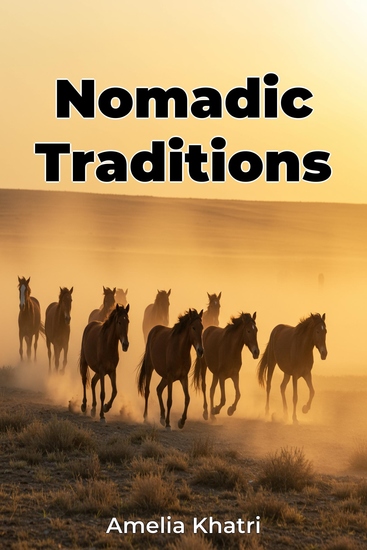
Nomadic Traditions - cover

Nomadic Traditions

Amelia Khatri

Translator A AI

Publisher: Publifye

  • 0
  • 0
  • 0

Summary

Nomadic Traditions offers a fresh perspective on world history by exploring the significant yet often overlooked role of nomadic societies. It challenges the traditional view of civilization by highlighting how these mobile empires, like the Mongols and Scythians, shaped cultural exchange, military strategies, and interregional networks. The book reveals how nomadic groups adapted to diverse environments and influenced settled societies, demonstrating their profound impact on global geopolitics.

 
This study delves into nomadic cultural adaptations, economic systems, and warfare tactics. Readers will discover how innovative military techniques, such as the use of cavalry and archery, allowed nomadic groups to project power across vast distances. Furthermore, the book examines how trade routes facilitated the exchange of goods and ideas, fostering both cooperation and conflict with settled civilizations.

 
The book progresses by first establishing the historical context of nomadic societies and then exploring their cultural practices, economic systems, and military innovations. Employing an interdisciplinary approach that integrates history, anthropology, and archaeology, Nomadic Traditions provides a nuanced understanding of these societies and their enduring relevance to contemporary issues.
Available since: 03/29/2025.
Print length: 55 pages.


Other books that might interest you

  • On the Motion of Animals - cover

    On the Motion of Animals

    Aristotle

    • 0
    • 0
    • 0
    "On the Motion of Animals" is a scientific work by Aristotle that explores the principles of motion in living beings. In this treatise, Aristotle observes and analyzes the movements of various animals, from insects to humans, in order to understand the mechanics of motion and the physiological and psychological factors that drive it. Aristotle begins by examining the different types of motion, including natural, violent, and voluntary, and how they relate to the movements of animals. He then delves into the anatomy and physiology of different animals, looking at their skeletal structures, muscular systems, and nervous systems, and how they work together to produce motion. Read in English, unabridged.
    Show book
  • The Child and the Curriculum - cover

    The Child and the Curriculum

    John Dewey

    • 0
    • 0
    • 0
    "The Child and the Curriculum" is a book written by John Dewey, an American philosopher, psychologist, and educational reformer, and published in 1902. The book is a collection of essays and lectures that explore Dewey's ideas about the relationship between the child and the curriculum in education. 
    Dewey argues that education should focus on the child's experiences and interests, rather than on a predetermined curriculum that is disconnected from the child's life. He advocates for a child-centered approach to education that emphasizes active learning, critical thinking, and problem-solving. 
    According to Dewey, the curriculum should be flexible and adaptable to the needs and interests of each child, rather than a fixed set of subjects that all students must learn. He also emphasizes the importance of hands-on, experiential learning, and the integration of subjects across disciplines. 
    Overall, "The Child and the Curriculum" is a seminal work in the field of education that continues to influence educational theory and practice today. Dewey's ideas about child-centered education, active learning, and the integration of subjects continue to shape the way educators think about teaching and learning
    Show book
  • Intersectionality 2nd Edition - cover

    Intersectionality 2nd Edition

    Sirma Bilge, Patricia Hill Collins

    • 0
    • 0
    • 0
    The concept of intersectionality has become a central topic in academic and activist circles alike. But what exactly does it mean, and why has it emerged as such a vital lens through which to explore how social inequalities of race, class, gender, sexuality, age, ability, and ethnicity shape one another?  


    In this fully revised and expanded second edition of their popular text, Patricia Hill Collins and Sirma Bilge provide a much-needed introduction to the field of intersectional knowledge and praxis. Analyzing the emergence, growth, and contours of the concept of intersectionality, the authors also consider its global reach through an array of new topics such as the rise of far-right populism, reproductive justice, climate change, and digital environments and cultures. Accessibly written and drawing on a plethora of lively examples to illustrate its arguments, the book highlights intersectionality's potential for understanding complex architecture of social and economic inequalities and bringing about social justice-oriented change. 


    Intersectionality will be an invaluable resource for anyone grappling with the main ideas, debates, and new directions in this field.
    Show book
  • Scripting Empire - Broadcasting the BBC and the Black Atlantic - cover

    Scripting Empire - Broadcasting...

    James Procter

    • 0
    • 0
    • 0
    Scripting Empire recovers the literary and cultural history of West Indian and West African writing at the BBC in order to rethink the critical mid-century decades of shrinking British sovereignty, late modernism, and mass migration to the metropole. Between the 1930s and the 1960s, a remarkable group of black Atlantic artists and intellectuals became producers, editors, and freelancers at the corporation. Operating at the interface of a range of literary and broadcast genres, this loose network of African Caribbean writers and thinkers prompt a reassessment of the aesthetic, formal, and political fallout of decolonization between the outbreak of World War II and the first airings of post-colonial independence. 


    Scripting Empire works comparatively across dozens of different programs spanning the General Overseas Service, Home Service, Light Program, and Third Program. Drawing upon a transnational archive of materials, including scripts, correspondence, periodicals, visual records, and sound recordings, it seeks to reposition the cultural contribution of West Indians and West Africans within a more pervasive and porous account of radio transmission, the legacy of which extends well beyond broadcasting.
    Show book
  • The Great Deluge - Hurricane Katrina New Orleans and the Mississippi Gulf Coast - cover

    The Great Deluge - Hurricane...

    Anonymous

    • 0
    • 0
    • 0
    In the span of five violent hours on August 29, 2005, Hurricane Katrina destroyed major Gulf Coast cities and flattened 150 miles of coastline. Yet those wind-torn hours represented only the first stage of the relentless triple tragedy that Katrina brought to the entire Gulf Coast from Louisiana to Mississippi to Alabama.  
    First was the hurricane, one of the three strongest ever to make landfall in the United States -- 150 mile per hour winds, with gusts measuring more than 180 miles per hour ripping buildings to pieces. Second, the storm-surge flooding, which submerged a half million homes, creating the largest refugee crisis since the Civil War. Eighty percent of New Orleans was under water, and whole towns in southeastern Louisiana ceased to exist. And third, the human tragedy of government mismanagement, which proved as cruel as the natural disaster itself. 
    In The Great Deluge, bestselling author Douglas Brinkley, a New Orleans resident and professor of history at Tulane University, rips the story of Katrina apart and relates what the category 3 hurricane was like from every point of view, while recognizing the true heroes. 
    Throughout the book, Brinkley lets the Katrina survivors tell their own stories, masterfully allowing them to record the nightmare that was Katrina. The Great Deluge investigates the failure of government at each level and breaks important new stories. Packed with interviews and original research, it traces the character flaws, inexperience, and ulterior motives that allowed the Katrina disaster to turn the Gulf Coast into a scene from a war movie or a third-world documentary.
    Show book
  • Islamic Relics: The History of Some of the Holiest Items in Islam - cover

    Islamic Relics: The History of...

    Editors Charles River

    • 0
    • 0
    • 0
    Muslim relics have become sought after relatively recently, since in the tradition of Islam it is customary to bury the deceased together with his belongings. However, many religious relics have rather controversial origins. Sometimes the faithful sincerely worship artful forgeries masquerading as holy relics and things that supposedly belonged to saints. The real sanctuaries are carefully guarded and are not always accessible to believers. They are brought out for public viewing on especially festive days. It is often represented as creating a special ritual.  
    	It is curious that the attitude towards such relics gradually changed over the centuries. If, at first, they were considered amulets used by private individuals, then over time their purpose and comprehension took on a different character. Most notably, the possession of the relics of the prophet began to be considered one of the arguments in favor of the appointment of the Caliph. The concentration of several relics in one mosque immediately sharply increased, in the eyes of the believers, the piety of such a mosque; this, in turn, immediately affected the growth of its wealth and political influence. Thus, in the published catalog of relics stored in the former Badshahi mosque of the Mughal state in Lahore (now Pakistan), there are 28 items: seven belonged to the prophet himself, three to the son-in-law of the prophet Ali, two to the daughter of the prophet Fatima, five to the grandson of the prophet Hussein, etc. It is believed that some of these items were taken out by Timur after the capture of Damascus, and some were donated by Sultan Bayazid to Timur's descendant, Babur. After the fall of the Mughal dynasty in India, they were first in private possession in the second half of the 19th century. In different ways, they came to the Lahore Mosque.
    Show book