Join us on a literary world trip!
Add this book to bookshelf
Grey
Write a new comment Default profile 50px
Grey
Subscribe to read the full book or read the first pages for free!
All characters reduced
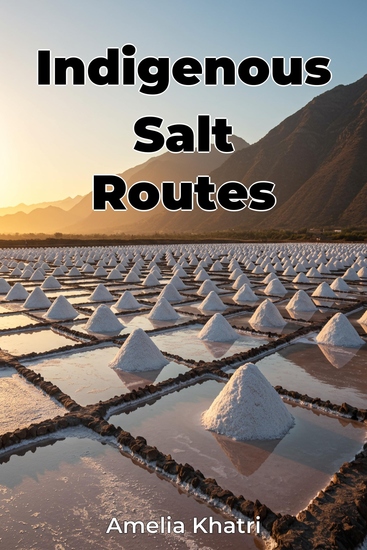
Indigenous Salt Routes - cover

Indigenous Salt Routes

Amelia Khatri

Translator A AI

Publisher: Publifye

  • 0
  • 0
  • 0

Summary

Indigenous Salt Routes reveals the untold stories of how indigenous communities worldwide managed salt, a commodity as valuable as gold. The book uncovers intricate networks of salt production, trade, and cultural practices, challenging conventional views of global economic history. It emphasizes that control over salt was a significant driver of social and political structures in many indigenous societies, highlighting their economic sophistication often overlooked in Eurocentric narratives.

 
Did you know some communities extracted salt from seawater, salt springs, and mineral deposits, showcasing remarkable resourcefulness? This book takes an interdisciplinary approach, using archaeological findings, ethnohistorical accounts, and linguistic analysis to reconstruct these forgotten histories.

 
Organized into three sections, the book progresses by first introducing diverse salt extraction methods, then examining trade routes, and finally delving into the cultural and spiritual significance of salt. It explores the logistical challenges and political agreements that facilitated salt movement, and reveals rituals, beliefs and social structures tied to salt production. The book concludes by discussing the legacy of these routes and their relevance to contemporary issues of indigenous rights and resource management.
Available since: 03/29/2025.
Print length: 61 pages.

Other books that might interest you

  • The Second Substance - cover

    The Second Substance

    Anne Lardeux

    • 0
    • 0
    • 0
    "A revolutionary diary that parses the lines of sex and power, in language that pushes itself around on the page like paint. With echoes of Emma Goldman's if I can't dance, Lardeux's revolution has fucking at its core. The Second Substance is fleshy, cinematic, intuitive." – Tamara Faith Berger, author of Queen Solomon
       
    “A nomadic miscellany of gruff scavengers and would-be pioneers has commandeered the derelict filling station at 69 Rue Principale—an anonymous sensualist and moonlighting authoritarian among them—all jockeying for position at the nexus of self-determination and fate. In Anne Lardeux’s enigmatic debut, presented here in a translation by Pablo Strauss, the constant friction between societal strictures and communal revision spark a series of disorderly experiments, abstract epiphanies blasting off in every direction. The Second Substance is a novel about overriding our programming, rewriting our code in order to initiate an even more radical set of protocols for eroticism, destruction, and rebirth.” – Justin Walls, Bookshop.org
    Show book
  • The Heart of Therapy - Developing Compassion Understanding and Boundaries - cover

    The Heart of Therapy -...

    Laura Barnett

    • 0
    • 0
    • 0
    This thoughtful and heartfelt book develops two main themes: the healing power of a compassionate understanding towards ourselves and others, and the ways boundaries are set within and around various areas of our lives. 


    It examines how we live these boundaries, how they impact us, and what it takes to live these with deeper satisfaction. This book also addresses shame and rage; the impact of trauma; the power of parental messages, spoken and unspoken; and transgenerational burdens. A theoretical chapter summarizes the author's integrative, phenomenological approach: it brings the insights of a body-focused trauma therapy and a systemic lens to an overarching existential perspective. Numerous vignettes, case studies, and client-therapist dialogues illustrate reflections on life, philosophy, and therapeutic modalities and practice. 


    This book will be a thought-provoking listen for trainee and practicing counselors and psychotherapists, or anyone looking for self-reflection on their own practices, life, and ultimately, what it means to be human.
    Show book
  • End of World War II The: The History of the Battles that Ended the Fighting in Europe and the Pacific - cover

    End of World War II The: The...

    Editors Charles River

    • 0
    • 0
    • 0
    After the successful amphibious invasion on D-Day in June 1944, the Allies began racing east toward Germany and liberating France along the way. The Allies had landed along a 50 mile stretch of French coast, and despite suffering 8,000 casualties on D-Day, over 100,000 still began the march across the western portion of the continent. By the end of August 1944, the German Army in France was shattered, with 200,000 killed or wounded and a further 200,000 captured. However, Adolf Hitler reacted to the news of invasion with glee, figuring it would give the Germans a chance to destroy the Allied armies that had water to their backs. As he put it, “The news couldn’t be better. We have them where we can destroy them.” While that sounds delusional in retrospect, it was Hitler’s belief that by splitting the Allied march across Europe in their drive toward Germany, he could cause the collapse of the enemy armies and cut off their supply lines.  
    Near the end of 1944, as Allied forces were pushing across the Pacific and edging ever closer to Japan, plans were drawn up to invade the Ryuku islands, the most prominent of them being Okinawa. Military planners anticipated that an amphibious campaign would last a week, but instead of facing 60,000 Japanese defenders as estimated, there were closer to 120,000 on the island at the beginning of the campaign in April 1945. The Battle of Okinawa was the largest amphibious operation in the Pacific theater, and it would last nearly 3 months and wind up being the fiercest in the Pacific theater during the war, with nearly 60,000 American casualties and over 100,000 Japanese soldiers killed. In addition, the battle resulted in an estimated 40,000-150,000 Japanese civilian casualties.
    Show book
  • Dying Rose: Six tragic deaths a culture of silence and an enduring national shame - cover

    Dying Rose: Six tragic deaths a...

    Douglas Smith, Kathryn...

    • 0
    • 0
    • 0
    An investigation into the deaths of six Aboriginal women and the police responses that left families reeling 
      
    'If you think it's hard being a white woman in Australia, try being a black woman.' These were the words that set a team of journalists at the Adelaide Advertiser on an investigation into the tragic deaths of six young Indigenous women. 
    It was Courtney Hunter-Hebberman who uttered those words, up on stage at an International Women's Day event. A shocking number of Indigenous women die every year by murder or suicide, and Courtney's daughter, Rose, was one of them. Rose's apparent death by suicide at nineteen, in a backyard shed, had left her mother craving answers - answers the police seemed unable to give her. 
    Inspired by Courtney's courage and grief, the Advertiser team hoped to shed light on Rose's death and put Courtney's mind at rest. But what they found, as their investigation of one death rolled into another five, was disturbing. Lack of urgency, sloppy searches, poor communication, and assumptions by police were just some of the problems . 
    As the team probed further, even bigger questions about whether Indigenous Australians, especially women, are heard when they speak. 
    Based on the podcast Dying Rose, this is a compelling look at young Indigenous women's vulnerability to danger, and how, when their lives are cut short, their families are left to cope with a grief seemingly compounded by indifference.
    Show book
  • Inside the criminal's mind - How Criminals Feel and Think (Understanding the science and Psychology behind criminal behavior) - cover

    Inside the criminal's mind - How...

    NM Serenity

    • 0
    • 0
    • 0
    INSIDE THE CRIMINAL 'S MINDHave you ever questioned how a devoted mother could deliberately and coldly take the life of her own child in the bathtub—the very child for whom she had just prepared breakfast? What dark forces could have been at work within her mind at that moment? How did such thoughts take hold? Were they embedded deep within her psyche long before the act?What compels individuals to cross the most sacred moral boundaries? What hidden patterns emerge within their minds? What common traits do they share?For decades, scholars and scientists have sought to determine whether criminal behavior is the product of genetic inheritance or the consequence of environmental and social influences.In this compelling examination of the criminal psyche, Inside the Criminal’s Mind ventures beyond the headlines, delving into the neurological and psychological forces that drive some of history’s most notorious offenders—such as Andrea Yates, Jeffrey Epstein, and John Wayne Gacy. This work dissects the minds of those who defy humanity’s most fundamental moral codes. Through the advanced study of neuroscience and psychology, we expose the structural anomalies and chemical imbalances within the brain that may underlie their actions. Pioneering research on the role of genetics—initiated by Cesare Lombroso in the late 19th century—laid the foundation for understanding how inherited traits might predispose individuals to criminal behavior and how such tendencies might one day be identified, or even prevented.Inside the Criminal’s Mind offers clear, research-based insights into these unsettling questions. Within these pages, you may come to realize that the seemingly ordinary neighbor next door is far more complex—and perhaps far more dangerous—than you ever imagined.                                              IF YOU DARE TO LOOK
    Show book
  • The Comte de St Germain - The Secret of kings: A Monograph - cover

    The Comte de St Germain - The...

    Isabel Cooper-Oakley

    • 0
    • 0
    • 0
    The Comte de Saint Germain was a European courtier, with an interest in science and the arts. He achieved prominence in European high society of the mid-1700s. In order to deflect inquiries as to his origins, he would invent fantasies, such as that he was 500 years old, leading Voltaire to sarcastically dub him "The Wonderman".
    Show book