¡Acompáñanos a viajar por el mundo de los libros!
Añadir este libro a la estantería
Grey
Escribe un nuevo comentario Default profile 50px
Grey
Suscríbete para leer el libro completo o lee las primeras páginas gratis.
All characters reduced
Historical Proofs - cover

Historical Proofs

Amelia Khatri

Traductor A AI

Editorial: Publifye

  • 0
  • 0
  • 0

Sinopsis

Historical Proofs delves into the crucial methods historians employ to separate fact from fiction and construct reliable narratives of the past. The book emphasizes that understanding historical methodology enhances our ability to critically evaluate information, especially in an era of misinformation. By examining source criticism and evidentiary analysis, it reveals how historians assess the reliability of sources, probe biases, and interpret archaeological findings. Understanding how we know what we know about history is just as important as the history itself.

 
 The book explores historical methodology, including the use of primary and secondary sources, and progresses through chapters that focus on written evidence and material culture. For example, understanding ancient Rome requires careful analysis of texts, artifacts, and interpretations, each carrying potential biases.

 
 Ultimately, Historical Proofs argues that grasping these methods is vital for comprehending both past and present, providing readers with tools to evaluate information critically and resist manipulation.
Disponible desde: 29/03/2025.
Longitud de impresión: 81 páginas.
Otros libros que te pueden interesar

  • Feel Better with CBT - Learn How to Master CBT for Better Mental Health Discover How CBT Can Help You Overcome Anxiety Depression and Negative Thinking - cover

    Feel Better with CBT - Learn How...

    Joshua East

    • 0
    • 0
    • 0
    Feel Better with CBT: Learn How to Master CBT for Better Mental Health. Discover How CBT Can Help You Overcome Anxiety, Depression and Negative ThinkingCBT is a widely recognized and evidence-based approach to treating a range of mental health conditions, including anxiety, depression, and post-traumatic stress disorder. It's a form of talk therapy that helps individuals identify and challenge negative thoughts and beliefs, which in turn helps to improve their emotional responses and behaviors.This audiobook is designed to be a comprehensive guide to CBT, providing you with a clear understanding of the principles and techniques used in this therapeutic approach. You'll learn how to identify negative thinking patterns, challenge them with evidence, and replace them with more positive and realistic thoughts. You'll also learn how to manage your emotions, identify triggers and responses, and develop coping skills to deal with difficult situations.This audiobook will cover the following topics:- Understanding Cognitive Behavioral Therapy- How CBT Works- How CBT Helps with Improving Self-Esteem- Overcoming Anxiety and Depression with CBT- CBT and Strengthening Relationships- CBT for Post-Traumatic Stress Disorder- Incorporating CBT into Your Daily Life- And many more!Whether you're struggling with a mental health condition or simply looking to improve your emotional well-being, this audiobook can help you. If you want to learn more, scroll up and click “add to cart” now!
    Ver libro
  • Why It's OK to Ignore Politics - cover

    Why It's OK to Ignore Politics

    Christopher Freiman

    • 0
    • 0
    • 0
    Do you feel like you’re the only person at your office without an "I Voted!" sticker on Election Day? It turns out that you're far from alone – 100 million eligible U.S. voters never went to the polls in 2016. That’s about 35 million more than voted for the winning presidential candidate. 


    In this book, Christopher Freiman explains why these 100 million need not feel guilty. Why It’s OK to Ignore Politics argues that you’re under no obligation to be politically active. Freiman addresses new objections to political abstention as well as some old chestnuts ("But what if everyone stopped voting?"). He also synthesizes recent empirical work showing how our political motivations distort our choices and reasoning. Because participating in politics is not an effective way to do good, Freiman argues that we actually have a moral duty to disengage from politics and instead take direct action to make the world a better place.
    Ver libro
  • One Blood - One Race One Origin One Savior - cover

    One Blood - One Race One Origin...

    Ken Ham

    • 0
    • 0
    • 0
    In a culture divided by race, identity, and competing ideologies, One Blood delivers a bold, biblical response to one of today’s most divisive issues. 
     
    In this fully updated and expanded edition, Ken Ham goes beyond surface-level solutions to uncover the true root of racism. Starting in Genesis, he traces humanity to our shared origin in Adam and Eve and reveals that there is only one human race, united both biologically and biblically. 
     
    With compelling insight from genetics, history, and theology, Ham explains how evolutionary thinking helped fuel racial division and why modern cultural solutions continue to fall short. He then points readers to the only foundation that restores true unity, dignity, and identity: the truth of God’s Word and the saving gospel of Jesus Christ. 
     
    Building on One Race, One Blood, this revised edition includes updated cultural analysis, expanded content, and fresh application for today’s rapidly shifting worldview landscape. 
     
    Inside, you’ll discover:Why modern science confirms there is only one human raceHow evolutionary ideas historically contributed to racism and divisionWhat Scripture teaches about human identity, value, and unityWhy cultural solutions alone cannot solve racismA clear, gospel-centered answer that brings lasting hope 
     
    Direct, thought-provoking, and deeply relevant, One Blood equips believers to stand confidently on biblical truth in today’s cultural conversations.
    Ver libro
  • Peak Human - What We Can Learn From History’s Greatest Civilizations - cover

    Peak Human - What We Can Learn...

    Johan Norberg

    • 0
    • 0
    • 0
    All golden ages are marked by periods of spectacular cultural flourishing, scientific exploration, technological achievement and economic growth; yet no two are the same. Their beliefs, societies and place in the wider world all vary. Despite this, all previous golden ages have ended, whether it be because of external pressures or internal fracturing; too much hubris or too little wariness. 
     
    Looking at seven of humanity's greatest civilisations - ancient Athens, the Roman Republic, Abbasid Baghdad, Song C hina, Renaissance Italy, the Dutch Republic and the Anglosphere - historian and commentator Johan Norberg seeks to distil their strengths and shortcomings in answering the question: how do we ensure that our current golden age doesn't end? 
     
    As insightful as it is riveting, Peak Human is at once a paean to our incredible progress and a warning that we cannot afford to be complacent.
    Ver libro
  • Common Sense for the Common Good - Libertarianism as the End of Two-Party Tyranny - cover

    Common Sense for the Common Good...

    Gary E. Johnson

    • 0
    • 0
    • 0
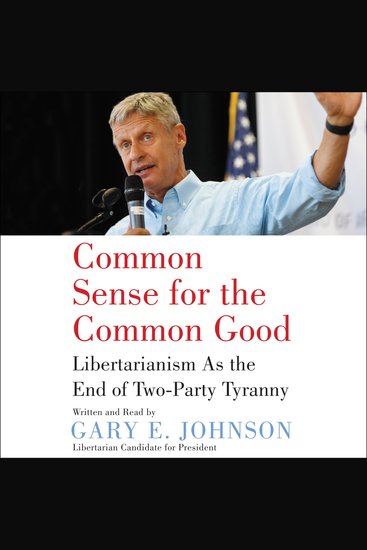
    With the contentious 2016 U.S. presidential election cycle spinning into its final phases, only one thing seems clear: the American people are less than satisfied with the two major political parties’ candidates.  
    Gary Johnson, Libertarian Party candidate for president and former two-term Republican governor of New Mexico, stakes his claim to the very center of the political spectrum. His new audiobook Common Sense for the Common Good offers his approach to how a member of a third party, acting as the Chief Arbiter of the U.S., can restore sanity and functionality to the highest office in the land. 
    Johnson succinctly shares his views on how the two-party system is dysfunctional. How its binary approach to issues doesn’t reflect the multiplicity of viewpoints inherent in our contemporary society. How the nasty divisiveness that rules public and private discourse is endemic to this flawed and outdated system.  
    He offers his alternative to the dualistic electoral process—and why he believes the on/off, black/white, I’m right/you’re wrong thinking—cripples our minds and grinds government to a halt.  
    He takes on the challenge of explaining Libertarianism as a philosophy that espouses:Freedom of choiceLimited government intrusion into our personal livesFree market capitalismEqualizing opportunity for all 
    This audiobook sets the stage for Johnson’s forthcoming book, which is part memoir and part manifesto. Here, Gary Johnson describes his own personal and political evolution. He firmly believes that, if the rigged electoral polling and debate processes were fair, the vast majority of Americans would come to understand that their beliefs and values are best represented by the Libertarian Party.
    Ver libro
  • The Roman Empire and Byzantine Empire - The History and Legacy of Europe’s Most Important Empire and Its Successor - cover

    The Roman Empire and Byzantine...

    Charles River Editors

    • 0
    • 0
    • 0
    For the people of the ancient Mediterranean and beyond, the city of Rome had been a symbol of power for centuries, and entering the early 5th century CE, the Eternal City hadn’t been taken by an enemy force since the Gauls had done it about 800 years earlier, an unheard of period of tranquility in a world wracked with almost constant warfare. 
    Thus, when the Visigoths, whom the Romans considered uncultured and inferior, took the city of Rome and sacked it in 410, the world was stunned. It made theologians of the newly Christianized empire question God’s plan on Earth, and it encouraged many leading Romans to look east to Constantinople for their future. Indeed, the Western Roman Empire would completely collapse in the late 5th century, less than 70 years after the Visigoths sacked Rome, and just how it went from being a superpower to a poorly led, weak, and vulnerable shadow of its former self has preoccupied historians for centuries. 
    To this day, it remains difficult to trace just when the decline began, but it’s fair to say that the sack of Rome was the result of a number of factors that had been coalescing for many years. In the end, the fall of the Roman Empire was not a tale of cataclysmic events that shattered the sprawling power, but the culmination of centuries of internal dissent and decay, combined with growing external threats that led to gradual decline and eventually to the empire’s final destruction.  
    In terms of geopolitics, perhaps the most seminal event of the Middle Ages was the successful Ottoman siege of Constantinople in 1453. The city had been an imperial capital as far back as the 4th century, when Constantine the Great shifted the power center of the Roman Empire there, effectively establishing two almost equally powerful halves of antiquity’s greatest empire. Constantinople would continue to serve as the capital of the Byzantine Empire even after the Western half of the Roman Empire collapsed.
    Ver libro