¡Acompáñanos a viajar por el mundo de los libros!
Añadir este libro a la estantería
Grey
Escribe un nuevo comentario Default profile 50px
Grey
Suscríbete para leer el libro completo o lee las primeras páginas gratis.
All characters reduced
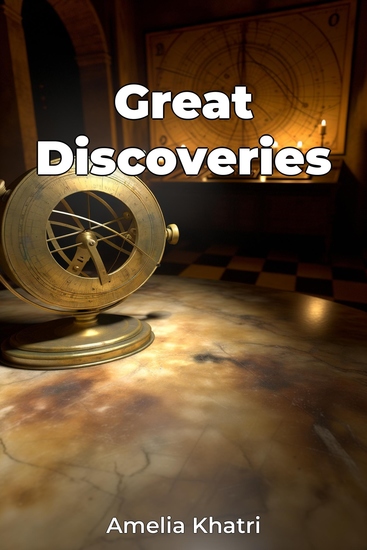
Great Discoveries - cover

Great Discoveries

Amelia Khatri

Editorial: Publifye

  • 0
  • 0
  • 0

Sinopsis

"Great Discoveries" offers a fascinating exploration of humanity's most significant scientific and technological breakthroughs, weaving together the complex tapestry of innovation across civilizations and centuries. The book uniquely demonstrates how discoveries emerge not in isolation, but through intricate networks of knowledge exchange and cultural interactions, from the fundamental tools of Mesopotamia to modern technological advances.Through careful analysis of archaeological evidence and historical records, it reveals how each era of discovery built upon previous achievements, creating a continuous chain of human progress. The narrative skillfully balances chronological progression with thematic organization, examining developments across mathematics, physics, chemistry, biology, and technology.By exploring pivotal periods like the Islamic Golden Age and the Renaissance, the book illuminates how social conditions and cultural exchange fostered innovation. Particularly compelling is its examination of how seemingly unrelated discoveries, such as the microscope's development, catalyzed breakthroughs across multiple scientific disciplines.Breaking from traditional Eurocentric perspectives, the work presents a global view of scientific progress, incorporating discoveries from diverse cultures and continents. The book's accessible approach combines technical accuracy with engaging human stories, making complex concepts understandable while maintaining scholarly rigor.Through detailed case studies and interdisciplinary analysis, readers gain valuable insights into how past innovations continue to influence modern research methods and technological development, making this work particularly relevant for anyone interested in understanding the evolution of human knowledge.
Disponible desde: 05/01/2025.
Longitud de impresión: 97 páginas.


Otros libros que te pueden interesar

  • Java and Data Structures - Code Your Future: A Comprehensive Exploration of Java Programming - cover

    Java and Data Structures - Code...

    Anthony Carter

    • 0
    • 0
    • 0
    For every learner of Java programming and basic data structures, this book is a useful and comprehensive manual to tap into. Both freshers and those who have some coding experience can rely on its methodical structure "Java and Data Structures: Code Your Future: A Comprehensive Exploration of Java Programming."  
    The starting point is the most basic syntax of Java, the programming concept that forms the basis of an understanding. After that, the book introduces OOP, mastering such important topics as polymorphism, inheritance, encapsulation, classes, and objects. 
    Mastering one's proficiency in every concept is done through activities and examples so that readers will easily remember and be able to apply the things learned. In the course of the journey, readers learn more complex subjects such as generics, lambda expressions, Java's Collections Framework, and the very powerful Stream API-all of which make data processing more effective and efficient. 
    The book proceeds further into important data structures that equip learners with skills needed to conquer tough programming problems. These include arrays, linked lists, stacks, queues, and hash tables. Focusing on real applications, "Java and Data Structures" challenges the reader to use real-world applications that support each subject. 
    By the end of this book, readers should have learned how to develop scalable, effective Java code and understand the reasoning behind data manipulation and management. Students, potential developers, and experts can all use this book since it takes an integrated approach on how to be a competent and confident Java programmer.
    Ver libro
  • Minds I've Met - From Denying to Embracing the Inner Lives of Animals - cover

    Minds I've Met - From Denying to...

    Frans de Waal

    • 0
    • 0
    • 0
    New York Times best-selling author and world-renowned primatologist Frans de Waal traces the dramatic changes in humanity’s perception of animals over the past half-century. 
    How humans think about animals―and our place among them―has undergone a seismic change. Breaking old scientific taboos and never shying away from controversial topics, renowned primatologist Frans de Waal was at the forefront of this revolution, fighting against claims of human exceptionalism. From de Waal’s early studies in the Netherlands through his five-decade professional career in the United States, Minds I’ve Met follows this radical shift in how science perceives animals. De Waal’s pioneering work challenged the traditional view of animals as living machines and contributed to a new image of animals as intentional agents with minds of their own, capable of remarkable cognitive feats, demonstrating empathy and self-awareness, showing emotions and consciousness. His final published work, Minds I’ve Met celebrates animals’ awe-inspiring abilities and traces the complete turnaround in one of the fiercest scientific debates of our time, bringing humans ever closer to the rest of the animal world and animals closer to us.
    Ver libro
  • Where the Earth Meets the Sky - A Story of Penguins People and Place in Antarctica - cover

    Where the Earth Meets the Sky -...

    Louise K. Blight

    • 0
    • 0
    • 0
    Antarctica is a land of extremes. But while its hurricane force winds, tooth-breaking cold, and resident penguins have long been iconic, the perspective of a practicing female scientist is all but absent from modern day Antarctic accounts. Where the Earth Meets the Sky fills that gap.Louise and her campmate David Ainley—one of the greatest Antarctic scientists on the planet—live in a world defined by hostile weather, breathtaking beauty, a continuous parade of avian visitors, and an occasional human visitor. There she explores the lingering grief that has followed the untimely death of her sister, and presents penguins as a window into how climate change and other environmental impacts are altering what has been one of the most untouched corners of the globe.While penguins and the awe-inspiring landscapes they inhabit provide the thread that runs through this story, a central theme is how the world's most unforgiving environment has shaped the psyches of Antarctica’s human visitors, past and present.Experiencing the Antarctic wildernesses has the potential to heal the human psyche and, perhaps, to give us the optimism to reimagine our relationship with the natural world.
    Ver libro
  • Thinking Small and Large - How Microbes Made and Can Save Our World - cover

    Thinking Small and Large - How...

    Peter Forbes

    • 0
    • 0
    • 1
    The environmental crisis will not be solved by battery technology. We are looking for answers in the wrong places.


    Life began with the hydrogenation of CO2, and this is the process we must return to in order to heal the planet. Ground-breaking ongoing research into bacterial processes means our knowledge of bacterial processes is ever-expanding, and we can harness this new knowledge to develop a parallel carbon economy using engineered bacteria for fuel, food, and materials. This would enable rewilding on a vast scale, with the small land footprint of bacterial technologies solving the current conflict in land use between farming and fuel and materials production.


    In this fascinating and illuminating book, Peter Forbes shines a light on this crucial technology and offers a tantalising glimpse at what is possible. To solve the big problems, sometimes you have to think small.
    Ver libro
  • Battlefields of The Future: The Evolution of the Technology of War 2025-2125 - cover

    Battlefields of The Future: The...

    Dr. Nick Coman, I. A.I.

    • 0
    • 0
    • 0
    A 36‑lecture audio course on how wars are actually fought in the machine age—from seabed cables and city power grids to low‑Earth orbit, cislunar space, and the neural loop between a human and a weapon. We break the kill chain open: sensing and space‑based cueing; edge compute and target fusion; communications that survive jamming; and the things that do damage—mines, missiles, loitering munitions, directed energy, electromagnetic pulse, and code. 
    We make the stack legible for operators and serious thinkers alike: synthetic aperture radar becomes SAR; high‑altitude long endurance becomes HALE; link budgets and laser crosslinks stop being magic and start being math you can reason about in words. You will see how orbital “stalkers” shadow satellites, why stratospheric platforms matter when air defenses make manned ISR bleed, how decoys and digital camouflage fracture an adversary’s picture, and where the automation boundary really sits when AI runs parts of the kill web with a human on the loop. 
    Engineering reality, not brochure fog, sets the pace. We trace power budgets, attrition math, and reconstitution timelines; map chokepoints in chips, propellants, optics, batteries, and shipyards; and follow sanctions, export controls, and standards as operational constraints, not afterthoughts. 
    The glidepath is explicit. 2025 to 2035: proliferated space, cheap autonomy, hard lessons from electronic warfare. 2035 to 2050: directed‑energy baselines, resilient meshes, smarter decoys. 2050 to 2075 and beyond: cislunar logistics with teeth, human performance management that is governed not ghoulish, brain–computer interfaces that shorten loops without erasing judgment. 
    Rigorous, unsentimental, and built for the intellectually ambitious, this course is an operator’s guide to modern combat systems—how they are built, how they break, and how they win.
    Ver libro
  • Data Governance Guide - Frameworks Strategies and Best Practices - cover

    Data Governance Guide -...

    Vincent Berry

    • 0
    • 0
    • 0
    In the digital era, data is a pivotal asset, but harnessing its power responsibly and effectively demands robust data governance. "Data Governance Guide: Frameworks, Strategies, and Best Practices" is an essential resource for anyone looking to deepen their understanding and implementation of data governance within their organization. 
    This book offers a detailed exploration of data governance, starting with its definition, significance, and the benefits it brings to an organization. It walks readers through the core components of data governance including data quality, security, privacy, and lifecycle management, providing a solid foundation for deeper strategic insight. 
    Delve into various data governance frameworks such as DAMA-DMBOK, COBIT, and ISO/IEC 38500, and learn how to select and tailor the right framework to meet your organizational needs. Practical advice on setting up a data governance program is presented in a step-by-step format, covering everything from initial assessment to the deployment of tools and technologies that enhance data governance practices. 
    With a focus on real-world applications, this guide addresses strategies, best practices, and challenges across various industries including finance, healthcare, and retail, offering numerous case studies and examples that demonstrate effective data governance in action. 
    "Data Governance Guide: Frameworks, Strategies, and Best Practices" provides the insights and tools necessary to establish, manage, and evolve a data governance program that aligns with and drives your business objectives, ensuring that your organization's data is a secure, well-managed asset that contributes to sustained growth and success.
    Ver libro