Join us on a literary world trip!
Add this book to bookshelf
Grey
Write a new comment Default profile 50px
Grey
Subscribe to read the full book or read the first pages for free!
All characters reduced
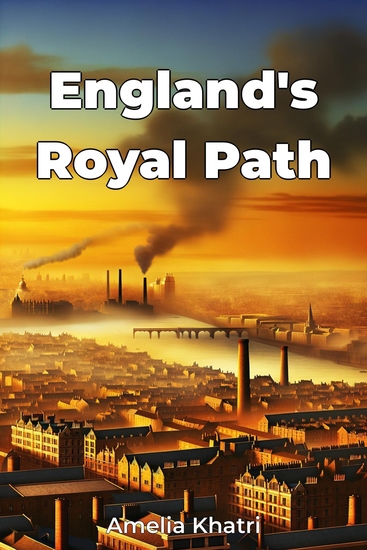
England's Royal Path - cover

England's Royal Path

Amelia Khatri

Publisher: Publifye

  • 0
  • 0
  • 0

Summary

"England's Royal Path" presents a compelling exploration of how Britain evolved from a modest island nation into a global powerhouse, focusing on the intricate interplay between monarchy, industrialization, and empire building. The narrative skillfully weaves together three transformative forces: the development of constitutional monarchy, the revolutionary impact of industrialization, and the far-reaching consequences of colonial expansion. Through careful examination of primary sources, from diplomatic correspondence to economic records, the book illuminates how these interconnected developments created lasting templates for modern governance and global trade.

 
The book's chronological journey begins with the Norman Conquest of 1066, tracking the evolution of absolute monarchy into a parliamentary system through pivotal moments like the Magna Carta and the Glorious Revolution. The central section delves into Britain's industrial revolution, explaining how the nation's unique combination of political stability, natural resources, and maritime trade sparked unprecedented technological advancement. The final portion examines how these domestic transformations fueled colonial expansion, spreading British institutional models and industrial practices across the globe.

 
What sets this work apart is its comprehensive approach to connecting historical developments with contemporary relevance. Rather than presenting simplified narratives, it offers nuanced analysis of how British innovations in governance and industry shaped modern environmental challenges, international law, and global political structures. The book maintains scholarly rigor while remaining accessible to both general readers and academics, making it an invaluable resource for understanding the origins of modern political systems and global trade networks.
Available since: 01/08/2025.
Print length: 97 pages.

Other books that might interest you

  • The Children We Left Behind - How Western Culture Rationalizes Family Separation & Ignores The Pain Of Child Neglect - cover

    The Children We Left Behind -...

    Adam B. Coleman

    • 0
    • 0
    • 0
    Nearly every major social problem in the West can be traced back to our declining appreciation for the nuclear family structure and our failure to plan for families properly. Our culture has shifted from prioritizing sacrifice for the benefit of innocent children to catering to the fleeting desires of the adults who bring them into the world. 
    As a result, family separation has become commonplace, and what we consider normal is often rationalized, even when it harms our children. The culture of radical individualism among adults has left children to bear the consequences of their parents' choices. 
    I was once that child who was left behind, neglected by his father, and witnessed his mother shoulder the load for our survival. My father's choice to abandon me physically and emotionally contributed to my decades of struggle with depression, low self-esteem, and suicidal ideation. 
    Unfortunately, my experience of homelessness, mental hospital incarceration, and perpetual internal strife is no longer rare. However, our stories are often ignored, and we avoid holding accountable the parents who have failed us. 
    If we are to change our culture's trajectory, we must sacrifice our pride and prioritize the needs of our children over our own selfish desires. Our children must come first, or they will come last-there is no middle ground.
    Show book
  • Social Media in the Classroom - Tools and Techniques that any teacher can use effectively 30-Minute Interview with Rick Sheridan - cover

    Social Media in the Classroom -...

    Dr. Rick Sheridan

    • 0
    • 0
    • 0
    In this 30-minute interview, Dr. Rick Sheridan - a longtime university professor and author of the book - Social Media in the Classroom, helps teachers understand why using social media in the classroom is so important, and the effective ways to use it. 
    Topics include: 
    Why is social media use in the classroom so valuable for both teachers and students?Ways to promote cultural understanding.Developing an online portfolio.What can students and teachers do to protect their privacy online?Learn about some of Google's many features besides the search engine.Getting shy students to participate.How to evaluate students on their social media experiences, and much more. 
    Dr. Rick Sheridan is a professor of Mass Media Communications at Wilberforce University in Ohio. Dr. Sheridan has also taught at California State University - Sacramento and Butte College. He has a master's degree in Media Arts, and has received awards for both his teaching and his web design. 
    ©2014 Dr. Rick Sheridan (P)2014 Dr. Rick Sheridan
    Show book
  • The Legacy of Akhenaten - The Heretic Pharaoh and His Revolution - cover

    The Legacy of Akhenaten - The...

    Omar Khalil

    • 0
    • 0
    • 0
    Akhenaten, originally named Amenhotep IV, emerged as one of ancient Egypt’s most enigmatic and controversial pharaohs. His rise to power marked the beginning of a transformative period in Egyptian history, characterized by significant religious, cultural, and political changes. Born into the illustrious 18th Dynasty, Akhenaten was the son of Amenhotep III and Queen Tiye. As a young prince, he was not initially destined for the throne, but circumstances eventually positioned him as the successor. 
    Upon ascending to the throne, Akhenaten quickly distinguished himself from his predecessors. Unlike his father, whose reign was marked by prosperity and relative stability, Akhenaten pursued a path that would challenge long-established traditions. Initially, he ruled under the name Amenhotep IV, signifying continuity with the Amun-centric religious practices. However, early in his reign, he began to favor the worship of Aten, the sun disk, over the traditional pantheon. This inclination marked the first signs of his radical departure from convention. 
    One of the most significant acts of his reign was the changing of his name from Amenhotep IV to Akhenaten, which means "Effective for Aten." This change was not merely symbolic but an open declaration of his devotion to Aten, marking a clear break from the established worship of Amun and other deities. By adopting this new identity, Akhenaten positioned himself as the earthly representative of the sun disk, consolidating both religious and political authority in his hands.
    Show book
  • How Reason Can Lead to God - A Philosopher's Bridge to Faith - cover

    How Reason Can Lead to God - A...

    Joshua Rasmussen

    • 0
    • 0
    • 0
    Do you seek the truth? 


    Do you value reason, science, and independent thinking? Are you skeptical of beliefs that people maintain merely "on faith," yet you remain interested in the big questions of life? Do you hope there could be a greater purpose to the universe, if only that were realistic? 


    If so, then philosopher Joshua Rasmussen can encourage you in your journey. Beginning with his own story of losing faith and the belief in any ultimate purpose in life, he then builds a bridge to a series of universal truths about ultimate reality. Using only the instruments of reason and common experience, Rasmussen constructs a pathway—step by step, brick by brick—that he argues can lead to meaning and, ultimately, a vision of God.
    Show book
  • 100 Amazing Facts about China - Secrets and Mysteries of the Middle Kingdom - cover

    100 Amazing Facts about China -...

    Marc Dresgui

    • 0
    • 0
    • 0
    Discover China like you've never seen it before through 100 amazing facts! 🇨🇳 
    Have you ever wondered:What is the largest desert in China, and why is it called "the desert of death"?Where is the highest volcanic lake in the world, and how did it form?How do Asian elephants survive in the subtropical forest of Xishuangbanna?Which region in China produces more than 80 billion pairs of chopsticks each year?Why do the dunes of the Gobi Desert seem to "sing" in the wind?How does the Dujiangyan dam, over 2,000 years old, still function today? 
    Why this book is perfect for your children:Educational and enriching content: This book is designed to spark curiosity and stimulate learning. Each fact is accurate and accompanied by clear explanations, perfect for young readers.An educational journey through time and space: From the ancient Silk Road to modern megacities like Shanghai, this book explores all aspects of China, offering a comprehensive view of this fascinating country.A format tailored for curious young minds: Each fact is presented in short paragraphs, making the reading experience smooth and engaging for young readers without overwhelming them with too much technical detail.Perfect for school projects and homework: This book is an excellent resource for deepening knowledge about China, whether for a class presentation, a school project, or simply to satisfy personal curiosity.A book that raises environmental awareness: Many facts highlight issues related to the preservation of nature and endangered species, such as giant pandas and sea turtles. 
    Give your child the chance to travel through the wonders of China while nurturing their curiosity and love for knowledge.
    Show book
  • The Copenhagen Papers - An Intrigue - cover

    The Copenhagen Papers - An Intrigue

    David Burke, Michael Frayn

    • 0
    • 0
    • 0
    In a brilliant coda to the play Copenhagen, Michael Frayn receives mysterious letters that take him back to the theme of his bestselling novel, Headlong -- human folly, this time his own.Michael Frayn's Copenhagen has established itself as one of the finest pieces of drama to grace the stage in recent years. The subject of the Tony-winning play is the strange visit the German nuclear physicist Werner Heisenberg made to his former mentor, scientist Niels Bohr, in Nazi-occupied Copenhagen and the quarrel that ensued. Heisenberg's intentions on that visit, for good or for evil, have long intrigued and baffled historians and scientists. One day, during the British run of Copenhagen, Frayn received a curious package from a suburban housewife, which contained a few faded pages of barely legible German writings. These pages, which she claimed to have found concealed beneath her floorboards, seemed to cast a remarkable new light on the mystery at the heart of play. As more material emerged -- specifically notes that appeared to give instructions on how to put up a table-tennis table but perhaps containing important encoded information -- actor David Burke, who was playing Niels Bohr, began to display extreme, even suspicious interest in Frayn's growing obsession with cracking the riddle of the papers. And Frayn, for his part, lost all sense of certainty. Was he the victim of an elaborate hoax? By turns comic and profound, The Copenhagen Papers explores the conundrum that is always at the heart of Frayn's work -- human gullibility and the eternal difficulty of knowing why we do what we do.
    Show book