Join us on a literary world trip!
Add this book to bookshelf
Grey
Write a new comment Default profile 50px
Grey
Subscribe to read the full book or read the first pages for free!
All characters reduced
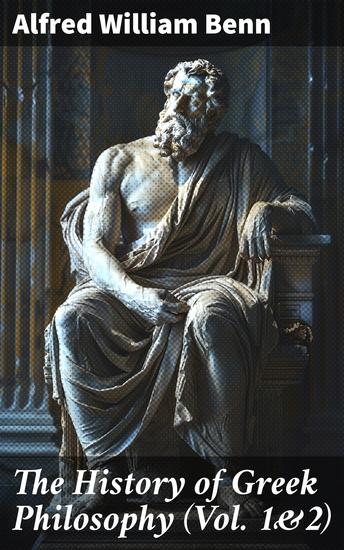
The History of Greek Philosophy (Vol 1&2) - Exploring the Roots of Western Thought: Ancient Greek Philosophy Unveiled - cover

The History of Greek Philosophy (Vol 1&2) - Exploring the Roots of Western Thought: Ancient Greek Philosophy Unveiled

Alfred William Benn

Publisher: Good Press

  • 0
  • 0
  • 0

Summary

Alfred William Benn's "The History of Greek Philosophy" (Volumes 1 & 2) offers a comprehensive and critical examination of the evolution of philosophical thought in ancient Greece. Structured thematically rather than chronologically, Benn meticulously explores the contributions of pre-Socratic thinkers, Socrates, and the later philosophical schools. His prose is both eloquent and precise, blending rigorous scholarship with an accessible narrative style that invites readers into the complex world of Greek intellectual culture. The work contextualizes philosophy within the broader tapestry of Greek history, art, and science, making it a vital resource for understanding how these interconnected domains influenced one another. Alfred William Benn was a profound thinker himself and a notable figure in late 19th and early 20th-century philosophy. His background as a scholar of both philosophy and history deeply informed his writing. Benn's desire to trace the origins and development of philosophical thought stems from a commitment to elucidating the profound impact of ancient Greek ideas on modern intellectual discourse, reflecting his belief in the relevance of philosophy to contemporary issues. This two-volume work is highly recommended for anyone seeking a deeper understanding of the foundations of Western thought. Scholars, students, and general readers alike will find Benn'Äôs insights enriching, as he not only documents the historical figures and texts but also engages with the philosophical questions that continue to resonate today.
Available since: 11/19/2023.
Print length: 865 pages.

Other books that might interest you

  • A History of the Warfare of Science with Theology in Christendom - cover

    A History of the Warfare of...

    Andrew Dickson White

    • 0
    • 0
    • 0
    This recording has been digitally produced by DeepZen Limited, using a synthesized version of an audiobook narrator’s voice under license. DeepZen uses Emotive Speech Technology to create digital narrations that offer a similar listening experience to human narration.  
     
    "A History of the Warfare of Science with Theology in Christendom" by Andrew Dickson White is a seminal two-volume work that delves into the prolonged struggle between science and religious orthodoxy throughout Western history. White, co-founder and first president of Cornell University, provides a comprehensive account of how religious dogma frequently stood in opposition to scientific advancements, from the age of Galileo to Darwinian evolution. He posits that this clash hindered intellectual progress and societal development, but also acknowledges the instances where religion fostered the growth of scientific understanding. Through detailed historical analysis, White underscores the necessity of maintaining a clear separation between theological beliefs and empirical investigation for the unhindered progress of knowledge.
    Show book
  • Carrie by Stephen King (Book Analysis) - Detailed Summary Analysis and Reading Guide - cover

    Carrie by Stephen King (Book...

    Bright Summaries

    • 0
    • 0
    • 0
    Unlock the more straightforward side of Carrie with this concise and insightful summary and analysis!This engaging summary presents an analysis of Carrie by Stephen King, a cult horror novel about a young girl who is bullied and isolated by her peers, while also being psychologically abused and neglected by her mother. However, Carrie also has a secret: she has powerful telekinetic powers, and when her tormentors take one of their pranks too far, she uses it to unleash a storm of revenge against them – and the entire town. Stephen King is often referred to as the 'King of Horror' thanks to the popularity of his novels and their influence on the genre as a whole, although his work also spans a range of other genres.Find out everything you need to know about Carrie in a fraction of the time!This in-depth and informative reading guide brings you:• A complete plot summary• Character studies• Key themes and symbols• Questions for further reflectionWhy choose BrightSummaries.com?Available in print and digital format, our publications are designed to accompany you on your reading journey. The clear and concise style makes for easy understanding, providing the perfect opportunity to improve your literary knowledge in no time.See the very best of literature in a whole new light with BrightSummaries.com!
    Show book
  • Her First College Party - FFM - cover

    Her First College Party - FFM

    Rainbow Press

    • 0
    • 0
    • 0
    When it’s your first time, may as well go all in. 
      
    For Becky and Laura, it only took one night of sharing a college dorm. The habit of sleeping in the buff proves too tempting, and Becky is treated to her very first climax via the talented lips of her new roommate. 
      
    But a little feminine playing around doesn’t mean that women are the only thing they want. 
      
    A new opportunity comes in the form of an invitation to a notoriously kinky frat party. 
      
    What began as a simple retelling of Becky and Laura’s first time together turns into a full-on reenactment — with spectator involvement. 
      
    Will Becky allow her innocence to be taken as everyone watches?
    Show book
  • Fighting After the War: A History of the Most Famous American Battles that Took Place after the Wars Had Ended - cover

    Fighting After the War: A...

    Editors Charles River

    • 0
    • 0
    • 0
    There are countless examples of battles that take place in wars after a peace treaty is signed. The last battle of the Civil War was a skirmish in Texas that Confederate forces won, nearly a month after Lee’s surrender at Appomattox. As fate would have it, the last fighting of the Civil War took place two days after Confederate President Jefferson Davis had been captured in Georgia 
    It’s certainly rare for the most famous battle of a war to take place after the peace treaty is signed, but luckily for Andrew Jackson, the War of 1812 was that unique exception. Less than a year after his victory in the Battle of Horseshoe Creek, Jackson led his forces into a more important battle at the Battle of New Orleans. The British hoped to grab as much of the land on the western frontier as they could, especially New Orleans, which had a prominent position on the Mississippi River for trading. With more than 8,000 soldiers aboard a British fleet sailing in from Jamaica in early January 1815, the attack on New Orleans promised to be a significant one, while Jackson’s men defended New Orleans with about half that number. This went on despite the fact that the two sides had signed the Treaty of Ghent on Christmas Eve 1814, which was supposed to end the war.  
    Despite the fact the French & Indian War had recently concluded, Pontiac led the first major attack of Pontiac’s War in May 1763, when he and 300 of his men attacked Fort Detroit in what is now the city by the same name. Unfortunately for his cause, Pontiac failed to gauge just how strong the British presence there was, and his attack was quickly repelled. On the other hand, he was not a man who gave up easily, so instead of retreating, he and his warriors would lay siege to the British stronghold. In the days that followed, word spread of his efforts, and in short order nearly 1,000 men from various tribes in the area had joined him.
    Show book
  • The Egyptian Book of the Dead - Texts and Interpretations - cover

    The Egyptian Book of the Dead -...

    Omar Khalil

    • 0
    • 0
    • 0
    The Egyptian Book of the Dead is one of the most significant and enigmatic works of ancient Egyptian literature. It is a collection of funerary texts that were intended to guide the soul of the deceased through the afterlife. The texts were not a single work but rather a compilation of spells, hymns, and prayers, which were tailored to ensure a safe passage to the afterlife and to grant protection in the realm of the dead. The Book of the Dead, also known as the "Book of Going Forth by Day," was typically inscribed on papyrus and placed in the tombs of the deceased, often alongside various amulets and offerings to aid the soul's journey. 
    The origins of the Book of the Dead can be traced back to the Pyramid Texts and Coffin Texts of the Old Kingdom, which were intended for royal burials. Over time, these texts evolved into the more accessible and expansive collection found in the New Kingdom, where it was available for individuals from all social classes. The Book of the Dead represents an essential aspect of ancient Egyptian religion, providing a vivid description of the journey the soul would undergo after death. It was believed that through the proper recitation and understanding of these texts, the deceased could navigate the trials of the underworld, known as Duat, and ultimately reach the afterlife in the presence of the gods. 
    The role of the Book of the Dead in Egyptian religion was deeply intertwined with the belief in Ma’at, the concept of divine order, truth, and justice. The texts emphasized the importance of the deceased’s heart being weighed in the Hall of Ma’at, where it would be measured against the feather of Ma’at to determine whether the soul was worthy of entering the eternal paradise. This idea of judgment after death is a central theme throughout the Book of the Dead and reflects the profound importance of moral conduct and the balance of cosmic forces in Egyptian thought.
    Show book
  • Violence and the Sacred - cover

    Violence and the Sacred

    René Girard

    • 0
    • 0
    • 0
    Violence and the Sacred is René Girard's landmark study of human evil. Here Girard explores violence as it is represented and occurs throughout history, literature, and myth. Girard's forceful and thought-provoking analyses of Biblical narrative, Greek tragedy, and the lynchings and pogroms propagated by contemporary states illustrate his central argument that violence belongs to everyone and is at the heart of the sacred.
    Show book