¡Acompáñanos a viajar por el mundo de los libros!
Añadir este libro a la estantería
Grey
Escribe un nuevo comentario Default profile 50px
Grey
Suscríbete para leer el libro completo o lee las primeras páginas gratis.
All characters reduced
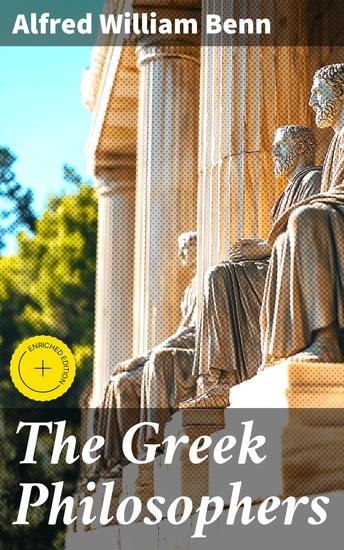
The Greek Philosophers - Complete Edition - cover

The Greek Philosophers - Complete Edition

Alfred William Benn

Editorial: Good Press

  • 0
  • 0
  • 0

Sinopsis

In "The Greek Philosophers," Alfred William Benn embarks on an exhaustive exploration of ancient thought, analyzing the contributions of key figures such as Socrates, Plato, and Aristotle within their historical context. Benn's literary style is characterized by its clarity and precision, reflecting his deep engagement with philosophical texts and their implications for contemporary discourse. He navigates the complexities of early philosophical inquiry with careful scholarship, highlighting not only the ideas themselves but also the socio-political climates that shaped their emergence. This thorough examination situates Greek philosophy as a foundational pillar of Western civilization, revealing the intricate interplay between thought and society. Benn, a noted English philosopher and historian of philosophy, was deeply influenced by the intellectual currents of the late 19th and early 20th centuries. His academic background and commitment to elucidating the nuances of philosophical developments led him to address the often overlooked richness of Greek philosophy. Benn's extensive knowledge of historical contexts allows readers to appreciate the profound impact these thinkers had, and how their inquiries resonate through the ages into modern philosophical debates. For anyone interested in philosophy's roots, "The Greek Philosophers" is an essential read that offers a compelling synthesis of historical scholarship and literary deftness. Benn's work invites readers to engage with the foundational ideas that have shaped not only philosophy but also the broader scope of human thought. This book is a valuable resource for students, scholars, and enthusiasts of philosophy alike.
Disponible desde: 17/12/2023.
Longitud de impresión: 788 páginas.

Otros libros que te pueden interesar

  • How much do you know about geography - cover

    How much do you know about...

    Onofre Quezada

    • 0
    • 0
    • 0
    This audiobook is narrated by an AI Voice.   
    🌍 How Much Do You Know About Geography is an invitation to test your knowledge of the world around us. Through questions, trivia, and surprising facts, this book will take you on a journey through continents, countries, cities, rivers, mountains, and natural phenomena that are part of our planet. 
    Whether you love maps, enjoy intellectual challenges, or want to learn in a fun way, you'll find an entertaining and educational journey here. Discover little-known facts, expand your general knowledge, and challenge your friends to see who knows the most about geography. 
    📖 Perfect for students, travelers, or just curious people, this book is a dynamic way to explore the world without leaving home.
    Ver libro
  • Voices - Inside the mind of someone who hears voices - cover

    Voices - Inside the mind of...

    Nic Richelle

    • 0
    • 0
    • 0
    This is an interactive book where the the main character engages with the reader. The reader will get a glimpse into the mind of someone who is not in full control of their reality because they hear voices. One of those voices are YOU! The main character, Dee out of Lakecity, Fl, will take you on a mission to kill her ex lover.
    Ver libro
  • Foundations of Our Democracy: The Documents that Made America - The Declaration of Independence The US Constitution The Federalist Papers and The US Bill of Rights - cover

    Foundations of Our Democracy:...

    Various Authors

    • 0
    • 0
    • 0
    In 1776, the United States of America was born from a document that declared all men created equal and free to choose who they serve in this world. What followed was a difficult fight against a monarchy, a fight that ended with the creation of a powerful country built on the tenets of freedom and equality. These documents are some of the foundational writings from the earliest days of the country that have shaped the United States government for centuries:The Declaration of Independence – This was the formal decree that the 13 colonies wished to separate from the rule of England. This essay declares that the rulership of England had been unjust and did not give the people living in America proper representation in the government, and declared independence from the King of Great Britain.The Constitution – The Constitution of the United States was adopted as the supreme law of the country in 1789. This document, along with its amendments, is the instruction manual for running the United States’ democracy, from outlining the three branches of government to enacting a protocol for succession of power. The Federalist Papers – The Federalist Papers were a series of articles written by Alexander Hamilton, John Jay, and James Madison. The essays present the reasoning and logic behind each article of the Constitution, and were written to garner congressional support for its ratification. Today, they are used to assist in interpreting the intentions of the original supporters of the Constitution.The Bill of Rights – The Bill of Rights is the set of the first 10 amendments added to the Constitution. These amendments outline inalienable and natural rights for individuals, as well as stating that states have the power to create their own laws for matters not addressed in the Constitution.
    Ver libro
  • Misfire - The Sarajevo Assassination and the Winding Road to World War I - cover

    Misfire - The Sarajevo...

    Paul Miller-Melamed

    • 0
    • 0
    • 0
    The story has so often been told: Archduke Franz Ferdinand, heir to the throne of the Habsburg Empire, was shot dead on June 28, 1914, in the Bosnian capital of Sarajevo. Thirty days later, the Archduke's uncle, Emperor Franz Joseph, declared war on the Kingdom of Serbia, producing the chain reaction of European powers entering the First World War. 


    In Misfire, Paul Miller-Melamed narrates the history of the Sarajevo assassination and the origins of World War I from the perspective of the Balkans. Miller-Melamed embeds the incident in the longer-term conditions of the Balkans that gave rise to the political murder. He thus illuminates the centrality of the Bosnian Crisis and the Balkan Wars of the early twentieth century to European power politics, while explaining how Serbs, Bosnians, and Habsburg leaders negotiated their positions in a dangerous geopolitical environment. Despite the absence of evidence tying official Serbia to the assassination conspiracy, Miller-Melamed shows how it spiraled into a diplomatic crisis that European statesmen proved unable to resolve peacefully. 


    Contrasting the vast disproportionality between a single deadly act and an act of war that would leave ten million dead, Misfire contends that the real causes for the world war lie in "civilized" Europe rather than the endlessly discussed political murder.
    Ver libro
  • France in the Early Middle Ages: The History of the Dynasties that Brought about the Kingdom of France - cover

    France in the Early Middle Ages:...

    Charles River Editors

    • 0
    • 0
    • 0
    The birth of Europe as people know it today was hardly an easy and effortless process. The end of antiquity was shaped by centuries of continuous wars, raids, and the falls and rises of empires. The most turbulent of these events happened at the beginning of the Middle Ages, from the 3rd-7th centuries CE. This was the time when the old slave society gave way to the feudal system that marked the latter Middle Ages, and it was also a period of battles between the Roman Empire and various barbarian peoples. The Roman Emperors waged wars, made and broke alliances, and bribed and negotiated with chieftains of various “barbarian” tribes to preserve the territorial integrity of their Empires. 
    After Julius Caesar conquered Gaul in the mid-1st century BCE, Augustus and his successors eventually began a program of Romanization that, in a remarkably short period of time, transformed Gaul into four provinces. All of these locales added enormously to the Roman Empire in terms of manpower, material goods and wealth. Even today, historians are amazed at how such a large population that was not without its own systems of administration and vibrant culture and tradition could so easily succumb to Rome’s pacification process, and to such an extent that, within short periods of time, the indigenous language and traditions of the Celtic peoples of Gaul were totally supplanted. The reasons why Rome was able to subjugate and then transform what was for that time an immense population of over 10 million people lie not only in its military superiority but its system of organization and its conscious program of Romanization.  
    	Ironically, even as Rome’s control over Gaul kept modern France fragmented, the medieval dynasties that sprouted up in the area looked up to the Romans as their predecessors, and in essence they would attempt to recreate the Roman Empire.
    Ver libro
  • Voices for the Future - 20 Years of the Trilogue Salzburg - cover

    Voices for the Future - 20 Years...

    Wolfgang Schüssel, Liz Mohn

    • 0
    • 0
    • 0
    How can culture, politics and business work together to meet the challenges of the future? Will united Europe fall victim to individual national interests? Is the economy the silver bullet when it comes to solving global challenges? Can policy makers still lead in an age of fake news and escalating expectations? What kind of support is needed – and from which culture – to shape a sustainable society?
    The book Voices for the Future documents the lively exchange between international thought leaders from the cultural, economic and political spheres on solutions to current and coming problems. Since 2002, they have been gathering at the Trilogue Salzburg to take a shared look at what the future holds. Where has the Trilogue been farsighted in terms of the issues that now dominate the policy agenda and our everyday lives? What must (still) happen if we are to respond effectively to future challenges? Voices for the Future essays answers to these questions, addressing the topics of Europe, the labor market, leadership, education and values.
    Ver libro