Junte-se a nós em uma viagem ao mundo dos livros!
Adicionar este livro à prateleira
Grey
Deixe um novo comentário Default profile 50px
Grey
Assine para ler o livro completo ou leia as primeiras páginas de graça!
All characters reduced
Demystifying Cryptography with OpenSSL 30 - Discover the best techniques to enhance your network security with OpenSSL 30 - cover
LER

Demystifying Cryptography with OpenSSL 30 - Discover the best techniques to enhance your network security with OpenSSL 30

Alexei Khlebnikov

Editora: Packt Publishing

  • 0
  • 0
  • 0

Sinopse

Security and networking are essential features of software today. The modern internet is full of worms, Trojan horses, men-in-the-middle, and other threats. This is why maintaining security is more important than ever.
OpenSSL is one of the most widely used and essential open source projects on the internet for this purpose. If you are a software developer, system administrator, network security engineer, or DevOps specialist, you’ve probably stumbled upon this toolset in the past – but how do you make the most out of it? With the help of this book, you will learn the most important features of OpenSSL, and gain insight into its full potential.
This book contains step-by-step explanations of essential cryptography and network security concepts, as well as practical examples illustrating the usage of those concepts. You’ll start by learning the basics, such as how to perform symmetric encryption and calculate message digests. Next, you will discover more about cryptography: MAC and HMAC, public and private keys, and digital signatures. As you progress, you will explore best practices for using X.509 certificates, public key infrastructure, and TLS connections.
By the end of this book, you’ll be able to use the most popular features of OpenSSL, allowing you to implement cryptography and TLS in your applications and network infrastructure.
Disponível desde: 26/10/2022.
Comprimento de impressão: 342 páginas.

Outros livros que poderiam interessá-lo

  • A New Capitalism - Creating A Just Economy That Works for All - cover

    A New Capitalism - Creating A...

    Frank Altman

    • 0
    • 0
    • 0
    Invest With Social Responsibility, It Can Be A Tool For GoodIn 1977, two years after I graduated from Brown University, college students around the country launched a movement against Apartheid. Their campaign focused on divestment: convincingAmerican corporations to sell shares of companies doing business with South Africa's Apartheid government. The foundation of their argument was moral and straightforward, that no one should profit from a system that brutally oppresses people. By the mid-1980s, the divestment campaign became made pariahs of the companies still willing to transact with the Apartheid regime. Reflecting on the movement, in 2010 Archbishop Desmond Tutu wrote, “We could not have achieved our freedom and just peace without the help of people around the world, who through the use of non-violent means, such as boycotts and divestment, encouraged their governments and other corporate actors to reverse decades-long support for the Apartheid regime.”Socially responsible investing is rooted in the recognition that money, because it holds power in people’s imaginations, can be a tool for accomplishing good.
    Ver livro
  • Data Mesh - A Comprehensive Guide to Decentralized Data Architecture - cover

    Data Mesh - A Comprehensive...

    Vincent Berry

    • 0
    • 0
    • 0
    In "Data Mesh: A Comprehensive Guide to Decentralized Data Architecture," readers are introduced to a transformative approach to data management that challenges conventional centralized systems. This essential guide delves into the principles and practices of Data Mesh, advocating for a paradigm shift towards a domain-oriented, decentralized data architecture. This book is meticulously designed for data architects, CTOs, data engineers, and any professionals involved in data-intensive industries who seek to overcome the limitations of traditional data management and unlock greater flexibility and scalability. 
    The guide starts with a thorough introduction to the core concepts of Data Mesh, including its four foundational pillars: domain-oriented decentralization of data ownership, data as a product, self-serve data infrastructure, and computational governance. Each section not only explains the theoretical aspects but also illustrates practical implementations through case studies and real-world scenarios, providing readers with a clear pathway to adopting Data Mesh in their organizations. 
    Further chapters are dedicated to the technical implementations of Data Mesh, detailing the technological stack and strategies required to support a scalable and efficient decentralized data architecture. The book also addresses common challenges and pitfalls, offering expert advice on navigating cultural shifts, integrating legacy systems, and maintaining data interoperability. 
    "Data Mesh: A Comprehensive Guide to Decentralized Data Architecture" also explores the future prospects of Data Mesh, including its role in leveraging artificial intelligence and machine learning within a decentralized framework. It outlines how Data Mesh can drive innovation, enhance data security, and improve data compliance in a rapidly evolving digital landscape.
    Ver livro
  • The Microscopic World Inside and Around Us - cover

    The Microscopic World Inside and...

    Martin K. Ettington

    • 0
    • 0
    • 0
    We live surrounded by an invisible world which affects our lives in many ways. 
     In this book we will take a journey from barely visible life, to cells, their structures, molecules, atoms, fundamental particles and even smaller. 
     We will explore not just the facts about this small world, but also try to unearth interesting facts to ponder too. 
     For example, what did paranormal investigators believe about the structure of atoms over one hundred years ago? 
     And what particles or forces might be smaller than the standard building block particles we know about today? 
     Also, what are the limitations of the standard model of subatomic particles? 
     There are many things in the microscopic world which you might not expect. 
     The journey from the small to the infinitely small starts here.
    Ver livro
  • The Corporateneur Plan - Your Roadmap From Mid-Career Professional to Entrepreneur - cover

    The Corporateneur Plan - Your...

    Greg Rohl, Ken Rohl, Pamela N....

    • 0
    • 0
    • 0
    The Corporateneur Plan shares stories and teachings from the business journey of Ken Rohl over a lifetime building an extraordinarily successful presence in the “white space” he identified within the luxury home market. Grounded in research and enlivened with personal anecdotes, The Corporateneur Plan is a guidebook for every aspiring entrepreneur to read before cutting the cord from their corporate careers and setting out on their own journey.These are the “rules of the road” that Ken’s son Greg adopted, trademarking his consulting company “The Rohl Model.” Its value proposition is rooted in 40 years of proven processes developed over Ken’s lifetime of learning, teaching, leading, and building relationships—with employees, customers, suppliers, and the myriad of associations that together contributed to his successes. This book is a roadmap for others who, like Ken, Pam, and Greg, stepped out of a corporate career to start a business of their own.
    Ver livro
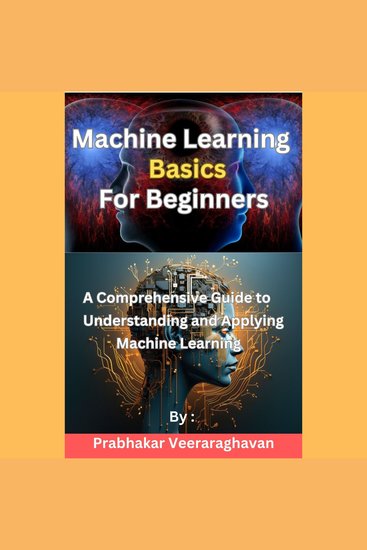
  • Machine Learning Basics for Beginners - A Comprehensive Guide to Understanding and Applying Machine Learning - cover

    Machine Learning Basics for...

    Prabhakar Veeraraghavan

    • 0
    • 0
    • 0
    Do you Want to add 'Machine Learning' skills to your LinkedIn profile? Are you ready to embark on the journey of Machine Learning from Basics? If Yes, then this book is for you! 
    Whether you're a curious novice or a tech enthusiast eager to dive into the realm of artificial intelligence, this book is your key to understanding the fundamental concepts that power the future.   
    This book provides the intricacies of Machine Learning with our 10 meticulously crafted chapters. Begin your journey with a warm welcome in the 'Introduction,' paving the way for a seamless exploration of the foundational principles in 'Foundations of Machine Learning’.  
    Navigate through the crucial terrain of 'Data Preprocessing and Feature Engineering' as you learn the essential techniques to refine and optimize your datasets. Take the leap into 'Building Your First Model,' where you'll witness the magic unfold as you breathe life into your machine learning project. 
    Unlock the power of predictive modeling with 'Supervised Learning Techniques,' and then delve into the mysteries of pattern recognition with 'Unsupervised Learning Techniques.' Our step-by-step approach ensures that even the most complex concepts become clear and accessible.  
    Venture into the future with 'Introduction to Deep Learning,' demystifying the advanced techniques that drive cutting-edge applications, and navigate the ethical dimensions of machine learning. Wrap up your learning journey with a glimpse into 'Future Trends in Machine Learning,' ensuring you stay ahead of the curve in this dynamic and ever-evolving field.
    Ver livro
  • Virology - Tiny Invaders and Their Global Impact - cover

    Virology - Tiny Invaders and...

    Mike Crawford

    • 0
    • 0
    • 0
    Viruses are microscopic entities that exist at the boundary between living and non-living matter. Despite their minuscule size, viruses have a profound impact on all forms of life, from bacteria and plants to humans and animals. They are the most abundant biological entities on Earth, outnumbering bacteria by a factor of ten. Viruses have played a key role in shaping ecosystems, driving evolution, and causing significant diseases in both humans and other organisms. 
    A virus is fundamentally a small particle, or "virion," composed of genetic material (either DNA or RNA) encased in a protein coat known as a capsid. Some viruses also have an outer lipid membrane called an envelope. Unlike bacteria or other microorganisms, viruses lack the machinery necessary for self-replication and metabolism. Instead, they must infect a host cell to reproduce. The virus hijacks the host's cellular machinery to replicate its genome and assemble new viral particles, which are then released to infect other cells. 
    The structure of viruses is incredibly diverse. There are simple, rod-shaped viruses, more complex spherical ones, and even geometrically intricate varieties like the icosahedral viruses. The genetic material within the virus—whether it is single-stranded or double-stranded, RNA or DNA—dictates the virus's replication strategy and determines how it interacts with the host organism. While some viruses infect only specific species or cell types, others are capable of infecting multiple hosts, sometimes crossing species barriers in the process.
    Ver livro