Join us on a literary world trip!
Add this book to bookshelf
Grey
Write a new comment Default profile 50px
Grey
Subscribe to read the full book or read the first pages for free!
All characters reduced
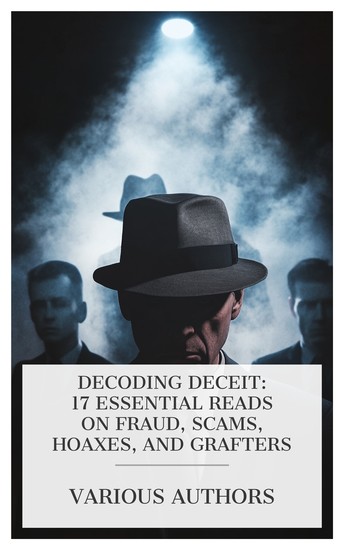
Decoding Deceit: 17 Essential Reads on Fraud Scams Hoaxes and Grafters - The Princess Tarakanova Famous Impostors Quacks and Grafters The Fraud of Feminism etc - cover

Decoding Deceit: 17 Essential Reads on Fraud Scams Hoaxes and Grafters - The Princess Tarakanova Famous Impostors Quacks and Grafters The Fraud of Feminism etc

Alexandre Dumas, Bram Stoker, L. Frank Baum, Edward Stratemeyer, John Newman, Julia K. Duncan, Clarence Young, G. P. Danilevskii, Ernest Belfort Bax, Austin Bidwell, F. Colburn Adams, W. H. Inglis, Fydell Edmund Garrett, Horatio Jr. Alger

Publisher: e-artnow

  • 0
  • 0
  • 0

Summary

Decoding Deceit: 17 Essential Reads on Fraud, Scams, Hoaxes, and Grafters is a compelling anthology that delves into the intricate webs of deception that have captured human fascination for centuries. This collection encompasses a wide array of literary styles, from thrilling narratives and insightful essays to fictive explorations, each shedding light on the various manifestations of deceit. The selected works navigate the labyrinthine paths of swindlers and charlatans, providing a panoramic view of fraud’s multifaceted nature. The anthology carefully curates tales of deception, each contributing a unique perspective and depth to the timeless intrigue of human cunning. This anthology features an eclectic mix of contributors, including literary giants and lesser-known scribes, united by their exploration of fraud's thematic intricacies. Among them, Bram Stoker and L. Frank Baum bring their narrative prowess, while figures like Ernest Belfort Bax and G. P. Danilevskii offer historical and philosophical insights. The convergence of diverse backgrounds, spanning from Victorian sensibilities to early 20th-century realism, enriches the exploration of deceit across various societal contexts. This convergence enhances the anthology’s alignment with the literary traditions of espionage and moral exploration, providing a comprehensive lens through which to view human duplicity. Decoding Deceit is a must-read for anyone eager to explore the complexities of fraudulent schemes through a rich tapestry of storytelling styles and historical contexts. It offers readers an extraordinary chance to engage with the minds of celebrated and obscure authors alike, broadening their understanding of the human propensity for deception. This anthology not only serves as an educational resource but also ignites a dialogue between the distinct voices within its pages, offering a multidimensional understanding of deceit's allure and implications. Embrace this collection to uncover insights that span beyond the temporal constraints of its narratives and transcend cultural and ethical boundaries.
Available since: 03/04/2025.
Print length: 2000 pages.

Other books that might interest you

  • Drop the Act - The Inside Secrets for Elite Performance - cover

    Drop the Act - The Inside...

    Kate Glancey

    • 0
    • 0
    • 0
    Are you ready to embark on a transformative and life-changing journey towards elite performance and genuine success? 
    In Drop The Act: The Inside Secrets For Elite Performance, renowned psychologist and performance specialist Kate Glancey delves into the secrets of champions, and unveils the path less travelled by those who achieve unparalleled success. 
    As Kate explains, elite performance is often only considered in the realm of sporting superstars, CEOs, world-class musicians and those who reach the dizzying heights of their chosen profession. However, when we peel back the layers of façade and dive into the heart of authenticity, we can discover the place inside us where the true power to excel resides. 
    Today, we are a society of disconnected individuals who are living through our mind instead of our heart. This tendency to live in the mind, in a place of thought rather than being guided by the pure energy of our soul, is the greatest challenge and barrier to uncovering your inner wisdom and power. In her signature story-telling style, Kate guides you towards uncovering that hidden potential that lies beneath the act you present to the world. Packed with practical exercises and insightful tips, this book shows you how to drop the act once and for all, and be the person you were born to be. 
    Most people assume the words ‘elite’ and ‘performer’ can only be applied to a select few, but as Kate explains, we are all performers in our own lives. Whether you are a mum, a dad, a wife, a husband, a partner, or a friend – or a player, an academic, an employee or an employer, we are all performing in life. And we all have the potential within us to fulfil our purpose and achieve genuine success and happiness.
    Show book
  • Forgotten Authors The - Volume 5 - The Brothers Grimm to William Dean Howells - cover

    Forgotten Authors The - Volume 5...

    The Brothers Grimm, Beatrice...

    • 0
    • 0
    • 0
    Throughout the long centuries of human history is the want, and the need, to share information, to exchange ideas and for that knowledge and experience, for curiosity and learning, to be the basis of a civil society. 
    In literature the ambition is much narrower.  In order to be known, to be popular, you had to be published.  And for that people had to know you existed and your ideas worth reading.  Obviously for most of humanity’s time people couldn’t read and texts couldn’t be published in any great number. 
    In the 15th Century Gutenberg’s printing press began the revolution to address the second and by the 19th century had gathered pace with startling speed and mass distribution.  Education for the many was brought in to help people understand more of their world and, with new skills, how to have a better place within it.  Now, if the powers that owned the presses and means of distribution agreed an audience would now be able to avail themselves of your ideas, your printed words.  
    Sadly, in the thirst for the new, the recent and the past fell from sight, relegated to dark corners and dusty shelves.   
    But the printed word is rarely without someone, somewhere busying themselves through piles of papers and books rediscovering what a good story is, whatever its age. 
    Sadly, in the thirst for the new, the recent and the past fell from sight, relegated to dark corners and dusty shelves.    
    But the printed word is rarely without someone, somewhere busying themselves through piles of papers and books rediscovering what a good story is, whatever its age. 
    In this volume we offer up a small selection of those talents whose time has now come again.
    Show book
  • Kitchen Medicine - How I Fed My Daughter out of Failure to Thrive - cover

    Kitchen Medicine - How I Fed My...

    Debi Lewis

    • 0
    • 0
    • 0
    For many parents, feeding their children is easy and instinctive. For others, though, it is on the same spectrum in which Debi Lewis found herself: part of what felt like an endless slog to move her daughter from failure-to-thrive to something that looked, if not like thriving, at least like survival. The emotional weight of not being able to feed one's child feels like a betrayal of the most basic aspect of nurturing. While every faux matzo ball, every protein-packed smoothie that tasted like a milkshake, every new lentil dish that her daughter liked made Lewis's spirit rise, every dish pushed away made it sink. 


    Kitchen Medicine tells the story of how Lewis made her way through mothering and feeding a sick child, aided by Lewis's growing confidence in front of the stove. It's about how she eventually saw her role as more than caretaker and fighter for her daughter's health and how she had to redefine what mothering—and feeding—looked like once her daughter was well. This is the story of learning to feed a child who can't seem to eat. It's the story of growing love for food, a mirror for people who cook for fuel and those who cook for love; for those who see the miracle in the growing child and in the fresh peach; for matzo-ball lovers and the gluten-intolerant; and for parents who want to feed their kids without starving their souls.
    Show book
  • The Murderer - Bulgakov expertly explores life and death choices set on the backdrop of the Bolshevik Revolution - cover

    The Murderer - Bulgakov expertly...

    Mikhail Bulgakov

    • 0
    • 0
    • 0
    Mikhail Bulgakov was born on 15th May 1891 in Kiev, in the Kiev Governorate of the Russian Empire, into a Russian family.  He was one of seven children. 
     
    In 1901, Bulgakov attended the First Kiev Gymnasium, and developed a keen interest in Russian and European literature, theatre and opera.  After the death of his father in 1907, his mother assumed responsibility for his education.  After graduating Bulgakov entered the Medical Faculty of Kiev University and then took up a post as physician at the Kiev Military Hospital. 
     
    At the outbreak of the First World War, he volunteered as a doctor and was sent directly to the front, where he was badly injured at least twice.  To suppress chronic pain, especially in the abdomen, he injected morphine.  It took years to wean himself off. 
     
    He now took up medical posts in various towns and in 1919, he was mobilised by the Ukrainian People's Army and assigned to the Northern Caucasus.  There, he became seriously ill with typhus and barely survived.  
     
    After this illness, Bulgakov abandoned his medicine to pursue writing.  He moved to Vladikavkaz and had two plays staged there with great success.  He wrote too for various newspapers and other outlets, but his critics were many.  And growing. 
     
    When a Moscow's theatre director severely criticised Bulgakov, Stalin personally protected him, saying that a writer of Bulgakov's quality was above ‘party words’ like ‘left’ and ‘right’.   Indeed, it is said that Stalin watched ‘The Days of the Turbins’ at least 15 times. 
     
    It was not to last and by March 1929, Bulgakov's career was ruined when Government censorship stopped publication of any of his work and plays. 
     
    In despair, Bulgakov wrote a personal letter to Stalin.  He requested permission to emigrate.  He received a phone call from the Soviet leader, who asked the writer whether he really desired to leave. He replied that a Russian writer cannot live outside of his homeland.  Stalin thus gave him permission to continue working. In May 1930, he re-joined the theater, as stage director's assistant.  
     
    During the last stressful decade of his life, and in poor health, Bulgakov continued to work on ‘The Master and Margarita’, wrote plays, critical works, stories, and continued translations and dramatisations of novels.  Many of them were not published, others were derided by critics.  
     
    On 10th March 1940, Mikhail Afanasyevich Bulgakov died from nephrosclerosis.  He was 48. 
     
    ‘The Master and Margarita’ was not published in any form until the mid-1960’s 
     
    Here Bulgakov relates a story as told by a doctor describing the terrible things that humanity is capable of doing in times of war.
    Show book
  • India Uniform Nine - Secrets From Inside a Covert Customs Unit - cover

    India Uniform Nine - Secrets...

    Mark Perlstrom

    • 0
    • 0
    • 0
    An eye-opening account from inside an ultra-secret Customs unit
    
    Mark Perlstrom is no stranger to money laundering, drug smuggling and crooked firms.
    
    In the late 1980s he started working for HM Customs and was quickly thrown in the deep end, joining Operation C-Chase, an undercover investigation that penetrated Pablo Escobar's mighty Medellin cartel, brought down the corrupt BCCI bank and stopped London's gangs from moving their ill-gotten gains around the capital.
    
    As part of the Uniforms - the new, secret, anti-money-laundering squad - high-speed car chases, bugging homes and spying on targets was day-to-day business.
    
    Told by a true insider and revealing never-before-told-secrets of the industry, India Uniform Nine lays bare the intense rivalry between crime-fighting organisations and how that leads to corruption, chaos and some scarcely believable antics in the covert world. And how Mark's own operation was nearly scuppered by a US Customs bungle.
    Show book
  • Bodyguard: The Real Story - Inside the secretive world of armed police and close protection - cover

    Bodyguard: The Real Story -...

    Jonathan Levi, Emma French,...

    • 0
    • 0
    • 0
    Bestselling authors Jonathan Levi and Emma French use their unrivalled access to the secret world of police protection officers as they tell the dramatic and astonishing stories of bravery, and the decisions that can change lives in a heartbeat.With the constant threats now posed by gangs, drugs turf wars and terrorism, the world of police protection has changed almost beyond recognition. But the story of these incredible officers is also the story of Britain's most dramatic and traumatic news events. In Bodyguard: The Real Story we meet individuals with first-hand recollection of these indelible events with powerful stories to tell.
    Show book