Join us on a literary world trip!
Add this book to bookshelf
Grey
Write a new comment Default profile 50px
Grey
Subscribe to read the full book or read the first pages for free!
All characters reduced
Queensland Rail - cover

Queensland Rail

Aisha Khan

Translator A AI

Publisher: Publifye

  • 0
  • 0
  • 0

Summary

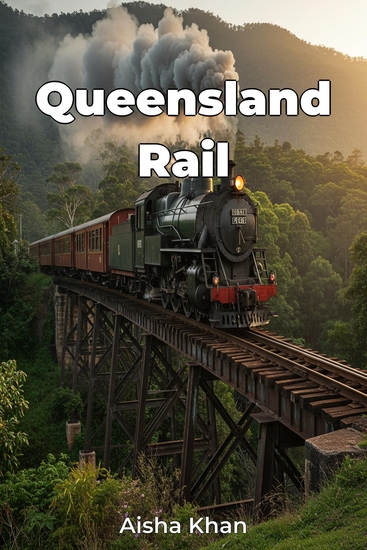
Queensland Rail explores the rich history of Queensland's railway system, highlighting its crucial role in shaping the state's social and economic development. More than just a story of tracks and trains, the book reveals how strategic infrastructure investments overcame geographic barriers, enabling the transport of resources and people across vast distances. Queensland's reliance on agriculture and mining in the 19th and 20th centuries meant the railways were essential for connecting remote regions and fostering growth. The book examines the early motivations driving railway construction, the technological evolution involving innovative engineering techniques, and the social and economic impacts. It demonstrates how the railway facilitated trade, supported urban growth, and provided access to vital services for rural communities.

 
Through archival documents, maps, and statistical data, Queensland Rail offers a detailed, localized study of railway development, distinguishing itself by focusing on the unique challenges and opportunities presented by Queensland's distinct geography and economy. The narrative unfolds across three major parts, initially introducing the political and economic factors, then exploring the technological advancements, and finally investigating the lasting social and economic effects. By connecting to broader fields like economic geography and urban planning, the book provides a comprehensive understanding of Queensland Rail's significance and its continuing relevance in the 21st century.
Available since: 03/20/2025.
Print length: 65 pages.

Other books that might interest you

  • Physics - cover

    Physics

    Aristotle

    • 0
    • 0
    • 0
    This seminal work delves into the essence of change, motion, and the purposes of natural phenomena, exploring the interplay of matter and form. Aristotle's methodical inquiries lay the groundwork for centuries of scientific thought, dissecting the laws that govern the universe. A must-read for anyone seeking to understand the origins of natural philosophy and the roots of modern science.
    Show book
  • Crusading against the Ottomans: The History and Legacy of the Christian Battles against the Ottoman Empire in Central Europe - cover

    Crusading against the Ottomans:...

    Editors Charles River

    • 0
    • 0
    • 0
    In terms of geopolitics, perhaps the most seminal event of the Middle Ages was the successful Ottoman siege of Constantinople in 1453. The city had been an imperial capital as far back as the 4th century, when Constantine the Great shifted the power center of the Roman Empire there, effectively establishing two almost equally powerful halves of antiquity’s greatest empire. Constantinople would continue to serve as the capital of the Byzantine Empire even after the Western half of the Roman Empire collapsed in the late 5th century. Naturally, the Ottoman Empire would also use Constantinople as the capital of its empire after their conquest effectively ended the Byzantine Empire, and thanks to its strategic location, it has been a trading center for years and remains one today under the Turkish name of Istanbul. 
    Naturally, the Byzantines and Europeans didn’t take the Ottoman incursions laying down, and in the generations before the Ottoman victory at Constantinople, European alliances frequently tried to check Ottoman advances, couching their campaigns in the terms of crusading. One of them came near the end of the 14th century, and it presaged what was to come in the 15th century. 
    The Ottoman campaigns of the 14th century would provide the context for the events that led to the Battle of Nicopolis. One of the last major crusades was launched in 1396 by Pope Boniface IX, and the timing was perfect for the European kingdoms to unite and form a strong threat to the Ottomans. The 100-year war between France and England was in a state of truce, and King Richard II had just married Princess Isabella of France. Thus, both the English and the Franks would be able to send forces to join in a crusade, and so would Hungary, Bulgaria, Venice, Genoa, Croatia, Wallachia, the Holy Roman Empire, and the Knights Hospitaller.
    Show book
  • How to embrace academic failure - Building a career with meaning integrity and honesty - cover

    How to embrace academic failure...

    Tara Brabazon

    • 0
    • 0
    • 0
    This book explores current attitudes towards failure in academia. Tara Brabazon argues that success and failures are rarely linked and instead failure can be harnessed as both a diagnostic and a literacy to improve research integrity, authenticity, accountability and consciousness. 
    Brabazon demonstrates how instances of failure can facilitate an awareness of asymmetrical power dynamics and injustice in academic life. How To Embrace Academic Failure illustrates how to create personal, professional and organizational change as a result of failure. It offers practical strategies for using failure to enhance academic careers and improve research ethics and teaching. Brabazon concludes by presenting an idealised academic future where a culture of failure provides transparency, rigour, ethical leadership and followership. 
    This insightful book is a vital resource for students and scholars of higher education management, business leadership and the sociology of education. Academics in critical university studies and early career researchers will also benefit from Brabazon's novel perspective on the post-pandemic, claustropolitan university.
    Show book
  • A Rare Recording of Psychologist Timothy Leary - cover

    A Rare Recording of Psychologist...

    Timothy Leary

    • 0
    • 0
    • 0
    Timothy Francis Leary (October 22, 1920 - May 31, 1996) was an American psychologist and author known for his strong advocacy of psychedelic drugs, particularly LSD. Evaluations of Leary are polarized, ranging from "bold oracle" to "publicity hound". According to poet Allen Ginsberg, he was "a hero of American consciousness", and writer Tom Robbins called him a "brave neuronaut". President Richard Nixon called him "the most dangerous man in America". During the 1960s and 1970s, at the height of the counterculture movement, Leary was arrested 36 times. The following recording was made in 1992.
    Show book
  • How We Think - cover

    How We Think

    John Dewey

    • 0
    • 0
    • 0
    "How We Think" by John Dewey is a pivotal exploration into the mechanics of thought and its critical role in education. Dewey dissects the process of reflective thinking into clear stages, advocating for its essential place in problem-solving and learning. This enlightening text is not just an academic treatise but a guide to cultivating a more thoughtful and effective approach to our daily challenges and intellectual endeavors. Read in English, unabridged.
    Show book
  • Wild Apples - cover

    Wild Apples

    Henry David Thoreau

    • 0
    • 0
    • 0
    Henry David Thoreau's Wild Apples is a thought-provoking reflection on the effect of modern society on nature. Through his personal experiences, he highlights the tension between man and nature, emphasizing the need for balance between the two. Thoreau's vivid descriptions of wild apples offer a stark contrast to those created by human interference. Read in English, unabridged.
    Show book