Junte-se a nós em uma viagem ao mundo dos livros!
Adicionar este livro à prateleira
Grey
Deixe um novo comentário Default profile 50px
Grey
Assine para ler o livro completo ou leia as primeiras páginas de graça!
All characters reduced
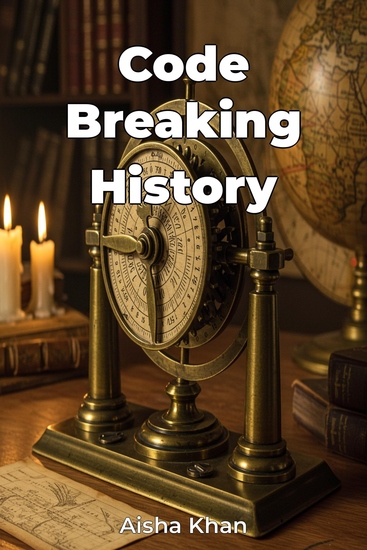
Code Breaking History - cover
LER

Code Breaking History

Aisha Khan

Tradutor A AI

Editora: Publifye

  • 0
  • 0
  • 0

Sinopse

Code Breaking History explores the fascinating evolution of cryptography, from ancient ciphers to modern cybersecurity, revealing how code breaking has shaped pivotal moments in history. The book examines the intertwined development of cryptographic techniques, such as substitution and transposition ciphers, alongside the art and science of cryptanalysis, highlighting the ongoing battle between those who protect information and those who seek to unveil it.

 
One intriguing fact is that cryptography's influence extends beyond military strategy to impact diplomatic negotiations and personal liberties. The book argues that the history of cryptography and cryptanalysis reflects broader social, political, and technological forces. It begins by introducing fundamental concepts like encryption and decryption, then traces their development through major historical periods, each addressed in distinct chapters. For example, the rise of mechanical cipher devices like the Enigma machine during World War II demonstrates the escalating sophistication of encryption methods.

 
The book uniquely combines technical explanations with comprehensive historical analysis, emphasizing the practical implications of these techniques in modern digital security and data protection.
Disponível desde: 22/02/2025.
Comprimento de impressão: 77 páginas.

Outros livros que poderiam interessá-lo

  • Robots Revealed - Machines that fly grip slice and even sense their world - cover

    Robots Revealed - Machines that...

    Science News

    • 0
    • 0
    • 0
      Imagine a robot performing surgery on a living body with perfection, without the help of a human surgeon. Or a drone zipping through the air smooth as a bird, fighting forest fires or catching environmental polluters. These futuristic-sounding ideas are already in the works, as robotics transforms life as we know it. The stories that follow from Science News take a look at the innovative ways that scientists are building machines to complete tasks – and even to think – as well as where the scientists are finding their sources of inspiration.
    Ver livro
  • Reflections on the Mind of Plato - cover

    Reflections on the Mind of Plato

    Joseph Norio Uemura

    • 0
    • 0
    • 0
    "Plato was not a Platonist! I would like to show in the following audio that anyone who reads the dialogues of Plato without bias or an ax to grind will find a humorous, witty, pleasant friend and not a desiccated scholarly mandarin. Plato was an open-minded, tolerant, reasonable individual, not a tight-lipped, pietistic puritan. In a word, Plato was an Athenian, not a Spartan!"In the 24 centuries that have passed since the Athenians put Socrates to death, every generation has interpreted the meaning of Plato's work differently. Joseph Uemura guides us through six dialogues in an effort to promote a dialectical quest rather than seek a final resting place.Plato's dialogues treat the big questions that confront any thoughtful person. Eythyphro explores religion, Phaedo reflects on the mind, Theatetus examines knowledge, Sophist probes being, Phaedrus reflects on art, and Republic ponders society.All great literature must be experienced firsthand. Because it is not self-explanatory, it must be interpreted and evaluated. Professor Uemura's reflections serve as a touchstone by which to test every new reading of Plato's work.© Agora Publications
    Ver livro
  • Finding Genius: Stories Told by Bones - A day in the Museum of Osteology: (7 compelling observations; 31 captivating photos) - cover

    Finding Genius: Stories Told by...

    Richard Jacobs

    • 0
    • 0
    • 0
    A lifelong fascination with all things bones. A four-decades-long hunt for the specimens of 2,500+ species past and present. An unwavering desire to preserve, appreciate, and display this rich history of life on Earth. 
    These things led to the establishment of the largest privately-held collection of osteological pieces in the world; a place where science displays are more like works of art ... capturing the attention of every eye that lands upon them, and telling a profound story without uttering a single word. 
    I'm Richard Jacobs. A casual trip with my family to a bone museum sparked a number of observations that I found too intriguing not to share. 
    Enjoy. And please, never stop being curious, and never stop asking questions – the good ones can lead to the greatest discoveries of mankind. 
    Ver livro
  • The Fantastic Book of Chemistry Jokes: - For Everyone not Just Chemists - cover

    The Fantastic Book of Chemistry...

    Shane Van

    • 0
    • 0
    • 0
    Welcome, welcome! With so many people slapping their neon The Fantastic Book of Chemistry Jokes, this author’s edition has been released. No matter your understanding of chemistry, I am sure you'll get a reaction, because the jokes within, are sodium funny. These jokes have been accumulated through years of interactions with fellow scientists and teachers and lots of drinking in strange bars late at night. A word of caution must be had, some jokes are innocent, and some are rude & lewd, but none are meant to offend. As studies have shown, the darker your sense of humour, the more intelligent you are. With that being said, sit back, put your feet up and wait for the nerdy fluorine, uranium, nitrogen-filled laughs to tickle your fancy. 
    “Chemistry can be a good and bad thing. Chemistry is good when you make love with it. Chemistry is bad when you make crack with it.” 
    -Adam Sandler
    Ver livro
  • Treatise on Light - cover

    Treatise on Light

    Christiaan Huygens

    • 0
    • 0
    • 0
    Treatise on Light was published in 1690 and is probably the largest scientific volume on light published before Newton's Opticks. The book explains how light travels (i.e., that it has a certain velocity), and what happens when it hits a surface (refraction and reflection). A large portion of the book is devoted to the double refraction occurring in Iceland chrystal, and all drawn conclusions are proved geometrically. Christiaan Huygens (1629 - 1695) was a prominent physicist and astronomer. His main discoveries are the centrifugal force, collision laws for bodies and the argument that light consists of waves. He was a contemporary of Galilei and Descartes, and a member of the French Royal Society since 1663. (Summary by Availle)
    Ver livro
  • The Tale of Benny Badger - cover

    The Tale of Benny Badger

    Arthur Scott Bailey

    • 0
    • 0
    • 0
    Mr. Bailey centered all his plots in the animal, bird and insect worlds, weaving natural history into the stories in a way that won educator's approval without arousing the suspicions of his young readers. He made it a habit to never 'write down' to children and frequently used words beyond the average juvenile vocabulary, believing that youngsters respond to the stimulus of the unfamiliar. (Summary – Wikipedia )
    Ver livro