¡Acompáñanos a viajar por el mundo de los libros!
Añadir este libro a la estantería
Grey
Escribe un nuevo comentario Default profile 50px
Grey
Suscríbete para leer el libro completo o lee las primeras páginas gratis.
All characters reduced
The Testimonies of Slaves - Hundreds of Recorded Interviews and Life Stories of Former Slaves in the South - cover

The Testimonies of Slaves - Hundreds of Recorded Interviews and Life Stories of Former Slaves in the South

Administration Work Projects

Editorial: Good Press

  • 0
  • 0
  • 0

Sinopsis

In "The Testimonies of Slaves," the Work Projects Administration (WPA) presents a compelling compilation of firsthand narratives from former enslaved individuals, illuminating the profound human experiences often obscured by historical abstraction. This work employs a straightforward literary style that juxtaposes raw emotion with stark realities, reflecting the WPA's objective to document, preserve, and share the voices of those who endured centuries of oppression. Contextually aligned with the New Deal era, this anthology emerges as an essential socio-historical artifact, unmarred by romanticism, shedding light on the brutalities of slavery and the resilience of the human spirit. The WPA, established during the Great Depression, aimed to provide employment and foster cultural enrichment through an array of projects. Driven by a commitment to social justice and historical preservation, the WPA sought to give individuals a platform to recount their experiences. This endeavor was not merely about collecting stories but was also a crucial means of acknowledging the legacy of slavery and its enduring implications for American society. I wholeheartedly recommend "The Testimonies of Slaves" to readers seeking a deeper understanding of American history, social justice, and the lived experiences of enslaved people. The book's powerful and authentic voices invite reflection on the past while encouraging dialogues about our present and future.
Disponible desde: 17/12/2023.
Longitud de impresión: 7859 páginas.


Otros libros que te pueden interesar

  • Learn Korean: Discover Korean Culture & Traditions - Bonus: Travel to South Korea Cheat Sheet - cover

    Learn Korean: Discover Korean...

    Innovative Language Learning, ...

    • 0
    • 0
    • 0
    Want to learn and speak Korean?
     
    Fact: One of the BEST ways to start speaking Korean is to learn more words!


    The more you know, the more you speak, right? But if you want to impress natives and sound like a native, you'll need Korean words that are not taught in textbooks. You'll need to learn about the details of Korean culture as well. And you get just that with Learn Korean: Discover Korean Culture & Traditions by KoreanClass101.com.


    Are you ready to learn language and culture at the same time?
    
      Get Access to 25 Korean Audio Lessons
      Total Length of the Audiobook: 2 Hours
      Learn 125+ Korean Words & Phrases
      Master Words & Phrases with Example Sentences
      Learn All About Korean Culture, Traditions & Way of Life


    Who is this for?
     
    This audiobook is for beginners and experienced learners alike. You learn native-level phrases that textbooks don't teach you as well as Korean culture.


    How will you learn Korean?
     
    Just listen and repeat. You can repeat and review your lessons as many times as you want for extra practice.


    Download the PDF and read along
    Ver libro
  • Edo Period - Tokugawa Rule Isolation and the Samurai Code - cover

    Edo Period - Tokugawa Rule...

    Rolf Hedger

    • 0
    • 0
    • 0
    The Edo period in Japan began with the dramatic rise of Tokugawa Ieyasu and the establishment of the Tokugawa Shogunate, which would bring over two centuries of relative peace and stability to the country. This transformation was not immediate but was set into motion by the pivotal Battle of Sekigahara in 1600. Ieyasu, a powerful daimyo and skilled strategist, emerged victorious in this decisive conflict, defeating rival factions and securing his dominance over the fractured Japanese landscape. This battle marked the end of the Warring States period, a time of nearly constant civil war, and laid the foundation for a new era of centralized feudal rule. 
    In 1603, Ieyasu was granted the title of shogun by the emperor, officially establishing the Tokugawa Shogunate. Although the emperor remained a symbolic figurehead, true political power rested with the shogun. Ieyasu’s government was based in Edo, a small fishing village that quickly developed into a sprawling political and economic center—modern-day Tokyo. From here, the Tokugawa clan implemented a system of governance that emphasized strict control, social hierarchy, and regional oversight. The shogunate devised a complex administrative structure that allowed it to maintain authority over hundreds of semi-autonomous domains ruled by daimyo, while ensuring loyalty through a combination of military strength, economic policy, and social regulation. 
    One of the key strategies used by Tokugawa Ieyasu to solidify his power was the creation of the han system. Under this arrangement, each daimyo governed a specific territory but was subject to strict oversight from the shogunate. The policy of sankin-kotai, or alternate attendance, required daimyo to spend alternating years in Edo, effectively draining their resources and keeping them under close surveillance. Their families were often kept in Edo as virtual hostages, ensuring obedience and discouraging rebellion.
    Ver libro
  • Inquisition - The Reign of Fear - cover

    Inquisition - The Reign of Fear

    Toby Green

    • 0
    • 1
    • 0
    A journey across centuries of religious conflict Toby Green's incredible new book brings a vast panorama to life by focusing on the untold stories of individuals from all walks of life and every section of society who were affected by the Inquisition. From witches in Mexico, bigamists in Brazil, Freemasons, Hindus, Jews, Moslems and Protestants, the Inquisition reached every aspect of society. This history, though filled with stories of terror and the unspeakable ways in which human beings can treat one another, is ultimately one of hope, underscoring the resilience of the human spirit. Stretching from the unification of Spain under Ferdinand and Isabella in the fifteenth century to the Napoleanic wars, The Inquisition details this incredible history in all its richness and complexity.
    Ver libro
  • From The Accession Of Henry The Third To The End Of The Reign Of Richard The Second AD 1216—1399 - cover

    From The Accession Of Henry The...

    Gilbert Abbott A'Beckett

    • 0
    • 0
    • 0
    "A fun introduction to English history for those who may find conventional history books dry and tedious... it offers an accessible and enjoyable alternative to more traditional texts." 
    "a delightful blend of history, humor, and art. It provides readers with an entertaining way to learn about England’s past while enjoying the wit and creativity of A. Beckett. Whether you are a history buff or someone looking for a lighthearted approach to learning, this book offers something for everyone." 
    In the third drily hilarious volume of A Comic History Of England, we move forward to the thirteenth century, when a succession of Edwards and Henrys gain the throne and immediately use it to steal everything they can from the population, in order to fund attempts to conquer France (or pay their debts from conquering England). Along the way we get the fabled Black Prince, one of the greatest battles in English history, a queen far more powerful than her king or sons, and a consideration of the manners and condition of the English period up to this point in the history. 
    Covers: 
    Henry The Third, Surnamed Of Winchester. 
    Edward The First, Surnamed Longshanks. 
    Edward The Second, Surnamed Of Caernarvon. 
    Edward The Third. 
    Richard The Second, Surnamed Of Bordeaux. 
    On The Manners, Customs, And Condition Of The People.
    Ver libro
  • Conquer Your Bad Habits - Secrets to Long-Lasting Change - cover

    Conquer Your Bad Habits -...

    MD Amen

    • 0
    • 0
    • 0
    Habits, whether good or bad, run our lives. What if there's a simple, practical way to get rid of the bad ones and replace them with healthy ones?
    
    If you find yourself habitually overeating, overspending, procrastinating, getting distracted, interrupting, people-pleasing, wasting time, automatically saying no, or drinking too much alcohol, neuropsychiatrist and best-selling author Daniel Amen, MD, has encouraging news for you: Your brain does what you train it to do. So even if you've trained your brain to normalize unhealthy behavior, you can also train it to turn bad habits into good ones in order to experience more joy and contentment.
    
    
    In Conquer Your Bad Habits, Dr. Amen combines approachable neuroscience and years of clinical research as he reveals:
    
    - the six most important brain systems that run your life
    - the five basic steps to conquering your unhealthy habits and setting new goals
    - how to overcome ten common bad habits
    - what to do when bad habits become addictions
    There's no better time than now to let Dr. Amen show you how to retrain your brain and eliminate your negative behaviors once and for all—so you can live a happier, healthier life.
    Ver libro
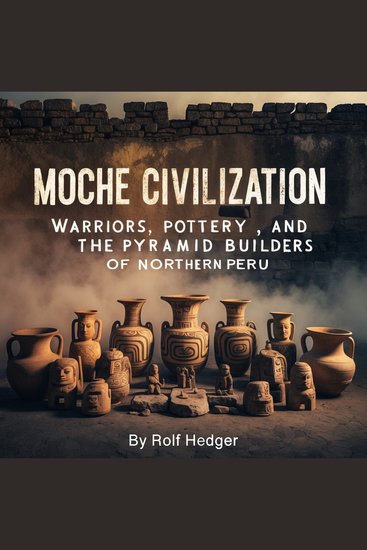
  • Moche Civilization - Warriors Pottery and the Pyramid Builders of Northern Peru - cover

    Moche Civilization - Warriors...

    Rolf Hedger

    • 0
    • 0
    • 0
    The Moche civilization emerged along the northern coast of present-day Peru, flourishing between approximately 100 and 750 CE. This society developed in a region marked by arid deserts, fertile river valleys, and proximity to the Pacific Ocean, which shaped its economy, culture, and political structure. The Moche were not a singular unified state but rather a collection of regional polities connected through shared traditions, artistic styles, and religious beliefs. Their rise was influenced by earlier Andean cultures, particularly the Cupisnique and Chavín, which had already laid the foundations for complex societies in the region. 
    The origins of the Moche civilization can be traced to the early centuries of the Common Era when small communities along the coast began to expand due to agricultural advancements and increasing social stratification. The region's rivers, fed by Andean runoff, allowed for irrigation-based farming that supported large populations. Over time, leaders emerged who controlled land, labor, and water resources, leading to the development of hierarchical societies. These early rulers likely solidified their power through religious authority, military strength, and their ability to organize large-scale construction projects. 
    One of the defining aspects of Moche civilization was its adaptation to the harsh environment. The coastal deserts of northern Peru posed challenges for sustaining large populations, yet the Moche mastered irrigation technology, channeling river water to expand arable land. This agricultural innovation provided surplus food, which in turn fueled urban growth, specialization of labor, and the rise of elite classes. Moche settlements grew into centers of political and religious activity, with monumental architecture such as pyramids and temples becoming focal points of their cities.
    Ver libro