Junte-se a nós em uma viagem ao mundo dos livros!
Adicionar este livro à prateleira
Grey
Deixe um novo comentário Default profile 50px
Grey
Assine para ler o livro completo ou leia as primeiras páginas de graça!
All characters reduced
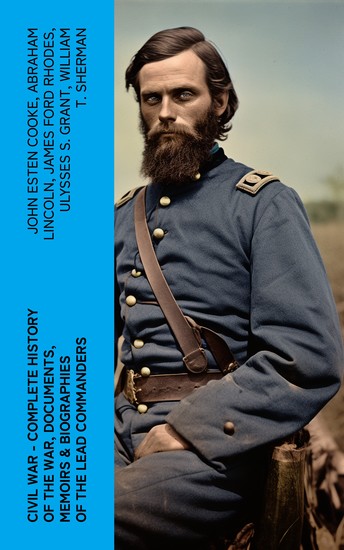
CIVIL WAR – Complete History of the War Documents Memoirs & Biographies of the Lead Commanders - cover
LER

CIVIL WAR – Complete History of the War Documents Memoirs & Biographies of the Lead Commanders

Abraham Lincoln, Ulysses S. Grant, John Esten Cooke, William T. Sherman, James Ford Rhodes, Frank H. Alfriend

Editora: e-artnow

  • 0
  • 0
  • 0

Sinopse

This meticulously edited collection contains a Pulitzer Prize awarded History of Civil War, as well as the memoirs of the two most important military commanders of the Union, Ulysses S. Grant and William T. Sherman, complete with biographies of Abraham Lincoln, Jefferson Davis and Robert E. Lee. Finally, this collection is enriched with pivotal historical documents which provide an explicit insight into this decisive period of the American past. Content:   History of the Civil War, 1861-1865 Leaders & Commanders of the Union: Abraham Lincoln Ulysses S. Grant William T. Sherman Leaders & Commanders of the Confederation: Jefferson Davis  Robert E. Lee Civil War Documents: The Emancipation Proclamation Gettysburg Address Thirteenth Amendment to the United States Constitution Presidential Actions and Addresses by Abraham Lincoln: 1861 1862 1863 1864 1865
Disponível desde: 14/12/2023.
Comprimento de impressão: 3541 páginas.


Outros livros que poderiam interessá-lo

  • Lourdes - The Famous Roman Catholic Shrine - cover

    Lourdes - The Famous Roman...

    Kelly Mass

    • 0
    • 0
    • 0
    You may have heard of Lourdes, a town in France where millions of people go every year, either as a tourist to take pictures or see what the hype is all about, or real believers who think that the town has a sanctity to it and can somehow cure them, help them, or inspire them through divine means. Whatever the reason for the many visitors is, it is undeniably an interesting historical heritage, something worth exploring. 
    To be precise, Lourdes is a small market town nestled in the Pyrenees' foothills. It is in the Occitanie area of southern France and is a part of the Hautes-Pyrénées department. Prior to the mid-nineteenth century, the town was well-known for the Château fort de Lourdes, a prepared castle set down atop a rocky cliff in the town's heart. 
    Today, I invite you to explore the background and historicity of this town with me, to form your own opinion, and to be open-minded to the story beneath the surface, buried in the past and brought to light in the many narratives the presenters at the site tell. Perhaps you will have the opportunity to visit it sometime yourself, and if or when you do, you will be equipped with more knowledge than the majority of the visitors. Perhaps that way, it will touch you more.
    Ver livro
  • Texas Revolution and Mexican-American War The: The History and Legacy of the Conflicts that Led to Mexico’s Cession of the American Southwest - cover

    Texas Revolution and...

    Editors Charles River

    • 0
    • 0
    • 0
    The most important war of all for Texas came in the early 19th century, and the common story heard in America is about rebellion against intolerance, oppression and Mexican cruelty. The Battle of the Alamo in particular, surrounded by legend and testimonies of heroism, is a textbook example of the fight for freedom, comparable to the Jewish defenders during the Roman siege at Masada. The words "martyrs" and "Mexican tyranny" are almost always present in the recounts, and “Remember the Alamo!” is both a slogan of self-glorification and martyrdom that remains one of the most famous phrases in America. 	Texas formally asked to be annexed by the United States in 1845. This annexation angered the Mexican government, which still considered Texas to be part of its territory. Mexico had previously warned that the annexation of Texas would cause Mexico to declare war on the United States.  
    	When a Mexican patrol attacked American cavalry in the disputed area north of the Rio Grande, President Polk went to Congress for a declaration of war. The declaration passed on May 13, 1846. The war against Mexico was unpopular with the opposition Whig party, especially in the North. Opponents of the war denounced it as a war of aggression, and denied that there had been a valid reason for war.	Small American military units were quickly able to occupy key points in California, including San Francisco and Los Angeles. Although California was sparsely populated, some Mexican inhabitants formed an effective resistance which was eventually put down in 1847 by American reinforcements. Subsequently, a larger American army was sent to invade central Mexico, and managed to capture the Mexican capital, Mexico City, on September 13, 1847. News of the capital falling caused it to retreat to try to retake the capital. After the defeat of the last Mexican army, major hostilities ended.
    Ver livro
  • The Antichrist - cover

    The Antichrist

    Friedrich Nietzsche

    • 0
    • 0
    • 0
    The Antichrist by Friedrich Nietzsche 
    What if everything you believed about morality, religion, and truth was built on a lie? 
    In The Antichrist, Friedrich Nietzsche unleashes a thunderous critique of Christianity and its moral foundations, challenging the pillars of Western thought with fiery precision. A cornerstone of his late philosophy, this work is both an assault on complacent belief systems and a bold declaration of the will to power, vitality, and individual greatness. 
    Nietzsche, a prophet of existentialism and iconoclasm, invites the listener to confront uncomfortable truths. Through razor-sharp aphorisms, he dissects the psychology of faith, the decay of values, and the rise of decadence disguised as virtue. In powerful passages, he exposes how pity can weaken the spirit, how priestly morality undermines life itself, and how the figure of Christ has been distorted into a symbol of weakness rather than strength. 
    Each chapter is a spark that ignites reflection, rebellion, or revelation—yet never leaves you indifferent. 
    More than a philosophical manifesto, The Antichrist remains a cultural lightning rod. Its bold vision continues to resonate in modern debates about freedom, authenticity, and the role of religion in human progress. For thinkers, seekers, and those who dare to question, this audiobook offers a direct channel to one of history’s most electrifying minds. 
    Narrated with the precision and poise of advanced AI voice technology, this edition ensures clarity, rhythm, and accessibility—ideal for absorbing Nietzsche’s provocative arguments while immersed in thought or motion. 
    Dare to confront the uncomfortable. Challenge the herd. Listen to The Antichrist and enter the mind of a philosopher who burned with the desire to awaken humanity from its moral slumber. 
    Experience it now—let the voice of Nietzsche echo through your mind.
    Ver livro
  • The White Privilege Album - Bringing Racial Harmony to Very Fine People… on Both Sides - cover

    The White Privilege Album -...

    A. J. Rice, Vince Everett Ellison

    • 0
    • 0
    • 0
    A comedy about race, wokeness, and cancel culture in America. A tragedy about race, wokeness, and cancel culture in America. Part satire, part journalism, part truth serum, A. J. Rice follows up his runaway #1 bestseller The Woking Dead with a hilarious sequel that picks up where the laughs left off.
    Ver livro
  • How God Thinks - Revealing God's Heart through the Language of Symbolism - cover

    How God Thinks - Revealing God's...

    David Vancelette

    • 0
    • 0
    • 0
    God created us in his image. This places a great burden on each person to not break that image of God within us. God thinks in symbols and so do we. There is always punishment for broken symbolism. Questions considered are, what does God think about: Gender, marriage, sex, the Cross as broken, not fulfilled symbolism? Why did God punish Moses so harshly when he struck the Rock in the wilderness the second time? Why is God allowing seemingly innocent victims to die by random shooters? Why does God see the climate change movement as idolatry? Why did Satan devise homosexuality? Why did God assign the death penalty for male but not female homosexuality? Why is having multiple wives acceptable in the Old Testament, but not having multiple husbands? All these topics, and many others, have to do with symbolism and are explained by How God Thinks.
    Ver livro
  • History of Colombia - An Overview of Its Politics Corruption and Culture - cover

    History of Colombia - An...

    Kelly Mass

    • 0
    • 0
    • 0
    Colombia’s history is marked by a rich tapestry of indigenous cultures and societies, which laid the foundations for the diverse nation that exists today. Long before the Spanish arrived in 1492, the region was home to advanced civilizations such as the Muisca Confederation, the Quimbaya Civilization, and the Tairona Chiefdoms. These indigenous groups thrived in Colombia's varied geography, establishing complex societies with sophisticated agricultural practices, intricate trade networks, and elaborate spiritual beliefs. 
    The Spanish conquest of the Americas brought significant change to the region. Following Christopher Columbus's arrival in the Caribbean, Spanish explorers began their colonization efforts. In 1538, the Spanish established Bogotá, which became the capital of the Viceroyalty of New Granada. This vast colonial territory included what is now Colombia, Ecuador, Panama, and Venezuela. The Spanish imposed their rule over the indigenous peoples, exploiting both the land and the labor of native communities, which would profoundly shape the future of the region.
    Ver livro