Join us on a literary world trip!
Add this book to bookshelf
Grey
Write a new comment Default profile 50px
Grey
Subscribe to read the full book or read the first pages for free!
All characters reduced
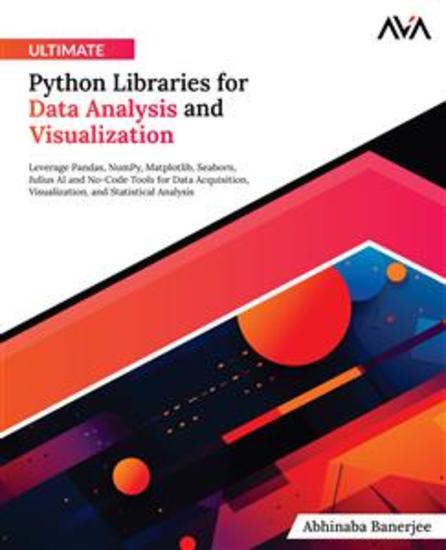
Ultimate Python Libraries for Data Analysis and Visualization - Leverage Pandas NumPy Matplotlib Seaborn Julius AI and No-Code Tools for Data Acquisition Visualization and Statistical Analysis - cover

Ultimate Python Libraries for Data Analysis and Visualization - Leverage Pandas NumPy Matplotlib Seaborn Julius AI and No-Code Tools for Data Acquisition Visualization and Statistical Analysis

Abhinaba Banerjee

Publisher: Orange Education Pvt Ltd

  • 0
  • 0
  • 0

Summary

Test your Data Analysis skills to its fullest using Python and other no-code tools

Book Description
Ultimate Data Analysis and Visualization with Python is your comprehensive guide to mastering the intricacies of data analysis and visualization using Python. This book serves as your roadmap to unlocking the full potential of Python for extracting insights from data using Pandas, NumPy, Matplotlib, Seaborn, and Julius AI. Starting with the fundamentals of data acquisition, you'll learn essential techniques for gathering and preparing data for analysis. From there, you’ll dive into exploratory data analysis, uncovering patterns and relationships hidden within your datasets.

Through step-by-step tutorials, you'll gain proficiency in statistical analysis, time series forecasting, and signal processing, equipping you with the tools to extract actionable insights from any dataset. What sets this book apart is its emphasis on real-world applications. With a series of hands-on projects, you’ll apply your newfound skills to analyze diverse datasets spanning industries such as finance, healthcare, e-commerce, and more.

By the end of the book, you'll have the confidence and expertise to tackle any data analysis challenge with Python. To aid your journey, the book includes a handy Python cheat sheet in the appendix, serving as a quick reference guide for common functions and syntax.

Table of Contents
1. Introduction to Data Analysis and Data Visualization using Python
2. Data Acquisition
3. Data Cleaning and Preparation
4. Exploratory Data Analysis
5. Statistical Analysis
6. Time Series Analysis and Forecasting
7. Signal Processing
8. Analyzing Real-World Data Sets using Python
      APPENDIX A Python Cheat Sheet
      Index
Available since: 04/05/2024.
Print length: 266 pages.

Other books that might interest you

  • The Hell Bomb - cover

    The Hell Bomb

    William L. Laurence

    • 0
    • 0
    • 0
    The Hell Bomb by Pulitzer Prize–winning journalist William L. Laurence is a sobering, meticulously detailed account of the dawn of the hydrogen bomb era. Written in the early 1950s, this scientific and political examination offers a front-row perspective on one of the most terrifying technological advancements in human history. Drawing on firsthand experiences from his time at Los Alamos and exclusive interviews with leading figures such as Hans A. Bethe, Laurence unpacks the terrifying potential of thermonuclear fusion and its unparalleled destructive power. 
    More than just a scientific treatise, The Hell Bomb wrestles with the ethical dilemmas and geopolitical consequences of nuclear armament in a rapidly changing post–World War II world. Laurence urges the public to confront the moral weight of such weapons and consider the path humanity must choose as it stands on the brink of unimaginable devastation. 
    Narrated with gravity and insight by Nathan Edwards, this audiobook remains a critical historical document and a powerful warning from the nuclear age's front lines.
    Show book
  • Don’t Die Ugly - Live Beautifully - cover

    Don’t Die Ugly - Live Beautifully

    Lynn Soles

    • 0
    • 0
    • 0
    Lynn Soles made her career about creating beauty – as an artist, art teacher, tattoo artist and owner of a “permanent beauty” clinic. Then her doctors told her she had cancer. She had to choose: Die soon and ugly from cancer or enter a long course of treatments that might allow her to regain the life she’d known.  
    This remarkable memoir and guidebook, written in the course of her first year of treatment, gives real-life guidance for best supporting others through long-term illnesses and surgeries. Practical tips describe:how a cancer friend is different from other friends; things to say (and things never to say!) to your friend in treatment; essential cancer self-care tips for the habitual Superwoman;specific ways to ask for and give help to a person exhausted by cancer treatments.  
    You’ll laugh with Lynn as she and her family adjust to the changes treatment causes. You’ll be amazed by her contractor husband’s commitment to support her–even applying her eyelashes to the sounds of crooner Dean Martin. You’ll sense her longing as family holiday traditions, client care schedules, and the most mundane of daily tasks are revised to accommodate her chemotherapy-induced exhaustion. You’ll marvel at the perseverance cancer treatment can teach and learn to respect the times when a patient needs to rest in the “cancer cocoon.”  
    Hollywood stars rely on beauty professionals like Lynn to keep them physically beautiful right to the day their body is viewed in its coffin. Lynn’s cancer journey will inspire you to reconsider whether your hope rests in the beautiful things of this world that will fade away, and to rethink what it means to leave a beautiful, eternal Christian legacy.
    Show book
  • A Little Cocaine to Loosen My Tongue - cover

    A Little Cocaine to Loosen My...

    Sigmund Freud

    • 0
    • 0
    • 0
    In the 1880s, Freud discovered cocaine and became enthusiastic about what was not yet considered a party drug. Favoring the use of cocaine in the treatment of neurasthenia, as an energizer, or as an anesthetic, Freud made a creative and fashionable use of it, heralding practices that our society knows well. Several surprising texts are gathered here on cocaine. Freud recounts the use of coca in history, particularly in South America, from where it was imported. In Cocaine Addiction and Cocaine Phobia, the inventor of psychoanalysis defended coca against its accusers as a dangerous product. Finally, in the letters to Martha Bernays, his future wife, we discover an intimate and loving Freud, telling how he escaped boring dinners thanks to his dear magic substance.
    Show book
  • Perfect - Feeling Judged on Social Media - cover

    Perfect - Feeling Judged on...

    Rosalind Gill

    • 0
    • 0
    • 0
    Social media is replete with images of 'perfection'. But many are unrealistic and contribute to a pervasive sense of never being good enough: not thin enough; not pretty enough; not cool enough. Try too hard and you risk being condemned for being ‘attention-seeking’, don't try hard enough and you're slacking. 
     
    Rosalind Gill challenges polarized perspectives that see young women as either passive victims of social media or as savvy digital natives. She argues the real picture is far more ambivalent. Getting likes and followers and feeling connected to friends feels fantastic, but posting material and worrying about 'haters' causes significant anxieties. 
     
    Gill uses young women's own words to show how they feel watched all the time; worry about getting things wrong; and struggle to live up to an ideal of being 'perfect' yet at the same time ‘real’. It's the wake-up call we all need.
    Show book
  • Designing for Democracy - How to Build Community in Digital Environments - cover

    Designing for Democracy - How to...

    Jennifer Forestal

    • 0
    • 0
    • 0
    How should we "fix" digital technologies to support democracy instead of undermining it? In Designing for Democracy, Jennifer Forestal argues that accurately evaluating the democratic potential of digital spaces means studying how the built environment—a primary component of our "modern public square"—structures our activity, shapes our attitudes, and supports the kinds of relationships and behaviors democracy requires. 


    While many scholars and practitioners are attentive to the role of design in shaping behavior, they have yet to fully engage with the question of what structures are required to support democratic communities—and how to build them. Forestal closes this gap by providing a new theory of democratic space. Drawing from a wide range of disciplines, she argues that "democratic spaces" must be designed with three environmental characteristics—boundaries, durability, and flexibility—that, taken together, afford users the ability to engage in fundamental civic practices. 


    Through extended analyses of Facebook, Twitter, and Reddit, Forestal shows precisely how well these digital platforms meet the criteria for democratic spaces, or whether they do so at all. The result is a nuanced analysis of the democratic communities that form—or fail to emerge—in these spaces, as well as more concrete suggestions for how to improve them.
    Show book
  • The Internet Con - How to Seize the Means of Computation - cover

    The Internet Con - How to Seize...

    Cory Doctorow

    • 0
    • 0
    • 0
    When the tech platforms promised a future of "connection," they were lying. They said their "walled gardens" would keep us safe, but those were prison walls. 
    The platforms locked us into their systems and made us easy pickings, ripe for extaction. Twitter, Facebook and other Big Tech platforms hard to leave by design. They hold hostage the people we love, the communities that matter to us, the audiences and customers we rely on. The impossibility of staying connected to these people after you delete your account has nothing to do with technological limitations: it's a business strategy in service to commodifying your personal life and relationships. 
    We can - we must - dismantle the tech platforms. In The Internet Con, Cory Doctorow explains how to seize the means of computation, by forcing Silicon Valley to do the thing it fears most: interoperate. Interoperability will tear down the walls between technologies, allowing users leave platforms, remix their media, and reconfigure their devices without corporate permission. 
    Interoperability is the only route to the rapid and enduring annihilation of the platforms. The Internet Con is the disassembly manual we need to take back our internet.
    Show book