¡Acompáñanos a viajar por el mundo de los libros!
Añadir este libro a la estantería
Grey
Escribe un nuevo comentario Default profile 50px
Grey
Suscríbete para leer el libro completo o lee las primeras páginas gratis.
All characters reduced
The Apparent Meaninglessness of Life - A Journey Through Existential Inquiry and Cosmic Indifference - cover

The Apparent Meaninglessness of Life - A Journey Through Existential Inquiry and Cosmic Indifference

Abdellatif Elhomani

Editorial: Spines

  • 0
  • 0
  • 0

Sinopsis

In this thought-provoking exploration of meaning, readers are led through the confluence of existentialism and science, challenging the pursuit of purpose against cosmic indifference. The text draws from philosophical giants and evolutionary theory to inspire resilience and individual destiny. It serves as a guide for navigating life’s uncertainties and celebrates the human spirit's capacity to find harmony within the cosmos's vast expanse, urging us to forge our own path with authenticity and creative rebellion.
Disponible desde: 07/07/2025.
Longitud de impresión: 188 páginas.


Otros libros que te pueden interesar

  • Ujjde Baag Da Full - cover

    Ujjde Baag Da Full

    Balwant Singh Gill UK

    • 0
    • 0
    • 0
    Ujjde Baag Da Full by Balwant Singh Gill is a powerful collection of stories centered on the lives of Punjabis who have migrated abroad. Each chapter explores a unique and heartfelt experience, touching on the struggles, challenges, and emotional battles faced while living far from home. With deep insight and moving narratives, the book captures the reality of migration and the strength it takes to survive and adapt in a new world.
    Ver libro
  • A Modern Utopia - cover

    A Modern Utopia

    H. G. Wells

    • 0
    • 0
    • 0
    "For a Utopia to be credible, it must be kinetic—not a static state, but a hopeful stage in an infinite development."
    
    Unlike the rigid, stagnant utopias of the past, H.G. Wells presents a "Kinetic Utopia"—a living, breathing world located on a planet identical to Earth but light-years ahead in social and technological evolution. Following two travelers who find themselves transported to this parallel world, Wells explores a global civilization governed by a World State, where poverty is abolished, technology serves humanity, and a voluntary nobility known as the "Samurai" maintains the moral fiber of the race. This is a brilliant exploration of how a planet-wide society could balance individual liberty with the common good.
    
    The "Samurai" Class: The most enduring concept of the novel is the Samurai—a voluntary order of men and women who follow a strict Rule of life to qualify for leadership. They are not a hereditary caste but an intellectual and moral meritocracy. Wells uses this concept to solve the age-old problem of governance: how to ensure that those in power are disciplined, selfless, and dedicated to the progress of the species.
    
    A World of Motion: Wells argues that a modern utopia cannot be a walled city; it must encompass the entire globe. In this world, every citizen is tracked by a universal indexing system (a startlingly prophetic vision of modern data), ensuring that while people are free to travel and change professions, the state can provide for their needs and maintain social stability. It is a world where the "Five Freedoms" are guaranteed, and the focus of human life shifts from survival to self-actualization.
    
    Rediscover the dream of a better world. Purchase "A Modern Utopia" today and explore the frontiers of human possibility.
    Ver libro
  • The Golden State Killer Case - cover

    The Golden State Killer Case

    William Thorp

    • 0
    • 0
    • 0
    In 2018, police announced that they had finally arrested the "Golden State Killer," a man responsible for over 140 burglaries, fifty rapes, and at least thirteen murders committed in California throughout the 1970s and '80s. That man turned out to be a former California police officer, Joseph James DeAngelo Jr. 


    Just two months earlier, the publication of I'll Be Gone in the Dark by Michelle McNamara had rocked the world of true crime. Published two years after her death, the book charts McNamara's obsessive search for the prolific criminal who had been known over the years as the East Area Rapist, the Original Night Stalker, and the Visalia Ransacker, among other epithets. McNamara is credited with coining the "Golden State Killer" moniker and heightening public awareness of the—at the time—still unsolved case. 


    William Thorp dives into the investigation, exploring the dark side of sunny California, the advances in forensic innovation that made solving this case possible, and the story inside the story—one of an amateur sleuth who dedicated the last years of her life to understanding how one of the country's worst criminals could have spent so many decades undetected.
    Ver libro
  • Holy Temples of Jerusalem The: The History of Solomon’s Temple and the Second Temple - cover

    Holy Temples of Jerusalem The:...

    Charles River Editors

    • 0
    • 0
    • 0
    There was not any one entity more central to the Yahwistic Judean religion during the monarchy than the temple of Solomon. It symbolized the presence of YHWH in the nation, as well as his enduring protection of the nation and the Davidic royal throne. Judean worshippers directed their prayers toward the Solomonic temple, and eventually, the Judean prophets and theologians declared that this was the only legitimate location where priests could perform sacrifices and other religious rites for YHWH. Its significance can be seen most clearly in the dramatic cognitive dissonance experienced by the Judeans in Babylonian captivity after the destruction of the temple, which had been so central to their religious conception that they had great difficulty reconciling its destruction with their continued belief in YHWH at all.  
    	Jerusalem was uninhabited for much of the 6th century B.C., and this period is known as the exile to Babylon, and Bible scholars believe that it was during those years that the Jewish people came into contact with several stories and legends that would later be incorporated into their sacred writings. A generation later, Achaemenid Persian Emperor Cyrus the Great allowed the Jews who so wished to return to Jerusalem to rebuild the temple and reestablish their nation.  
    	The reborn country, settled in the province called Yehud Medinata, survived semi-independently, although to a lesser extent than before, until it was again absorbed by the Greek kingdoms that arose after the conquests of Alexander the Great. After that, the Jews remained under the rule of the Hellenistic Seleucids, who ruled their Near Eastern kingdom from Mesopotamia, and occasionally under the rule of the Ptolemies, who reigned from Alexandria, Egypt. Eventually, though, a number of factors led to a Jewish revolt against Seleucid rule that started in 167 B.C. and came to be known as the Maccabean Revolt.
    Ver libro
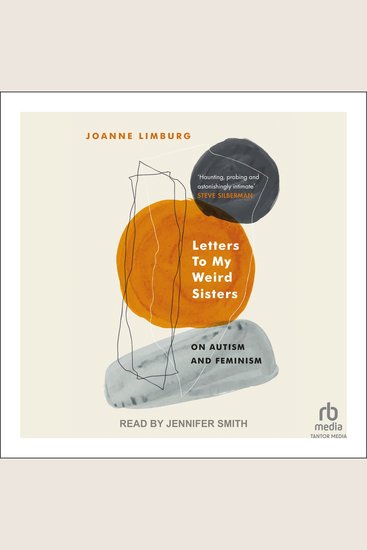
  • Letters to My Weird Sisters - On Autism and Feminism - cover

    Letters to My Weird Sisters - On...

    Joanne Limburg

    • 0
    • 0
    • 0
    An autistic feminist author looks at women's history, in search of her 'weird sisters.' 


    It seemed to me that many of the moments when my autism had caused problems, or at least marked me out as different, were those moments when I had come up against some unspoken law about how a girl or a woman should be, and failed to meet it. 


    An autism diagnosis in midlife enabled Joanne Limburg to finally make sense of why her emotional expression, social discomfort and presentation had always marked her as an outsider. 


    Eager to discover other women who had been misunderstood in their time, she writes a series of wide-ranging letters to four 'weird sisters' from history, addressing topics including autistic parenting, social isolation, feminism, the movement for disability rights and the appalling punishments that have been meted out over centuries to those deemed to fall short of the norm. 


    This heartfelt, deeply compassionate and wholly original work humanizes women who have so often been dismissed for their differences, and will be celebrated by 'weird sisters' everywhere.
    Ver libro
  • On Class - cover

    On Class

    Deborah Dundas

    • 0
    • 0
    • 0
    Deborah Dundas is a journalist who grew up poor and almost didn’t make it to university. In On Class, she talks to writers, activists, those who work with the poor and those who are poor about what happens when we don’t talk about poverty or class—and what will happen when we do.
    		 
    Growing up poor, Deborah Dundas knew what it meant to want, to be hungry, and to long for social and economic dignity; she understood the crushing weight of having nothing much expected of you. But even after overcoming many of the usual barriers faced by lower- and working-class people, she still felt anxious about her place, and even in relatively safe spaces reluctant to broach the subject of class. While new social movements have generated open conversation about gender and racism, discussions of class rarely include the voices of those most deeply affected: the working class and poor. 
    On Class is an exploration of the ways in which we talk about class: of who tells the stories, and who doesn’t, which ones tend to be repeated most often, and why this has to change. It asks the question: What don’t we talk about when we don’t talk about class? And what might happen if, finally, we did?
    Ver libro