¡Acompáñanos a viajar por el mundo de los libros!
Añadir este libro a la estantería
Grey
Escribe un nuevo comentario Default profile 50px
Grey
Suscríbete para leer el libro completo o lee las primeras páginas gratis.
All characters reduced
The Apparent Meaninglessness of Life - A Journey Through Existential Inquiry and Cosmic Indifference - cover

The Apparent Meaninglessness of Life - A Journey Through Existential Inquiry and Cosmic Indifference

Abdellatif Elhomani

Editorial: Spines

  • 0
  • 0
  • 0

Sinopsis

In this thought-provoking exploration of meaning, readers are led through the confluence of existentialism and science, challenging the pursuit of purpose against cosmic indifference. The text draws from philosophical giants and evolutionary theory to inspire resilience and individual destiny. It serves as a guide for navigating life’s uncertainties and celebrates the human spirit's capacity to find harmony within the cosmos's vast expanse, urging us to forge our own path with authenticity and creative rebellion.
Disponible desde: 07/07/2025.
Longitud de impresión: 188 páginas.

Otros libros que te pueden interesar

  • Global Degree African Roots - Ask me how to start an AI- powered business to fund your education - cover

    Global Degree African Roots -...

    Chiyedza Nyahuye

    • 0
    • 0
    • 0
    Global Degree, African Roots is not just a book—it’s a call to action for African students who are tired of waiting. 
    In a world where degrees no longer guarantee jobs, this bold and timely guide empowers the modern African learner to leverage digital tools, AI, and online platforms to learn, earn, and thrive—before graduation. 
    Written in the warm, no-nonsense voice of “Auntie Chiyedza,” this book speaks directly to students juggling school fees, family expectations, and the silent fear of failure. It answers the questions no one dares to ask out loud: 
    What if the degree isn’t enough? 
    How do I start making money now—from where I am? 
    From Nairobi to Accra, Harare to Kampala, this is for every young African refreshing scholarship pages, freelancing between classes, and dreaming of global possibilities from a borrowed laptop. 
    Your education isn’t a waiting room. 
    It’s your launchpad.
    Ver libro
  • A Modern Utopia - cover

    A Modern Utopia

    H. G. Wells

    • 0
    • 0
    • 0
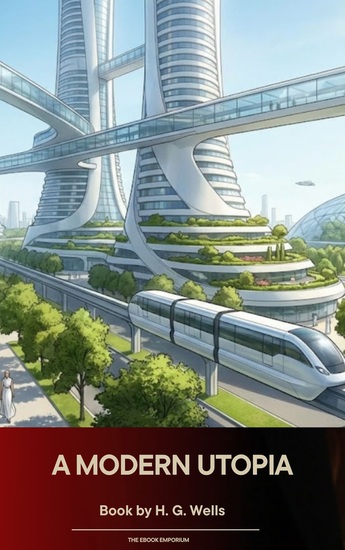
    "For a Utopia to be credible, it must be kinetic—not a static state, but a hopeful stage in an infinite development."
    
    Unlike the rigid, stagnant utopias of the past, H.G. Wells presents a "Kinetic Utopia"—a living, breathing world located on a planet identical to Earth but light-years ahead in social and technological evolution. Following two travelers who find themselves transported to this parallel world, Wells explores a global civilization governed by a World State, where poverty is abolished, technology serves humanity, and a voluntary nobility known as the "Samurai" maintains the moral fiber of the race. This is a brilliant exploration of how a planet-wide society could balance individual liberty with the common good.
    
    The "Samurai" Class: The most enduring concept of the novel is the Samurai—a voluntary order of men and women who follow a strict Rule of life to qualify for leadership. They are not a hereditary caste but an intellectual and moral meritocracy. Wells uses this concept to solve the age-old problem of governance: how to ensure that those in power are disciplined, selfless, and dedicated to the progress of the species.
    
    A World of Motion: Wells argues that a modern utopia cannot be a walled city; it must encompass the entire globe. In this world, every citizen is tracked by a universal indexing system (a startlingly prophetic vision of modern data), ensuring that while people are free to travel and change professions, the state can provide for their needs and maintain social stability. It is a world where the "Five Freedoms" are guaranteed, and the focus of human life shifts from survival to self-actualization.
    
    Rediscover the dream of a better world. Purchase "A Modern Utopia" today and explore the frontiers of human possibility.
    Ver libro
  • Vijayanagara Empire - Hampi's Glorious Past and the Last Hindu Kingdom - cover

    Vijayanagara Empire - Hampi's...

    Rolf Hedger

    • 0
    • 0
    • 0
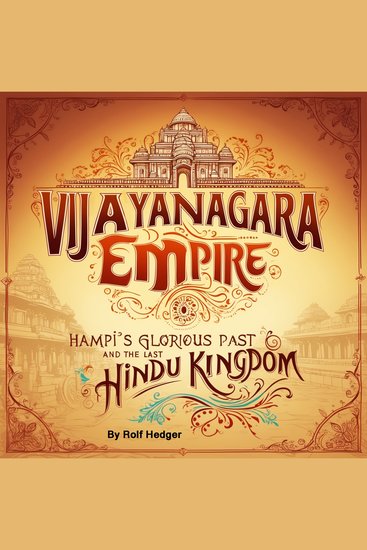
    The Vijayanagara Empire emerged as one of the most significant and powerful dynasties in Indian history, rising at a time when the Indian subcontinent was fragmented and facing threats from expanding Islamic sultanates. Its foundation in the 14th century was a turning point that not only established a strong Hindu kingdom in southern India but also laid the groundwork for a cultural and economic renaissance. 
    The origins of Vijayanagara trace back to the political instability of the Deccan region. The Delhi Sultanate had extended its influence into the south, leading to the weakening of older Hindu kingdoms such as the Kakatiyas, Hoysalas, and Pandyas. Amid this turmoil, two brothers, Harihara and Bukka, originally serving under the Kakatiya rulers, rose to prominence. After being captured and later released by the Delhi Sultanate, they sought guidance from the sage Vidyaranya, who inspired them to establish a strong Hindu kingdom to resist further invasions. In 1336, they founded the city of Vijayanagara on the banks of the Tungabhadra River, marking the birth of the empire. 
    From its inception, the Vijayanagara Empire was strategically positioned to thrive. The Tungabhadra River provided a natural defensive barrier, while the rocky terrain of Hampi served as a formidable protection against enemy invasions. The early rulers focused on consolidating power, expanding their territories, and strengthening their military capabilities. Under Harihara I, the empire extended its control over parts of Karnataka and Andhra Pradesh, securing key trade routes and fortifying its defenses.
    Ver libro
  • Reading the Times - A Literary and Theological Inquiry into the News - cover

    Reading the Times - A Literary...

    Jeffrey Bilbro

    • 0
    • 0
    • 0
    "Reading the morning newspaper is the realist's morning prayer."—G. W. F. Hegel 
    Whenever we reach for our phones or scan a newspaper to get "caught up," we are being not merely informed but also formed. News consumption can shape our sense of belonging, how we judge the value of our lives, and even how our brains function. Christians mustn't let the news replace prayer as Hegel envisioned, but neither should we simply discard the daily feed. We need a better understanding of what the news is for and how to read it well. 
    Jeffrey Bilbro invites readers to take a step back and gain some theological and historical perspective on the nature and very purpose of news. In Reading the Times he reflects on how we pay attention, how we discern the nature of time and history, and how we form communities through what we read and discuss. Drawing on writers from Thoreau and Dante to Merton and Berry, along with activist-journalists such as Frederick Douglass and Dorothy Day, Bilbro offers an alternative vision of the rhythms of life, one in which we understand our times in light of what is timeless. Throughout, he suggests practices to counteract common maladies tied to media consumption in order to cultivate healthier ways of reading and being. 
    When the news sets itself up as the light of the world, it usurps the role of the living Word. But when it helps us attend together to the work of Christ—down through history and within our daily contexts—it can play a vital part in enabling us to love our neighbors. Reading the Times is a refreshing and humane call to put the news in its place.
    Ver libro
  • Why Johnny Still Can't Read or Write or Understand Math - And What We Can Do About It - cover

    Why Johnny Still Can't Read or...

    Andrew Bernstein

    • 0
    • 0
    • 0
    The current school system churns out millions of illiterates and mental zombies—but here's how we're going to fix it, starting today. 


    Coming out of the COVID-19 pandemic, parents across the nation grapple with a new and horrifying understanding of just how bad our educational system has become. It all adds up to a system that seems hopelessly, terribly, and irrevocably broken. But as an educator and author, Andrew Bernstein reminds us that American education in the nineteenth through early-twentieth century was superb. This nation once knew how to turn out the brightest, most resourceful and independent-thinking people the world had ever seen. We can do it again.
    Ver libro
  • Summary: Your Next Five Moves - Master the Art of Business Strategy by Patrick Bet-David: Key Takeaways Summary & Analysis - cover

    Summary: Your Next Five Moves -...

    Brooks Bryant

    • 0
    • 0
    • 0
    Disclaimer: This is not the official book, but a summary & it does not accompany the official book. 
    Strap in for a deep dive into 'Your Next Five Moves: Master the Art of Business Strategy' with our concise, insightful summary. This essential guide encapsulates the wealth of knowledge imparted by entrepreneur and CEO Patrick Bet-David, whose principles have guided thousands towards achieving their business dreams. 
    Our summary elucidates Bet-David's unique approach to strategic thinking, teaching you how to anticipate challenges, predict industry trends, and make sound decisions to drive your business forward. This book is a blueprint for mastering personal and business strategy, understanding your competitive advantage, hiring the right people, and leading with purpose. 
    Learn the key aspects of business, from identifying your ideal customer and defining your brand to scaling your operations and building a loyal team. With this summary of 'Your Next Five Moves,' you will gain the tools to formulate your own winning strategies and propel your business to new heights.
    Ver libro