Join us on a literary world trip!
Add this book to bookshelf
Grey
Write a new comment Default profile 50px
Grey
Subscribe to read the full book or read the first pages for free!
All characters reduced
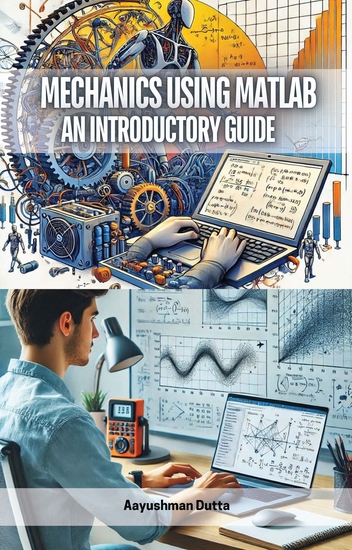
Mechanics Using Matlab - An Introductory Guide - cover

Mechanics Using Matlab - An Introductory Guide

Aayushman Dutta

Publisher: Educohack Press

  • 0
  • 0
  • 0

Summary

"Mechanics Using Matlab: An Introductory Guide" bridges the gap between fundamental principles of mechanics and their practical implementation using Matlab, a powerful computational tool widely used in engineering and scientific applications. We offer an invaluable resource for students, educators, and professionals seeking to deepen their understanding of classical mechanics and enhance their problem-solving skills through computational techniques.
We begin by laying a solid foundation in core concepts of mechanics, including kinematics, dynamics, and energy principles. Through clear explanations and illustrative examples, we guide readers through essential theories and equations governing the motion of particles and rigid bodies. Emphasis is placed on developing a conceptual understanding of the underlying physics, reinforced through Matlab-based exercises and simulations.
One of the key strengths of our book lies in its integration of theory with practical application. Each chapter elucidates the theoretical framework and demonstrates how to implement it computationally using Matlab scripts and functions. Topics covered include particle dynamics, projectile motion, Newton's laws of motion, circular motion, conservation principles, rotational dynamics, oscillations, and orbital mechanics.
Throughout the text, Matlab code snippets are provided alongside explanations, allowing readers to gain hands-on experience in solving mechanics problems numerically. This interactive approach reinforces theoretical concepts and equips readers with valuable computational skills.
With worked examples and practice problems, "Mechanics Using Matlab: An Introductory Guide" challenges readers and reinforces their understanding. This book serves as a practical reference for engineers, scientists, and researchers in fields where mechanics plays a crucial role.
Available since: 02/20/2025.
Print length: 306 pages.

Other books that might interest you

  • Healthcare Revolution: Secrets for Empowered Patients - "Transform your health knowledge! Engage with powerful audio insights to become an empowered patient" - cover

    Healthcare Revolution: Secrets...

    Lysander Bexley

    • 0
    • 0
    • 0
    Healthcare Revolution: Secrets for Empowered Patients 
    Are you ready to take charge of your healthcare journey and enhance your understanding of the healthcare landscape? 
    In search of a thorough guide that equips you with all the essential tools for navigating today’s complex healthcare system? 
    Your search ends here! 
    This guide serves as your ultimate resource for deepening your comprehension, applying your insights, and engaging in practical exercises. With this, you're set for success. 
    Updated to reflect the current healthcare system. 
    Key features of this enhanced guide: 
    - In-depth insights about navigating today’s healthcare landscape 
    - Thorough explanation of key healthcare concepts 
    - Effective strategies for preparation and tackling challenges 
    Our guide stands out due to its comprehensive coverage, which is vital for your success. Concepts are explored with precision rather than just skimmed over. 
    Please note that this guide is an independent resource and is not affiliated with any official healthcare entity. 
    Written with a clear structure and plain language, our guide ensures smooth transitions between topics. Say goodbye to confusing jargon and embrace clear, precise, and technically accurate content. 
    So, why wait? Click the BUY NOW button, secure your guide, and embark on your journey toward empowerment in the healthcare system!
    Show book
  • Artificial Intelligence - cover

    Artificial Intelligence

    Geeta Zunjani

    • 0
    • 2
    • 0
    Touchpad Artificial Intelligence series has some salient features such as AI Reboot, AI Deep Thinking, 
    AI in Life, AI Lab and AI Ready which ensures that NEP 2020 guidelines are followed. 
    
    KEY FEATURES 
    - National Education Policy 2020 
    - AI Game: It contains an interesting game or activity for the students to try on their own or with their classmates to learn how the game mechanics work while having fun. 
    - Brainy Fact: It presents an interesting fact relevant to the topic or the chapters. 
    - AI in Life: It presents questions that promotes the moral growth and experiential learning. 
    - AI Deep Thinking: It presents a question/scenario in which the students are required to think deeply and apply their knowledge. 
    - Digital Solutions 
    
    DESCRIPTION 
    Touchpad Artificial Intelligence series has some salient features such as AI Reboot, AI Deep Thinking, AI in Life, AI Lab and AI Ready which ensures that NEP 2020 guidelines are followed. Every chapter has competency based questions as guided by CBSE to ensure that students are capable of applying their learning to solve some real life challenges. 
    There are plenty of Video Sessions for students and teachers to go beyond the syllabus and enrich their knowledge. There are some brainstorming questions in the form of AI Task in between the topics to ensure that students give pause to their learning and use their skills to reach to some creative ideas in solving given problems. 
    
    WHAT WILL YOU LEARN 
    You will learn about: 
    - Introduction to AI 
    - Pioneers of AI 
    - Domains of AI 
    - Fields of AI 
    - Future of AI 
    
    WHO THIS BOOK IS FOR 
    Grade 7 
    
    TABLE OF CONTENTS (Numbered list) 
    1. Introduction to AI 
    2. Pioneers in the field of AI 
    3. Domains of AI 
    4. Fields of AI 
    5. Concept of Smart Living 
    6. Future of Artificial Intelligence 
    7. AI Ready 
    8. Projects 
    9. AI Glossary 
    10. AI Innovators
    Show book
  • How to Be a Scientist - Critical Thinking in the Life Sciences - cover

    How to Be a Scientist - Critical...

    Deborah M. Brown, Roslyn A. Kemp

    • 0
    • 0
    • 0
    Many undergraduate students choose a science degree but are not aware of how science and research work in the real world. This book explains how scientific research is conceived, carried out and analyzed. It outlines how research findings are constantly evolving and why that is exciting and important. Students using this textbook will learn how to design experiments, explain their data, and analyze and interpret the work of others. They will learn to think about broader aspects of science, such as bias and ethics. They will gain practical skills, including understanding the use of statistical tests and how to prepare an effective presentation. Active individual and class exercises provide opportunities for students to think about difficult concepts in science and research and to include their own perspectives. 


    Key Features: 


    ● Encourages discussion and critical thinking using individual and class exercises 


    ● Provides real-world examples and context for difficult concepts 


    ● Documents a variety of career options and opportunities from studying science 


    ● Permits students to advocate for science with suggestions for creating and sharing research
    Show book
  • Hydrology - Water's Journey in Nature - cover

    Hydrology - Water's Journey in...

    Mike Crawford

    • 0
    • 0
    • 0
    The water cycle, also known as the hydrological cycle, is a continuous and dynamic process that moves water throughout the Earth's atmosphere, surface, and underground reservoirs. This cycle plays a vital role in sustaining ecosystems, regulating climate, and supporting human life. Water undergoes various transformations as it moves through different stages, driven by the energy of the sun and the force of gravity. 
    One of the fundamental processes of the water cycle is evaporation, where water from oceans, lakes, rivers, and even soil turns into water vapor due to heat from the sun. Plants also contribute to this process through transpiration, where they release moisture from their leaves into the air. Together, these processes add significant amounts of water vapor to the atmosphere. As the air rises and cools, this vapor undergoes condensation, forming clouds composed of tiny water droplets or ice crystals. 
    When these droplets combine and become heavy enough, precipitation occurs in the form of rain, snow, sleet, or hail. Precipitation is the primary way water returns to the Earth's surface, replenishing water bodies and providing essential moisture for plant and animal life. Depending on the terrain and environmental conditions, this water can take several different paths. Some of it infiltrates into the ground, recharging underground aquifers in a process known as groundwater recharge. Other portions of the water flow overland as surface runoff, eventually collecting in rivers, lakes, and oceans. This runoff helps shape landscapes by eroding and transporting sediments over time.
    Show book
  • Cosmic Inflation - Gravitational Waves and the Physics of Expansion - cover

    Cosmic Inflation - Gravitational...

    Steff Jaywan

    • 0
    • 0
    • 0
    The story of our universe begins with one of the most profound and complex questions ever posed: How did it all begin? For centuries, humanity has sought to understand the origins of the cosmos, leading to an ever-evolving tapestry of ideas, theories, and discoveries. 
    In the early 20th century, the concept of the Big Bang emerged as a groundbreaking model, suggesting that the universe had a finite beginning—a singular moment in time when all matter, energy, and space itself erupted from an incredibly hot and dense state. This theory not only provided a framework for understanding the expansion of the universe but also posed new questions about the very nature of existence. 
    However, as scientists delved deeper into the implications of the Big Bang, they encountered puzzling anomalies. The uniformity of the cosmic microwave background radiation, the distribution of galaxies, and the large-scale structure of the universe seemed to suggest that something more profound had occurred in the first moments after the universe's birth.
    Show book
  • Vanishing Life on Earth - cover

    Vanishing Life on Earth

    Bimalendu B. Nath

    • 0
    • 0
    • 0
    The book is an abridged story of life that we see now and the life forms that 
    existed in the past. Readers can flip through pages of the planet's 
    history and explore the secrets hidden in the fossils scattered across forgotten landscapes. 
    The species we see today are only a tiny fraction of all those that 
    have ever lived on Earth. Most of the species have vanished throughout the Earth's history. 
    The author intersected at five major extinction episodes and narrated 
    selected stories of the lost world while highlighting life's journey on our plants —from tiny 
    microorganisms to massive dinosaurs, mammoths and mastodons, ultimately leading up to humans. 
    Unfortunately, we're now facing a critical moment when Earth’s biodiversity is at risk of being wiped out entirely, 
    and our planet may stop breathing one day. This prompts readers to reflect on what we have done to bring life's 
    diversity to such a vulnerable state. The author concludes the book with future perspectives on how we all can stop the next mass extinction.
    Show book