Join us on a literary world trip!
Add this book to bookshelf
Grey
Write a new comment Default profile 50px
Grey
Subscribe to read the full book or read the first pages for free!
All characters reduced
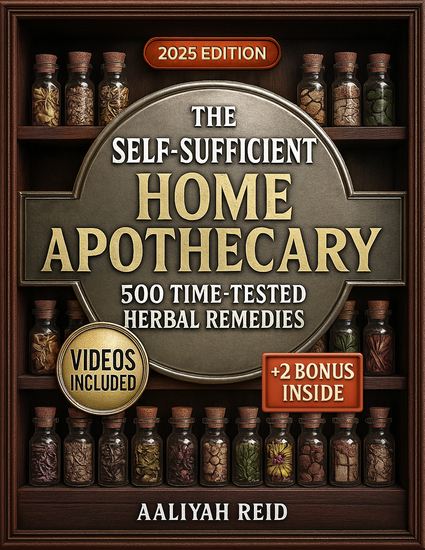
The Self-Sufficient Home Apothecary - 500 Time-Tested Herbal Remedies & Step-by-Step Recipes to Relieve Pain Boost Immunity Improve Sleep and Restore Vitality Naturally - cover

The Self-Sufficient Home Apothecary - 500 Time-Tested Herbal Remedies & Step-by-Step Recipes to Relieve Pain Boost Immunity Improve Sleep and Restore Vitality Naturally

Aaliyah Reid

Publisher: GoldenPeak Press

  • 0
  • 0
  • 0

Summary

🌿 Build Your Own Herbal Healing Toolkit with 500 Time-Tested Remedies to Relieve Pain, Boost Immunity, Improve Sleep, and Restore Balance — Naturally.
 
The Hidden Cost of Modern Healthcare and the Simple, Proven Wisdom That Puts Healing Back in Your Hands
 
What if the relief you’ve been searching for — from stress, fatigue, chronic pain, or restless nights — wasn’t sitting in your medicine cabinet… but growing in your backyard or waiting in your kitchen?
 
For generations, everyday people used the plants around them to heal, protect, and thrive.
 
But somewhere along the way, we stopped trusting our roots — and started outsourcing our wellness.
 
Now, it’s time to reconnect.
 
It’s time to take your health back, naturally and confidently — with remedies that are simple, effective, and rooted in generations of wisdom.
 
🌼 Introducing: The Self-Sufficient Home Apothecary
 
This isn’t just another herbal book — it’s your practical, step-by-step guide to creating a home apothecary that works for you and your family. Whether you’re brand new to herbs or ready to go deeper, this book will help you:
 
✅ Relieve everyday pain and inflammation using gentle, plant-based formulas✅ Support your immune system naturally with trusted herbal blends✅ Ease anxiety and stress with calming, restorative remedies✅ Sleep deeper and wake up refreshed, without pills or side effects✅ Craft teas, tinctures, oils, salves, and syrups at home — no prior experience required
 
And the best part? You don’t need to be a certified herbalist — just someone who wants to feel better, live cleaner, and reclaim their wellness.
 
🌿 What You’ll Discover Inside This Book:
 
🧪 500 Proven Herbal Remedies: for pain, sleep, immunity, digestion, skin, mental wellness, women’s health, and more.📚 Beginner-Friendly, Step-by-Step Guidance: no fluff. No jargon. Just clear, calming instruction you can follow right away.🌱 The 10 Must-Have Herbs: Start with the most powerful and versatile plants every home apothecary should include.👨‍👧‍👦 Safe for the Whole Family: Gentle and effective solutions for adults, kids, and even pets — with dosage tips included.📖 Rooted in Wisdom, Backed by Experience: A blend of practical knowledge, ancestral tradition, and real-life application — not hype or trends.
 
Most books just give you information. This one gives you transformation.You won’t just read about herbal healing — you’ll do it. You’ll prepare remedies, build confidence, and create a space of wellness that supports your body, mind, and home — every day.
 
🌻 Ready to Replace the Pharmacy With a Natural, Self-Sufficient Home Apothecary?
 
You’ve been told that healing only comes in a prescription.But the truth is the most powerful medicine is already within reach.
 
✨ Grab your copy now and begin your journey to natural, hands-on healing — one remedy at a time. This is your time to reclaim your health, reconnect with nature, and create a wellness lifestyle that lasts.
Available since: 04/06/2025.
Print length: 182 pages.

Other books that might interest you

  • Ecology - Understanding Ecosystems and the Interconnectedness of Life - cover

    Ecology - Understanding...

    Jeron Iris

    • 0
    • 0
    • 0
    Ecology is the branch of biology that deals with the relationships between living organisms and their interactions with their environment. This scientific discipline explores how organisms coexist within ecosystems, interact with one another, and adapt to their surroundings. The study of ecology is vital because it provides insight into the functioning of natural systems and the impact human activities have on the environment. It emphasizes the interdependence of all life forms, from microscopic bacteria to the largest animals, and underscores the intricate balance necessary for sustaining life on Earth. 
    At its core, ecology is concerned with understanding the distribution and abundance of organisms, as well as the processes that shape these patterns. It is a multidisciplinary field that draws from biology, geography, geology, chemistry, and physics. Ecologists examine how factors such as climate, geography, and natural resources influence the diversity of life in different habitats. They also study the effects of human intervention, such as deforestation, pollution, and climate change, on ecosystems.
    Show book
  • Lean Change Management - Navigating Organizational Transformation with Agility and Resilience - cover

    Lean Change Management -...

    Daniel Green

    • 0
    • 0
    • 0
    In this groundbreaking exploration, we delve into the dynamic world of change management, unveiling a paradigm shift that blends Lean principles with agile methodologies to navigate organizational transformations with unparalleled agility and resilience. 
    As the business landscape evolves at an unprecedented pace, traditional change management approaches prove inadequate in addressing the challenges of today's fast-paced environment. This book introduces the Lean Change Management Framework, a revolutionary guide that empowers leaders and change agents to steer their organizations through change with unparalleled efficiency and adaptability. 
    Discover the intricacies of Lean Change Management, exploring the framework's three pillars: Plan, Engage, and Iterate. Uncover the secrets of strategic planning, stakeholder engagement, and iterative implementation that form the bedrock of this transformative approach. Learn how to cultivate agile teams, overcome resistance to change, and measure progress effectively to achieve sustainable and lasting transformations. 
    The narrative unfolds through insightful case studies, drawing on real-world examples of organizations that have successfully embraced Lean Change Management. These stories provide invaluable lessons, offering practical insights and highlighting best practices that can be applied across various industries and contexts. 
    Embrace the principles of Lean Change Management, foster a culture of continuous improvement, and lead your organization into a future where adaptability and resilience are the cornerstones of success. 
     
    Show book
  • Creative Evolution - cover

    Creative Evolution

    Henri Bergson

    • 0
    • 0
    • 0
    Henri Bergson’s highly influential book, ‘Creative Evolution’ (‘Evolution Creatrice’, 1907) established a theory of evolution - called ‘Creative Evolution Theory’ - which gained a considerable following in the first half of the 20th Century. It also helped the author to win the Nobel Prize in 1927 for his work investigating the origins of biological information and divergence in the evolutionary process.  
     
    In this work, Bergson seeks an alternative explanation as to how new forms of life emerge compared to those prevailing at the time. This included both the ‘mechanistic’ or deterministic explanations of biological science on the one hand, and on the other the ‘finalist’ or strictly teleological explanation of those who believed in the hand of a ‘Creator’ or God, coordinating life in a divine plan. 
     
    Creative Evolution proposes a third explanation in what Bergson calls élan vital’ or ‘vital impetus’, a force that infuses all matter and drives it forward into an ever-changing and infinite variety of living forms. This appears as a vital impetus that can also be related to humanity’s own creative life force. Bergson’s book builds on his ‘Theory of Time’ as set forth in works such as ‘Matter and Memory’ and ‘Time and Free Will’.  In these works, and in the present volume, Bergson sees continuous ‘duration’ as real time, as opposed to the way in which time is divided up into measured units by the ‘organising’ mind of science. 
     
    Life, as we really experience it, is subject to constant change and our tendency to explain evolutionary change by looking only at ‘ends’ achieved rather than the processes by which they emerge, divorces us from the life force itself.  
     
    Instead, Bergson feels we need to reengage with our instincts as well as with our intelligence in order to understand the evolutionary process, as both co-exist to some extent within us, all forms of life having a common origin in that instinctual, innate knowledge of simpler life forms. Though these may be unconscious or semi-conscious, they are, in Bergson’s view, much more in touch with the ever-changing nature of real time than the analytical and rational knowledge of our species 
     
    As he writes:  “Our thought, in its purely logical form, is incapable of presenting the true nature of life, the full meaning of the evolutionary movement. Created by life, in definite circumstances, to act on definite things, how can it embrace life, of which it is only an emanation or an aspect?”  
     
    It is to attempt an answer to this question that ‘Creative Evolution’ directs its attention.
    Show book
  • Chorology - Geographical Distributions: How Organisms Spread Across the Planet - cover

    Chorology - Geographical...

    Mike Crawford

    • 0
    • 0
    • 0
    Chorology, the study of the geographical distribution of organisms, offers crucial insights into how life is spread across the planet. This scientific discipline examines the patterns, processes, and factors that determine where species occur and why they are found in particular regions. From dense tropical rainforests to arid deserts and remote island ecosystems, chorology helps explain the complex relationships between organisms and their environments. Understanding these distributions is essential not only for ecological research but also for conservation efforts, climate change studies, and predicting future biodiversity trends. 
    The origins of chorology date back to early explorations and observations of naturalists who noted how plants and animals varied across regions. Over time, with advancements in biology, geography, and technology, chorology has developed into a distinct field of study. It now integrates concepts from ecology, evolution, geology, and climatology to provide a comprehensive understanding of how species disperse, adapt, and thrive in diverse environments. By identifying distribution patterns, chorologists can trace the historical movements of species, understand their evolutionary relationships, and predict how current and future environmental changes might alter these patterns. 
    One of the fundamental aspects of chorology is recognizing that species distributions are influenced by a combination of environmental, biological, and historical factors. Climate, topography, soil composition, and availability of resources play significant roles in determining where species can survive and reproduce. Additionally, interactions such as competition, predation, and symbiosis shape the presence or absence of species in particular areas.
    Show book
  • Beat the Bots - A Writer's Guide to Surviving and Thriving in the Age of AI - cover

    Beat the Bots - A Writer's Guide...

    Jane K. Cleland

    • 0
    • 0
    • 0
    Beat the Bots offers science-based creativity techniques that guide you through the writing process to unlock your imagination and create compelling stories that resonate with emotional truth in ways AI can’t match. 
      
    Even though artificial intelligence is based on a technology called “machine learning,” computers can’t learn to be creative—but you can. This book will show you the way. AI is, by definition, derivative, not creative. It can’t bring rational judgment to determine the quality or value of its work. When you bring those capabilities to your writing, your stories will touch readers’ hearts and minds. 
      
    Just as real food is better for us than processed food, and actual social interactions are more meaningful than social media, when it comes to writing your story, artificial intelligence can’t replicate your individual human intelligence, imagination, and sensibility. Technical wizardry can’t tell your story. Only you can do that. Your uniqueness is what separates you from a chatbot, and explains why you can’t be replaced by an algorithm. You’ll succeed because you’re human, not in spite of it. 
      
    Through engaging FAQs, invaluable “Pro Tips,” and “AI Weighs In” revelations, you’ll be able to apply the writing lessons and creativity tactics to all aspects of storytelling, bringing your distinctive vision and voice to your projects in ways AI simply can’t. Thought-provoking, science-based guided exercises challenge you to apply each chapter’s lessons to your own writing. Whether you’re writing a novel, literary nonfiction, or a memoir, you’ll be able to write stories that are fresh and compelling—your stories—and those are the books that publishers want and readers crave. That’s how you’ll beat the bots.
    Show book
  • Blockchain - The Future is Blockchain: Harnessing the Disruptive Potential of Distributed Ledgers - cover

    Blockchain - The Future is...

    Jasper Donovan

    • 0
    • 0
    • 0
    With our ground-breaking book, "Blockchain: The Future is Blockchain - Harnessing the Disruptive Potential of Distributed Ledgers," learn about the strength of blockchain technology and its potential to transform industries. 
    We delve into the blockchain world in this thorough book and examine how it is redefining businesses, sectors, and how we conduct transactions. This book is your go-to resource whether you're an interested person trying to grasp the principles of blockchain or a smart businessperson hoping to benefit from its disruptive potential. 
    Uncover blockchain's benefits, difficulties, and uses as we explore them in diverse fields. We explore how blockchain technology is upending established paradigms and creating new opportunities for innovation in various industries, including finance, supply chain management, healthcare, real estate, and more.
    Show book