Join us on a literary world trip!
Add this book to bookshelf
Grey
Write a new comment Default profile 50px
Grey
Subscribe to read the full book or read the first pages for free!
All characters reduced
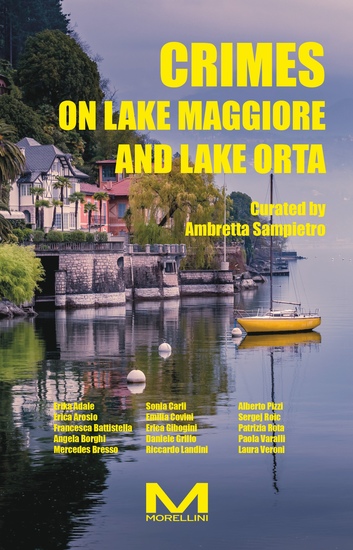
Crimes on Lake Maggiore and Lake Orta - cover

Crimes on Lake Maggiore and Lake Orta

AA. AA.VV

Publisher: Morellini Editore

  • 0
  • 0
  • 0

Summary

Fifteen crime stories set on or nearby the beautiful Lake Maggiore and Lake d'Orta.
The backdrop for these stories are Stresa, Levo, Belgirate, Santa Caterina del Sasso, Luino, Maccagno, Sesto Calende, Brissago, Mergozzo, Orta and Pettenasco. Fifteen authors with different styles and united by a love of the lakes and a passion for writing.
Available since: 02/11/2025.
Print length: 157 pages.

Other books that might interest you

  • Inspiration An - From their pens to your ears genius in every story - cover

    Inspiration An - From their pens...

    George Gissing

    • 0
    • 0
    • 0
    George Robert Gissing was born on November 22nd, 1857 in Wakefield, Yorkshire.  
    He was educated at Back Lane School in Wakefield. Gissing loved school. He was enthusiastic with a thirst for learning and always diligent.  By the age of ten he was reading Dickens, a lifelong hero. 
    In 1872 Gissing won a scholarship to Owens College. Whilst there Gissing worked hard but remained solitary. Unfortunately, he had run short of funds and stole from his fellow students. He was arrested, prosecuted, found guilty, expelled and sentenced to a month's hard labour in 1876. 
    On release he decided to start over.  In September 1876 he travelled to the United States. Here he wrote short stories for the Chicago Tribune and other newspapers. On his return home he was ready for novels. 
    Gissing self-published his first novel but it failed to sell.  His second was acquired but never published. His writing career was static.  Something had to change.  And it did. 
    By 1884 The Unclassed was published.  Now everything he wrote was published. Both Isabel Claren-don and Demos appeared in 1886. He mined the lives of the working class as diligently as any capitalist. 
    In 1889 Gissing used the proceeds from the sale of The Nether World to go to Italy. This trip formed the basis for his 1890 work The Emancipated. 
    Gissing's works began to command higher payments. New Grub Street (1891) brought a fee of £250.  
    Short stories followed and in 1895, three novellas were published; Eve's Ransom, The Paying Guest and Sleeping Fires. Gissing was careful to keep up with the changing attitudes of his audience.  
    Unfortunately, he was also diagnosed as suffering from emphysema. The last years of his life were spent as a semi-invalid in France but he continued to write. 1899; The Crown of Life. Our Friend the Charlatan appeared in 1901, followed two years later by The Private Papers of Henry Ryecroft. 
    George Robert Gissing died aged 46 on December 28th, 1903 after catching a chill on a winter walk.
    Show book
  • The Mouse - From their pens to your ears genius in every story - cover

    The Mouse - From their pens to...

    Saki Saki

    • 0
    • 0
    • 0
    Hector Hugh Munro, more familiarly known by his pen-name ‘Saki’ was born in what was then Akyab in British Burma on 18th December 1870. His father was an Inspector General for the Indian Imperial Police, and his mother the daughter of a Rear Admiral. 
    When he was 2 his mother died and he and his siblings were sent back to England to be raised by their grandmother and paternal maiden aunts in a strict, puritanical household near Barnstaple, Devon. Educated by governesses Saki used many of these women as character models for his later writing. 
    At 17 his father retried and returned to England and then embarked on a series of European travels with Saki and his siblings. 
    After a short stint working in Burma with the Indian Imperial Police Saki decided to move to London to make a living as a writer. Initially he wrote as a journalist for a number of newspapers and magazines before attempting an historical study, ‘The Rise of the Russian Empire’, whose real value lay in directing him to writing short stories instead, the first of which, ‘Dogged’, he published in 1899. 
    From here it was a short stab of the pen to writing political satire before in 1902 he became the foreign correspondent for The Morning Post, first in the Balkans, then Russia, Paris and back to London in 1908, where 'the agreeable life of a man of letters with a brilliant reputation awaited him.'  
    Collections of his short stories full of witty, mischievous and often macabre stories that satirized Edwardian society and two novels now appeared in the years up to the Great War.  At its’ outbreak he was 43 but managed to join as an ordinary trooper. More than once he returned to the battlefield when officially too sick or injured.  
    On 14th November 1916 Hector Hugh Munro was sheltering in crater during the Battle of the Ancre, when he was shot and killed by a German sniper. According to several sources, his last words were "Put that bloody cigarette out!"
    Show book
  • Extra Ordinary Animal Tales - cover

    Extra Ordinary Animal Tales

    Swati Jain

    • 0
    • 0
    • 0
    This book captures the facts about the extraordinary animals. The facts are amazing and so are the short stories associated with each animal. 
    The author Swati Jain has tried to keep it simple yet surprising for kids to enjoy the facts and the stories. 
    Increase your knowledge about animal , birds, ocean creatures world with interseting stories very related to the animals surrondings and behavirous.  
    The focus of the stories are families and childhood.
    Show book
  • Stories About Miners And Mining - An interesting array of tales from around the world - cover

    Stories About Miners And Mining...

    Bret Harte, D H Lawrence, E T A...

    • 0
    • 0
    • 0
    Man has learnt to control his dominion by the use of what initially lay about him; wood and stone for shelter and building as well as resources from the plant and animal worlds over which he slowly obtained dominion.  But as he organised into Nations and Empires, he needed more with which to keep the whole machine spinning.  Society was growing and consuming more.  But many of the richer seams of fuel and minerals lay buried underground.  These riches needed exploiting, brought to the surface to be used and sold.   
     
    In this volume our authors detail sharp-eyed narratives on people whose lives were connected and directed by what happened underground. 
     
    1 - Stories About Mines and Mining - An Introduction 
    2 - Odour of Chrysanthemums by D H Lawrence 
    3 - The Mine Cart by Ryunosuke Akutagawa 
    4 - The Luck of Roaring Camp by Bret Harte 
    5 - An Unexpected Reunion by Johann Hebel 
    6 - The Mines of Falun - Part 1 by E T A Hoffman 
    7 - The Mines of Falun - Part 2 by E T A Hoffman 
    8 - Her Turn by D H Lawrence
    Show book
  • The Absent Minded Man - From their pens to your ears genius in every story - cover

    The Absent Minded Man - From...

    Jerome K. Jerome

    • 0
    • 0
    • 0
    Jerome Klapka Jerome was born on the 2nd May 1859 at Belsize House in Caldmore, Walsall, England. 
    His family were reduced to poverty whilst he was a toddler owning to failed investments in the local mining industry. 
    After several moves in declining circumstances Jerome became a pupil at St Marylebone Grammar School.  His aim then was to go into politics, or even become a man of letters, but with the death of his father, when he was thirteen, and his mother two years later, now meant that he had to support himself and leave all thoughts of education behind. 
    He spent four years working for the London and North Western Railway, initially collecting coal that fell along the railway lines.  Thereafter, using the name Harold Crichton, he tried his hand at acting but the repertory company he joined was stretched in its resources and, at times, relied on the actors to purchase their own props and costumes.  After three years he tried journalism, teaching and work as a solicitor’s clerk.  All came to nothing.  Finally, in 1885, he had some success with ‘On the Stage―and Off’, a comic memoir collection of his stage experiences and his early attempts at acting.  
    Shortly thereafter he married and his honeymoon on the Thames became the inspiration for ‘Three Men in a Boat’.  This of course was a wild success, both critically and commercially, but also his creative high point.  
    Although he was now able to write full time, he was never able to attain all the heights of that classic humorous novel.  He remained a prolific writer of novels, plays and short stories and its from those classic works that these stories have been mined. 
    Jerome K Jerome died in Northampton General Hospital on the 14th June 1927 two weeks after suffering a paralytic stroke and a cerebral haemorrhage on a motoring tour.  He was 68.
    Show book
  • Man Overboard - A horror tale set on a ship full of mystery and twists along the way - cover

    Man Overboard - A horror tale...

    F. Marion Crawford

    • 0
    • 0
    • 0
    Francis Marion Crawford, an only child, was born on 2nd August 1854 at Bagni di Lucca, Italy. He was a nephew to Julia Ward Howe, the American poet and writer of ‘The Battle Hymn of the Republic’.  
     
    Crawford was educated at St Paul's School, Concord, New Hampshire and then on to Cambridge University, the University of Heidelberg and the University of Rome.  
     
    In 1879 he went to India, to study Sanskrit and then to edit The Indian Herald. In 1881 he returned to America to continue his Sanskrit studies at Harvard University. 
     
    His family became increasingly concerned about his employment prospects.  After an attempt at a singing career as a baritone was ruled out, he was encouraged to write.  
     
    In December 1882 his first novel, ‘Mr Isaacs’, was published and was an immediate hit as was his second novel ‘Dr Claudius’ in 1883.  
     
    In October 1884 he married Elizabeth Berdan and encouraged by his excellent start to a literary career they returned to Sant Agnello, Italy to make a permanent home, buying the Villa Renzi that then became Villa Crawford.  
     
    In the late 1890s, Crawford began work on his historical works which would later include ‘Corleone’, in 1897, the first major treatment of the Mafia in literature.  
     
    Crawford is also exceedingly popular and anthologized as a short story writer of bizarre and creepy tales.   
     
    In 1908 came his classic ‘The Screaming Skull’. Without doubt its unsettling nature is heightened as the reader/listener is drawn into to the story by its narrator.  Everything is explained and plausible until, of course, it isn’t. 
     
    Francis Marion Crawford died at Sorrento on Good Friday 1909 at Villa Crawford of a heart attack.  
     
    In ‘Man Overboard’ Crawford uncovers the story of identical twins.  When one falls overboard it unravels a sequence of events that take years to complete, all with a growing sense of uneasiness that further misery awaits
    Show book