Begleiten Sie uns auf eine literarische Weltreise!
Buch zum Bücherregal hinzufügen
Grey
Einen neuen Kommentar schreiben Default profile 50px
Grey
Jetzt das ganze Buch im Abo oder die ersten Seiten gratis lesen!
All characters reduced
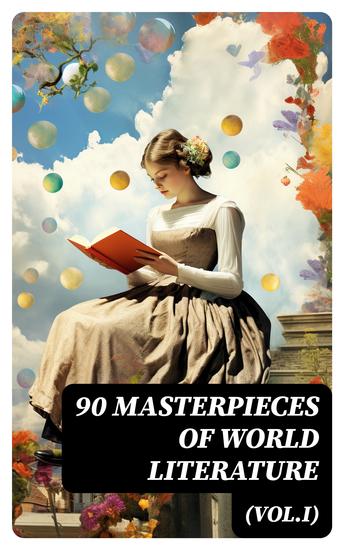
90 Masterpieces of World Literature (VolI) - Novels Poetry Plays Short Stories Essays Psychology & Philosophy - cover

90 Masterpieces of World Literature (VolI) - Novels Poetry Plays Short Stories Essays Psychology & Philosophy

Edgar Allan Poe, George Eliot, Benito Pérez Galdós, William Shakespeare, Juan Valera, Charles Dickens, Lewis Carroll, Mark Twain, Louisa May Alcott, Jane Austen, Oscar Wilde, Herman Melville, Alexandre Dumas, Joseph Conrad, Charlotte Brontë, Daniel Defoe, Henry David Thoreau, L. Frank Baum, Emily Brontë, Washington Irving, Walt Whitman, Henry James, Hans Christian Andersen, D. H. Lawrence, Anthony Trollope, Giovanni Boccaccio, Guy de Maupassant, Sigmund Freud, Marcus Aurelius, Frederick Douglass, Stephen Crane, William Makepeace Thackeray, Anne Brontë, Robert Louis Stevenson, John Keats, Anton Chekhov, Marcel Proust, George Bernard Shaw, Charles Baudelaire, Walter Scott, R. D. Blackmore, Sun Tzu, H. P. Lovecraft, Francis Hodgson Burnett, Mary Shelley, Rudyard Kipling, Upton Sinclair, Kahlil Gibran, Edgar Rice Burroughs, Ernest Hemingway, Agatha Christie, Herman Hesse, E. M. Forster, H. A. Lorentz, Theodore Dreiser, Plato, H. G. Wells, Nikolai Gogol, Arthur Conan Doyle, Brothers Grimm, Wallace D. Wattles, Selma Lagerlöf, Victor Hugo, Fyodor Dostoevsky, James Joyce, T. S. Eliot, James Allen, Apuleius, Margaret Cavendish, Thomas Hardy, Jack London, Jules Verne, Soseki Natsume, Miguel de Cervantes, Leo Tolstoy, Princess Der Ling, Johann Wolfgang Goethe, Pierre Choderlos de Laclos, Voltaire

Verlag: DigiCat

  • 0
  • 0
  • 0

Beschreibung

In "90 Masterpieces of World Literature (Vol.I)", readers are invited to explore a rich tapestry woven from some of the most influential and diverse voices in literature. This anthology captures a vast spectrum of styles, from the surreal landscapes of Lewis Carroll to the incisive realism of Charles Dickens, and the natural mysticism of Walt Whitman. Within these pages, short stories, essays, and excerpts unfold themes of existential quest, social justice, romantic idealism, and philosophical intrigue. Each piece stands as a testament to the eras and milieus that birthed them, showcasing the expanse of human creativity and thought that transcends time. The anthology benefits from the collective power of its contributors, drawing upon a wide array of cultural and historical contexts. The voices of Plato and Marcus Aurelius converge with the modern insights of Sigmund Freud and D. H. Lawrence, while global narratives from Soseki Natsume to Miguel de Cervantes resonate through time. This collection is a reflection of the transformative movements in literature, such as Romanticism, Realism, and Modernism, bridging Western and Eastern storytelling traditions. Together, these authors offer insights into the universal human experience, enriched by their unique backgrounds and perspectives. This volume serves as a voyage through the corridors of time and thought, offering readers an unparalleled breadth of insights in one curated tome. Whether a seasoned scholar or an enthusiastic newcomer, "90 Masterpieces of World Literature (Vol.I)" provides an invaluable educational resource that fosters an appreciation for the multifaceted dialogues in world literature. Dive into this anthology to uncover the intricate layers and timeless wisdoms it offers, making it not just a reading experience, but a profound exploration of literary brilliance.
Verfügbar seit: 16.11.2023.
Drucklänge: 28094 Seiten.

Weitere Bücher, die Sie mögen werden

  • The Fall of the Monarchy - The Events Leading to the Execution of King Louis XVI and Queen Marie Antoinette - cover

    The Fall of the Monarchy - The...

    Amara Blackwood

    • 0
    • 0
    • 0
    The Ancien Régime, the political and social system that governed France for centuries, was built on a rigid hierarchy that concentrated power in the hands of the monarchy and nobility. This structure, deeply rooted in tradition, relied on the divine right of kings, reinforcing the belief that the king’s authority was absolute and unquestionable. King Louis XVI, like his predecessors, ruled with the assumption that his word was law, but by the late 18th century, the very foundations of this system were beginning to crumble. Economic hardship, social inequality, and growing discontent among the people exposed the fragility of a monarchy that had long ignored the demands of change. 
    At the heart of the Ancien Régime was the Estates System, which divided French society into three distinct groups. The First Estate consisted of the clergy, who enjoyed vast privileges, including exemption from most taxes. The Second Estate was made up of the nobility, who held significant land and influence while also being largely free from taxation. The Third Estate, which comprised the vast majority of the population, included peasants, urban workers, and the emerging bourgeoisie. This group bore the heaviest tax burden while having little political power, a reality that bred resentment and a growing desire for reform. 
    The economic struggles of France further weakened the monarchy’s stability. Years of extravagant spending by the royal court, particularly under King Louis XV and Louis XVI, had left the country in financial ruin. The lavish expenditures of Queen Marie Antoinette, though exaggerated in popular discourse, became a symbol of royal excess. Additionally, France’s costly involvement in the American Revolution had drained the treasury, deepening the crisis. By the 1780s, the government faced an insurmountable debt, and repeated attempts to impose new taxes on the privileged classes were met with fierce resistance.
    Zum Buch
  • Arnold Rothstein and Meyer Lansky: The Lives and Legacies of the Gangsters Who Reformed Organized Crime in America - cover

    Arnold Rothstein and Meyer...

    Editors Charles River

    • 0
    • 0
    • 0
    One of the most integral members of that criminal underworld was Arnold Rothstein, the archetype of the old school mobster. He was intelligent, charming, well-spoken, grotesquely wealthy, and a sharp dresser, often pictured with a patterned bowtie and a flat-top fedora snugly fit over his receding hairline. And yet, he was nothing like the stereotypical mobster; Arnold was not a drinker or smoker, and he was not one to be tempted by illicit substances. He was a notorious high roller, with pockets holding wads of $100 bills, but to the casual eye, he was just another dapper, well-mannered gentleman who frequented the tracks and casinos after a long day at the office. 	In addition to his aversion to the aforementioned vices, Rothstein never chewed gum or cursed (at least in public). He snacked on figs and fruits, and he was equipped with an insatiable sweet tooth. Affectionately nicknamed the “Cookie Monster” by his loved ones, Rothstein adored cookies of all kinds – which he washed down with a glass of milk every evening before bed – and constantly ate cakes, pies, and all sorts of desserts.  
    	One of America’s most infamous mobsters, Meyer Lansky, was also one of the most mysterious, a perplexing, yet inexplicably intriguing individual with multiple reputations. To his admirers, he was in many ways the ultimate genius and survivor within the callous and cut-throat world of 20th century organized crime. Even in adulthood, Meyer was smaller than most, standing anywhere between 4'11” to 5'4”, and weighing 136 pounds at his heaviest. He was not merely an intellectual – he was worldly and wise, one who often doled out advice akin to poetry to his children and grandchildren, his gravelly voice oddly soothing. At the same time, he had all the stealth and cunning of a sphinx, and while remarkably even-tempered, gangsters twice his size dared not cross him.
    Zum Buch
  • Top 10 Short Stories The - The 1910's - The Europeans - The ten best stories written from 1910-1919 by European authors - cover

    Top 10 Short Stories The - The...

    James Joyce, Franz Kafka, Luigi...

    • 0
    • 0
    • 0
    Short stories have always been a sort of instant access into an author’s brain, their soul and heart.  A few pages can lift our lives into locations, people and experiences with a sweep of landscape, narration, feelings and emotions that is difficult to achieve elsewhere. 
     
    In this series we try to offer up tried and trusted ‘Top Tens’ across many different themes and authors. But any anthology will immediately throw up the questions – Why that story? Why that author?  
     
    The theme itself will form the boundaries for our stories which range from well-known classics, newly told, to stories that modern times have overlooked but perfectly exemplify the theme.  Throughout the volume our authors whether of instant recognition or new to you are all leviathans of literature. 
     
    Some you may disagree with but they will get you thinking; about our choices and about those you would have made.  If this volume takes you on a path to discover more of these miniature masterpieces then we have all gained something. 
     
    In this volume we examine a decade of tumult and upheaval for the continent and its Empires as both countries and social classes tense under insoluble issues.  All at once Europe is engulfed in slaughter and overwhelmed by fighting.  Its authors use their pens both to help enlighten and to provide some scant strands of escape in these most demanding of times.   
     
    1 - The Top 10 - The 1910's - The Europeans - An Introduction 
    2 - The Dead - Part 1 by James Joyce 
    3 - The Dead - Part 2 by James Joyce 
    4 - In the Penal Colony by Franz Kafka 
    5 - Sicilian Limes by Luigi Pirandello 
    6 - The Garden of the Holy Virgin by Alexander Kuprin 
    7 - The Horror of the Heights by Arthur Conan Doyle 
    8 - Son by Ivan Bunin 
    9 - The Marseillaise by Leonid Andreyev 
    10 - Dethroned by I N Potapenko 
    11 - The Revolutionist by Mikhail Petrovich Artzybashev 
    12 - The Testament of Magdalen Blair - Part 1 by Aleister Crowley 
    13 - The Testament of Magdalen Blair - Part 2 by Aleister Crowley
    Zum Buch
  • Breaking Better - 22 Armed Robberies and One Decision to Change - cover

    Breaking Better - 22 Armed...

    Lennox Rodgers

    • 0
    • 0
    • 0
    In this searingly honest account, Lennox gives a fascinating insider account of his experiences operating in the criminal underworld in and around London and Oxford. Stomach-churning, heart-breaking, eye-opening - he leaves no stone unturned. Lennox recounts in riveting detail how he was drawn into his life of crime, how he operated as a drug dealer, enforcer and armed robber, and how he survived numerous spells in prisons including Dartmoor, Strangeways, Grendon, Oxford and Lewes. All culminating in the fateful day when, friendless, bloodied and broke, he collapsed behind an industrial bin in an alleyway off London's Oxford Street, and saw an eerie image out of the corner of his eye. In Breaking Better, Lennox sets out the complete story of his decent into darkness and his inspiring road to redemption. Today Lennox is co-founder of Refocus Project and has dedicated his life to helping those most at risk of being exploited or caught up in knife crime, county lines, crime, grooming, money laundering and gangs.
    Zum Buch
  • Walking with Fay - My Mother’s Uncharted Path into Dementia - cover

    Walking with Fay - My Mother’s...

    Carolyn Birrell

    • 0
    • 0
    • 0
    In 2012, Carolyn Birrell flew down to Georgia to kidnap her mother. 
    Fay had been living by herself since her husband’s death in 2000 and clung fiercely to her independence. She went to church on Sundays, paid her bills on time, and volunteered at Vacation Bible School every summer. But at 79 years old, she’d begun showing escalating signs of early-stage dementia, each one making it harder for her daughter to discount as simple signs of aging. 
    After receiving calls from Fay’s local sheriff and the Department of Family Services, Carolyn took action. She quickly came to understand the meaning of the adage, “When we make plans the Universe laughs,” because hers required endless do-overs as she struggled to keep pace with her mother’s ever-progressing disease. 
    This is the story of Carolyn’s mother, her dementia, and how they navigated her journey together. Your loved one may not force feed stuffed animals vanilla pudding or burn their neighbor’s mail like Fay did, but if you’re living through the sad realities of your loved one’s slow and tortuous farewell, this book will help you find solace as you deal with it realistically and with a heart at peace.
    Zum Buch
  • Araby - From their pens to your ears genius in every story - cover

    Araby - From their pens to your...

    James Joyce

    • 0
    • 0
    • 0
    James Augustine Aloysius Joyce was born on the 2nd February 1882 in Dublin into a middle-class family, and the eldest of ten surviving siblings 
    Admired as a brilliant student he briefly attended the Christian Brothers-run O'Connell School before excelling at the Jesuit schools of Clongowes and Belvedere.  From there he went on to attend University College Dublin from 1898, studying English, French and Italian 
    In 1902, Joyce was now in his early twenties, and went to Paris to study Medicine but soon abandoned his teachings.  Back in Dublin to attend to his dying Mother he met Nora Barnacle. They bonded immediately into a life-long match. Together they decided to emigrate to Europe.  The couple lived in Trieste, Rome, Paris, and finally Zürich where Joyce pursued a variety of jobs and ventures to supplement his literary pursuits but none of these paid off.  
    After publishing a poetry volume, ‘Chamber Music’, in 1907, his short story collection ‘The Dubliners’, in 1914, helped establish his talent in the rapidly changing world.  
    Although far from home Joyce’s literary heart and works were set in his recollections of Dublin.  Characters are close resemblances of family and friends and indeed enemies.  His landmark work ‘Ulysses’, published in 1922, is set in the streets and alleyways of the city as it parallels Homer’s Odyssey in a variety of styles including its famed stream of consciousness. 
    His pen continued to produce classics of the order of ‘A Portrait of the Artist as A Young Man’ and ‘Finnegan’s Wake’ together with several volumes of poetry and a play ‘The Exiles, in 1918.   
    On the 11th January 1941, Joyce underwent surgery in Zürich for a perforated duodenal ulcer. The next day he fell into a coma. On the 13th after a brief period of lucidity in which he called for his wife and son he passed.  He was 58.
    Zum Buch