Join us on a literary world trip!
Add this book to bookshelf
Grey
Write a new comment Default profile 50px
Grey
Subscribe to read the full book or read the first pages for free!
All characters reduced
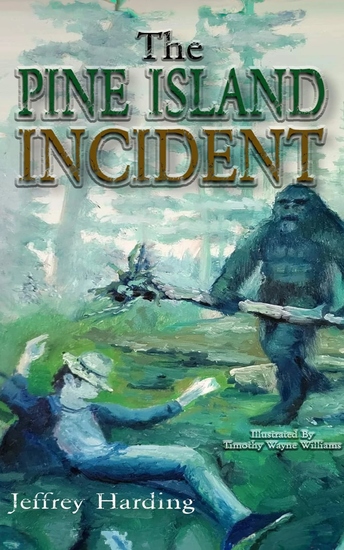
The Pine Island Incident - cover

The Pine Island Incident

Jeffrey Harding

Publisher: Hangar 1 Publishing

  • 0
  • 0
  • 0

Summary

"The Pine Island Incident" is an awe-inspiring, first-hand account of Sasquatch, the legendary and mysterious creature that has captivated the imagination of people for generations. Join the author, an expert outdoorsman, on his journey as he shares his own personal encounter with Sasquatch and his quest to uncover the truth about this elusive beast.
 
From his early years learning the ways of the wilderness, to his time in the US Army, and his post-military life, the author takes you on a journey that is both personal and insightful. He reflects on the impact that different aspects of his life have had on his perspective of Sasquatch, and how his experiences have shaped his understanding of this mysterious creature.
 
In this book, the author delves into the unknown, exploring theories and ideas about Sasquatch that have never been considered before. He discusses the challenges of collecting evidence of Sasquatch and the need for innovative techniques and approaches to study this elusive creature.
 
The author's innovative approach to researching Sasquatch is truly one-of-a-kind, proposing the use of mosquito traps to collect samples of unknown primate DNA in remote areas. This groundbreaking idea highlights the need for collaboration and partnership between the scientific community and Sasquatch researchers.
Available since: 04/21/2023.
Print length: 100 pages.

Other books that might interest you

  • History of Revolutions - cover

    History of Revolutions

    Introbooks Team

    • 0
    • 0
    • 0
    Revolutions differ in their purposes and intentions. Some seek to take over and change the current political order while others like to seek changes in the economy and social lifestyle. 
    Rebellions do share some common features such as they are influencing, they last for some years and they bring about a change, usually causing some chaos. 
    Revolts and revolutions are usually driven by individuals or groups that dream of having a better society, are inspired by hope, and are passionate about achieving their goals. These mutineers endeavor to change or upheaval the old command and replace it with a new one while the old order attempts to uphold its power. The consequences are clash, skirmish, disturbance, and division, which usually lead to battles, war, violence, and loss of human life. 
    Every revolution is unique and happens because of various reasons. Although the end results may be joyful, none of them come with consequences that usually cause turmoil, deaths, diseases, and loss in finances. Some revolutions have earned a place in history, and people ought to take learning from them.
    Show book
  • 444 Days - The American Hostages in Iran and the Fall of Diplomacy - cover

    444 Days - The American Hostages...

    Davis Truman

    • 0
    • 0
    • 0
    It is an explosive true story of survival, betrayal, and the moment America lost its grip on the Middle East. 
    On November 4, 1979, 52 Americans were taken hostage inside the U.S. Embassy in Tehran, an act that stunned the world and sparked a 444-day standoff that shattered U.S. diplomacy and changed global politics forever. 
    In this pulse-pounding narrative, acclaimed historian Davis Truman pulls back the curtain on the backroom deals, psychological torment, and international missteps that defined one of the longest hostage crises in modern history. Drawing from declassified documents, secret cables, and firsthand interviews, 444 Days brings to life the human drama at the heart of a geopolitical disaster. 
    When diplomacy fails, what remains: bluster, betrayal, or a better way forward?
    Show book
  • Yemen in Crisis - Autocracy Neo-Liberalism and the Disintegration of a State - cover

    Yemen in Crisis - Autocracy...

    Helen Lackner

    • 0
    • 0
    • 0
    Yemen is in the grip of its most severe crisis in years. The civil war between the Huthi rebels and the Western and Arab supporters of the regime has resulted in thousands killed and three million displaced. Those who remain suffer severe food shortages and a collapsed economy. The struggle for power in the Arab world's poorest but strategically vital nation has serious implications for the region and beyond. While Egypt and Saudi Arabia fear that a Huthi takeover would threaten free passage of oil through the Bab al-Mandab strait, western governments fear a rise of attacks from al-Qa'ida and IS as the country becomes more unstable. In this invaluable analysis, Helen Lackner uncovers the social and political conflicts that threaten the very survival of the state and its people. She reveals the corruption of the country's US-backed autocratic regime and how it failed to address national impoverishment and to plan an equitable economy for Yemen's growing population.
    Show book
  • How to Interpret the Constitution - cover

    How to Interpret the Constitution

    Cass R. Sunstein

    • 0
    • 0
    • 0
    From New York Times bestselling author Cass Sunstein, a timely and powerful argument for rethinking how the U.S. Constitution is interpreted 
     
    The U.S. Supreme Court has eliminated the right to abortion and is revisiting other fundamental questions today—about voting rights, affirmative action, gun laws, and much more. Once-arcane theories of constitutional interpretation are profoundly affecting the lives of all Americans.  
    In this brief and urgent book, Harvard Law School professor Cass Sunstein provides a lively introduction to competing approaches to interpreting the Constitution—and argues that the only way to choose one is to ask whether it would change American life for the better or worse. If a  
    method of interpretation would eliminate the right of privacy, allow racial segregation, or obliterate free speech, it would be unacceptable for that reason. 
     
    But some Supreme Court justices are committed to “originalism,” arguing that the meaning of the Constitution is settled by how it was publicly understood when it was ratified.  
     
    Originalists insist that their approach is dictated by the Constitution. That, Sunstein argues, is a big mistake. The Constitution doesn’t contain instructions for its own interpretation.  
     
    Any approach to constitutional interpretation needs to be defended in terms of its broad effects—what it does to our rights and our institutions. It must respect those rights and institutions—and safeguard the conditions for democracy itself. 
     
    Passionate and compelling, How to Interpret the Constitution is essential reading for anyone who is concerned about how the Supreme Court is changing the rights and lives of Americans today.
    Show book
  • Beyond Survival - Strategies and Stories from the Transformative Justice Movement - cover

    Beyond Survival - Strategies and...

    Leah Lakshmi...

    • 0
    • 0
    • 0
    Transformative justice seeks to solve the problem of violence at the grassroots level, without relying on punishment, incarceration, or policing. Community-based approaches to preventing crime and repairing its damage have existed for centuries. However, in the putative atmosphere of contemporary criminal justice systems, they are often marginalized and operate under the radar. Beyond Survival puts these strategies front and center as real alternatives to today's failed models of confinement and "correction." 


    In this collection, a diverse group of authors focuses on concrete and practical forms of redress and accountability, assessing existing practices and marking paths forward. They use a variety of forms—from toolkits to personal essays—to delve deeply into the "how to" of transformative justice, providing alternatives to calling the police, ways to support people having mental health crises, stories of community-based murder investigations, and much more. At the same time, they document the history of this radical movement, creating space for long-time organizers to reflect on victories, struggles, mistakes, and transformations.
    Show book
  • How Did Life End Up With Us? - The Secrets of Life: From Big Bang to Trump - cover

    How Did Life End Up With Us? -...

    Ss O'Connor

    • 0
    • 0
    • 0
    Why does the gene behave like a hedge fund manager? Why are mutations like a gambling scam? Why does nothing ever become top dog in life and win forever? Humans only arrived after 99.99% of the time there’s been life on earth. So what was here before us? And how did these species, and the evolutionary process that created them, end up with the unpromising creatures that were our ancestors?In this, the first book of The Secrets of Life quartet, SS O’Connor brings his outsider’s, questioning eye to reveal the great forces that lie behind life: from the laws that arose with Big Bang, through to the ‘decisions’ that organisms make to determine their chances.But how did everything come about? And what made some life forms succeed - while others would join the 99.9% of species that appeared, yet went on to become extinct? The story goes right back to our single-celled forebears - the only things that were on the planet for 80% of its existence, and then continues as it lays out the ways that successive transmissions built increasing complexity, and how the resulting species found their synergistic ways of coexisting.  In an easy-going, conversational style, O'Connor explains in lay-man's language how the gene is the great conductor of life’s orchestra, how it helped millions of life forms to refine themselves - yet why it also sees failure, death and extinctions as opportunities rather than disasters.  Last, the book tells the story of the men who unpicked the mysteries, what they meant by fitness and ‘the fittest’, but why they continued to be baffled by organisms that broke the rules by helping each other. Why would some even choose to be sterile when producing the next generation was the overriding compulsion in life? And why would the answer to this question explain why altruism is the proof for the ‘gene-based theory of evolution’ - and why cooperation was to become the strongest force in life?
    Show book