Rejoignez-nous pour un voyage dans le monde des livres!
Ajouter ce livre à l'électronique
Grey
Ecrivez un nouveau commentaire Default profile 50px
Grey
Abonnez-vous pour lire le livre complet ou lisez les premières pages gratuitement!
All characters reduced
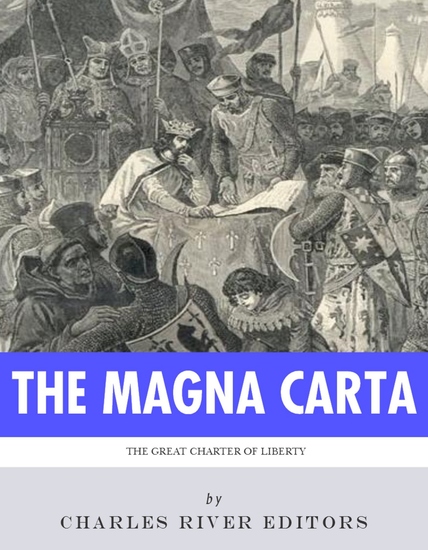
The Magna Carta - The Great Charter of Liberty - cover

The Magna Carta - The Great Charter of Liberty

Editors Charles River

Maison d'édition: Charles River Editors

  • 0
  • 0
  • 0

Synopsis

“To no man will we sell, or deny, or delay, right or justice.” – Magna Carta


The West is home to the world’s oldest and democracies, and though these democratic governments take many different forms, from America’s republican system to Britain’s parliamentary system, every democracy and the principles behind it have their origins in the Magna Carta.


A singularly consequential document in Western civilization, the Magna Carta (Latin for “Great Charter”) was a document consisting of 37 articles signed in June 1215 in Runnymede near Windsor Castle between the barons of the English aristocracy and King John, the absolute monarch. The document embodies a series of written promises between the king and his subjects that he, the king, would govern England and deal with its people according to the customs of feudal law. For the first time, the notion of a king’s absolute power had been successfully challenged without force of arms.


Today the Magna Carta is acknowledged as the founding legal instrument of English common law and thus much of the legal principles of the West, an ironic legacy given that parts of the Magna Carta were distinctly intended to preserve the power of the aristocracy against the interests of the ordinary people. At the same time, however, the Magna Carta was an attempt by the barons to prevent King John from abusing his power while his subjects endured lawlessness, cruel and unjust laws, severe penalties and exorbitant taxation, thus fairly earning its reputation as a charter for individual rights against encroachment by state power. The sovereign ruler was now also subject to law, a previously foreign concept.[1] 


As a cherished and vital part of the common law and the source of both civil and criminal procedure in the West, the Magna Carta is not just the “law of the land” but also “a sacred text, the nearest approach to an irrepealable, ‘fundamental statute' that England has ever had.”  Even scholarship that has resisted the overarching importance of the Magna Carta has had to concede that the Charter put “resistance to arbitrary government on a legal basis” with all the force of mandate, not just a moral idea or a wise notion.  These scholars argue that the romantic view of the Magna Carta as a cure-all should be resisted: “The king had acquired a power which he might abuse, and the acts of the reign of John are sufficiently on record to show how much a bad king could do before he became intolerable.”  These scholars also counsel, “Those who drew up the Great Charter never pretended to be formulating a syllabus of fundamental principles, nor was it a code any more than it was a declaration of rights. It was a rehearsal of traditional principles and practices which had been violated by John, and the universality of its scope is a measure of the king's misgovernment.”


Most of the content of the Magna Carta was drafted by Archbishop Stephen Langton and the most powerful Barons of England. On June 10, 1215, King John signed the document which was originally called the “Articles of the Barons.” The barons renewed the Oath of Fealty to King John on June 15, 1215. The royal chancery then replicated a formal royal grant, based on the compact at Runnymede, which became known as Magna Carta. Copies of this Magna Carta were circulated to bishops, sheriffs and other very important persons across the land. Apart from the weights and measures requirement stipulating uniformity across England, the Charter also required that the Catholic Church must free from royal interference, especially in the election of bishops; that no taxes except the regular feudal dues were to be levied, except by the consent of Parliament; and that a right to due process of law including trial by jury had to be preserved.
Disponible depuis: 06/05/2025.
Longueur d'impression: 21 pages.
D'autres livres qui pourraient vous intéresser

  • Goodnight Mate - cover

    Goodnight Mate

    Carl Teddy

    • 0
    • 0
    • 0
    Experience the transformative power of sleep and relaxation with this enchanting journey into tranquility. Immerse yourself in a breathtaking exploration of the rejuvenating wonders that unfold when we surrender to the serenity of slumber. Discover how to unlock the secrets of deep, restorative rest and awaken renewed, revitalized, and ready to embrace life's extraordinary possibilities. Escape the chaos of everyday life and uncover the ethereal realms of dreams, where tranquilitys supreme and rejuvenation limitless. Embark on etherealyssey that promises to transport to a realm of unparalleled and serenity. Indge in the restful embrace of this enchanting voyage experience and the beauty of sleep and relaxation like never before.
    Voir livre
  • The Future and You - Reflections on Freedom Responsibility and What It Means to Be Human - cover

    The Future and You - Reflections...

    Emma Gilligan

    • 0
    • 0
    • 0
    A Reminder of the Rights We Can't Afford to Forget - 
    Reflections on Freedom, Responsibility and What It Means to Be Human 
    What holds us together when the world feels fractured? In The Future and You, Emma Gilligan offers a quiet but powerful meditation on the enduring role of human rights and how they can ground us in a shifting world. 
    Written as a letter to her great-nephew and future generations, this deeply personal book draws on Gilligan’s lifelong commitment to global justice and moral responsibility, from the war-torn landscapes of Chechnya and Ukraine to the lecture halls of Indiana University. With clarity and purpose, she reflects on freedom, duty, dignity and the fragile beauty of being human. 
    Presented as a series of reflections, each centered on a fundamental human right, the book blends Gilligan’s values and lived experience to offer a framework for daily life. 
    This is not a manifesto or a memoir. It’s a reminder that we don’t exist in a vacuum and that courage, compassion and responsibility are already within us. We need only return to them. 
    The Future and You invites readers to remember that the freedoms to speak openly, move freely, live securely and be cared for are not guaranteed — they must be protected, practiced and passed on. 
    If you're seeking resilience, understanding or a sense of direction in uncertain times, you’ll find insight and reassurance woven throughout this concise yet powerful read. Gilligan’s whimsical illustrations add warmth and imagination to her call for introspection and renewal. 
    Emma Gilligan is an award-winning scholar and co-founder of the U.S. State Department’s Atrocity Crimes Advisory Group for Ukraine. 
     
    Voir livre
  • The American Operations in WW2: Central Europe - cover

    The American Operations in WW2:...

    History U.S. Army Center of...

    • 0
    • 0
    • 0
    World War II was the largest and most violent armed conflict in the history of mankind. Highly relevant today, World War II has much to teach us, not only about the profession of arms, but also about military preparedness, global strategy, and combined operations in the coalition war against fascism. This book follows military operations of the US Army in Central Europe from 22 March to 11 May 1945. 
    By the early spring of 1945 events favored the Allied forces in Europe. The Anglo-Americans had by January turned back the Germans' December counterattack in the Ardennes, in the famous Battle of the Bulge. The failure of this last great German offensive exhausted much of the Third Reich's remaining combat strength, leaving it ill-prepared to resist the final Allied campaigns in Europe. Additional losses in the Rhineland further weakened the German Army, leaving shattered remnants of units to defend the east bank of the Rhine. By mid-March the western Allies had pushed to the Rhine along most of the front, had seized an intact bridge at Remagen, and had even established a small bridgehead on the river's east bank.
    In the east the Soviets had overrun most of Poland, pushed into Hungary and eastern Czechoslovakia, and temporarily halted at the German border on the Oder-Neisse line. These rapid advances on the Eastern Front destroyed additional veteran German combat units and severely limited Hitler's ability to reinforce his Rhine defenses. Thus, as the western Allies completed their preparations for the final drive into the heart of Germany, victory seemed within sight.
    Voir livre
  • The Foxfire Book of Appalachian Women - Stories of Landscape and Community in the Mountain South - cover

    The Foxfire Book of Appalachian...

    Kami Ahrens

    • 0
    • 0
    • 0
    In 1966 in Rabun County, Georgia, a group of high school English students created theFoxfire magazine, a literary journal that celebrated Appalachian stories, peoples, and culture. The publication was filled with poetry and prose from local students and authors and featured interviews with community members. These oral histories quickly became the focal point of the magazine and, eventually, the material that generated the multivolume Foxfire book series. 
     
    Now, pulled from the vast Foxfire archive comes the first volume in the series focused specifically on the lives of Appalachian women. These remarkable narratives illuminate a diverse regional culture held together by the threads that are woven between women and place, and through generations. Told sometimes with humor, sometimes with sadness, but always with a gripping rawness and honesty, the stories recount women’s lived experiences from the 1960s to the present. The interviews cover work, family, and community, illuminating Cherokee, Black, and white women’s experiences; changes in Appalachian culture; and the importance of relationships in daily life. Reading each interview in this book is almost like joining these women on their porches and in their homes as they take us on a journey through their lives. Taken together, the stories speak against regional stereotypes and offer instead a sampling of the many expressions of these women’s strength.
    Voir livre
  • Ancient Mysteries and Modern Masonry - cover

    Ancient Mysteries and Modern...

    Charles H Vail

    • 0
    • 0
    • 0
    First published in 1909, this book consists of a series of lectures, first given in Pullman Memorial Church, Albion, New York. The purpose of these lectures is to consider the origin and nature of the Ancient Mysteries and Modern Masonry and to show the relation which they bear one to the other. Chapters include The Egyptian, Hindu and Persian Mysteries, The Christian Mysteries, The Meaning Of True Initiation, Masonic History, and The Origin and History of the Knights Templars. 
    LECTURE I. THE ORIGIN AND OBJECT OF THE ANCIENT MYSTERIES 
    LECTURE II. THE EGYPTIAN, HINDU, AND PERSIAN MYSTERIES 
    LECTURE III. THE DRUIDICAL, GOTHIC, GRECIAN, AND JEWISH MYSTERIES 
    LECTURE IV. THE CHRISTIAN MYSTERIES 
    LECTURE V. THE CHRISTIAN MYSTERIES (CONCLUDED) 
    LECTURE VI. THE MEANING OF TRUE INITIATION 
    LECTURE VII. THE MEANING OF TRUE INITIATION (CONCLUDED) 
    LECTURE VIII. THE ORIGIN AND HISTORY OF FREEMASONRY 
    LECTURE IX. THE ORIGIN AND HISTORY OF THE KNIGHTS TEMPLARS AND THE ANCIENT ACCEPTED SCOTTISH RITE 
    LECTURE X. THE SYMBOLS AND LEGENDS OF MASONRY 
    LECTURE XI. THE SYMBOLS AND LEGENDS OF MASONRY (CONTINUED) 
    LIST OF MASONIC AND KINDRED BOOKS
    Voir livre
  • A Rare Recording of Film Icon Charlie Chaplin - cover

    A Rare Recording of Film Icon...

    Charlie Chaplin

    • 0
    • 0
    • 0
    Sir Charles Spencer Chaplin (April 16, 1889 to December 25, 1977), born in London, was an English actor, filmmaker, and composer who rose to fame in the era of silent film. He became a worldwide icon through his screen persona, the Tramp, and is considered one of the film industry's most important figures. His career spanned more than 75 years, from childhood in the Victorian era until a year before his death in 1977. The following three recordings are from a speech at the Variety Club in 1952, discussing the re-release of his film The Circus in 1969, and from the 1972 Academy Awards ceremony when Chaplin received an Honorary Oscar.
    Voir livre