Join us on a literary world trip!
Add this book to bookshelf
Grey
Write a new comment Default profile 50px
Grey
Subscribe to read the full book or read the first pages for free!
All characters reduced
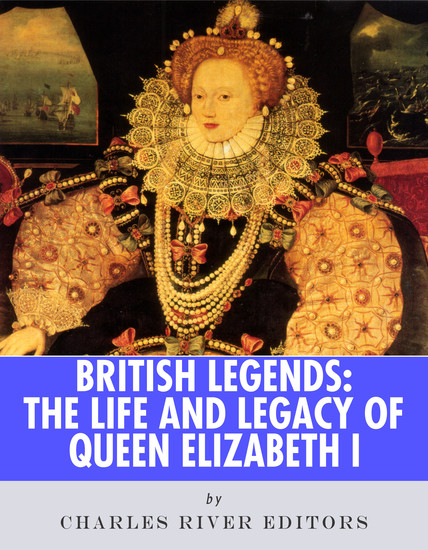
British Legends - The Life and Legacy of Queen Elizabeth I - cover

British Legends - The Life and Legacy of Queen Elizabeth I

Editors Charles River

Publisher: Charles River Editors

  • 0
  • 0
  • 0

Summary

"Video et taceo." ("I see, and say nothing") – Queen Elizabeth I
 
A lot of ink has been spilled covering the lives of history’s most influential figures, but how much of the forest is lost for the trees? In Charles River Editors’ British Legends series, readers can get caught up to speed on the lives of Great Britain’s most important men and women in the time it takes to finish a commute, while learning interesting facts long forgotten or never known.
 
When Queen Elizabeth II came to the throne in 1952, many commentators heralded the beginning of her reign as the second Elizabethan age. The first one, of course, concerned the reign of Henry VIII’s second surviving daughter and middle surviving child, Queen Elizabeth I, one of England’s most famous and influential rulers. It was an age when the arts, commerce and trade flourished. It was the epoch of gallantry and great, enduring literature. It was also an age of wars and military conflicts in which men were the primary drivers and women often were pawns.


Elizabeth I changed the rules of the game and indeed she herself was changed by the game. She was a female monarch of England, a kingdom that had unceremoniously broken with the Catholic Church, and the Vatican and the rest of Christendom was baying for her blood. She had had commercial and militaristic enemies galore. In the end, she helped change the entire structure of female leadership.


Elizabeth was the last Tudor sovereign, the daughter of the cruel and magnificent King Henry VIII and a granddaughter of the Tudor House’s founder, the shrewd Henry VII. Elizabeth, hailed as “Good Queen Bess,” “Gloriana” and “The Virgin Queen” to this day in the public firmament, would improve upon Henry VIII’s successes and mitigate his failures, and despite her own failings would turn out to “have the heart and stomach of a king, and a king of England too”. Indeed, that was the phrase she would utter in describing herself while exhorting her troops to fight for England against the Spanish Armada).


Elizabeth often has been featured in biographies that were more like hagiographies, glossing over her fits of temper, impatience and other frailties. It is fair to say, however, that she had also inherited her grandfather’s political acumen and her father’s magnificence, thus creating not just one of the most colourful courts in Europe but also one of the most effective governments in English history. It was an age of Christopher Marlowe’s and William Shakespeare’s flourishing creativity that still enhances English as well as comparative literature. Elizabeth was also patroness of Sir Francis Drake, the pirate, thereby promoting English settlement of foreign colonies. The Jamestown Settlement in Virginia would come in 1607, four years after Elizabeth’s passing, and the Plymouth colony in Massachusetts would come in 1620.


Elizabeth had also fought for her life time and time again in an era that was already unsafe for female leaders and she probably had remembered the searing feeling of realizing that her mother Queen Anne (Anne Boleyn) had been executed by her father arguably on a trumped-up charge. Danger was pervasive; strategy was needed not just to thrive but just to survive.


British Legends: The Life and Legacy of Queen Elizabeth I chronicles the life and reign of England’s most famous queen, but it also humanizes the woman who ruled one of the world’s most powerful kingdoms in an age dominated by men. Along with pictures of important people, places, and events in her life, you will learn about Elizabeth I like you never have before, in no time at all.
Available since: 05/05/2025.
Print length: 31 pages.

Other books that might interest you

  • The Watchmakers - A Powerful WW2 Story of Brotherhood Survival and Hope Amid the Holocaust - cover

    The Watchmakers - A Powerful WW2...

    Harry Lenga, Scott Lenga

    • 0
    • 0
    • 0
    Harry Lenga was born to a family of Chassidic Jews in Kozhnitz, Poland. The proud sons of a watchmaker, Harry and his two brothers, Mailekh and Moishe, studied their father's trade at a young age. Upon the German invasion of Poland, when the Lenga family was upended, Harry and his brothers never anticipated that the tools acquired from their father would be the key to their survival. 


    Under the most devastating conditions imaginable—with death always imminent—fixing watches for the Germans in the ghettos and brutal slave labor camps of occupied Poland and Austria bought their lives over and over again. From Wolanow and Starachowice to Auschwitz and Ebensee, Harry, Mailekh, and Moishe endured, bartered, worked, prayed, and lived to see liberation. 


    Derived from more than a decade of interviews with Harry Lenga, conducted by his own son Scott and others, The Watchmakers is Harry's heartening and unflinchingly honest first-person account of his childhood, the lessons learned from his own father, his harrowing tribulations, and his inspiring life before, during, and after the war. It is a singular and vital story, told from one generation to the next—and a profoundly moving tribute to brotherhood, fatherhood, family, and faith.
    Show book
  • America's Youngest Ambassador - The Cold War Story of Samantha Smith’s Lasting Message of Peace - cover

    America's Youngest Ambassador -...

    Lena Nelson

    • 0
    • 0
    • 0
    In 1982, amid the nuclear paranoia that engulfed the US and the Soviet Union, Samantha Smith, a fifth grader from Manchester, Maine, wrote a letter to the Kremlin asking the Soviet leader if he was going to start a war. When Pravda, the biggest Soviet newspaper, published her letter—and Samantha received an unprecedented invitation to visit the Soviet Union —her family embarked on a historic journey. 


    The story of a young American girl's letter to the Soviet leader and her innocent curiosity about the other side of the Iron Curtain holds an important lesson for every American. America's Youngest Ambassador provides insights into a forgotten era and has an important message for young people who strive to be more involved in facilitating change, both locally and worldwide. 


    Juxtaposing Samantha's narrative with that of her own childhood in the Soviet Union in the 1980s, Lena Nelson explores the consequences of government propaganda on both sides of the ocean and reveals how Samantha Smith's journey in the summer of 1983 helped melt the hearts of the Soviets and thaw the ice of the Cold War. Drawing on interviews conducted in both the US and Russia with key players in the events of those days, Nelson blends storytelling, anecdotes, and analysis of Soviet-American relations to tell the story of this unprecedented moment in history.
    Show book
  • Battle of Fornovo The: The History of the Italian Wars’ First Major Battle - cover

    Battle of Fornovo The: The...

    Editors Charles River

    • 0
    • 0
    • 0
    In 1494, there were five sovereign regional powers in Italy: Milan, Venice, Florence, the Papal States and Naples. In 1536, only one remained: Venice. These decades of conflict precipitated great anxiety among Western thinkers, and Italians responded to the fragmentation, forevermore, of Latin Christendom, the end of self-governance for Italians, and the beginning of the early modern era in a myriad of ways. They were always heavily influenced by the lived experience of warfare between large Christian armies on the peninsula. 
    The diplomatic and military history of this 30-year period was a complex situation that one eminent Renaissance historian, Lauro Martines, has described as "best told by a computer, so many and tangled are the treatises, negotiations and battles." At the same time, the fighting went in tandem with the Renaissance and was influenced by it. Most historians credit the city-state of Florence as the place that started and developed the Italian Renaissance, a process carried out through the patronage and commission of artists during the late 12th century. If Florence is receiving its due credit, much of it belongs to the Medicis, the family dynasty of Florence that ruled at the height of the Renaissance. The dynasty held such influence that some of its family members even became Pope. 
    Meanwhile, plans for a French invasion were years in the making, and France’s young King Charles VIII, heavily influenced by chivalric tales and his men of finance, had begun his preparations for conquering Naples as a base from which to launch a crusade in 1491. Two key events were the catalysts for these plans. The first was the arrival of Cardinal Giuliano della Rovere at Avignon in May 1494.
    Show book
  • Dark Feminine Energy - The Ultimate Guide To Become a Femme Fatale Unveil Your Shadow Decrypt Male Psychology Enhance Attraction With Magnetic Body Language and Master the Art of Seduction - cover

    Dark Feminine Energy - The...

    Melissa Smith

    • 0
    • 0
    • 0
    Have you ever felt a deep, mysterious pull towards the hidden aspects of your feminine power? 
    Do you long to embrace your shadows and tap into the seductive energy that lies within? 
    "Dark Feminine Energy" offers a powerful, straightforward approach to embracing your inner darkness as a source of strength and magnetism.  
    Designed for those who refuse to be boxed into a single narrative, this guide illuminates the path to leveraging your unique traits for influence, seduction, and undeniable presence. 
    Within these pages, you will discover:Concrete methods to harness your dark feminine energy for personal empowerment and seductive prowess.The key psychological principles behind attraction and how your dark side can make you irresistible.How to use body language to convey confidence, openness, and irresistible charm.Techniques for mastering the art of the gaze, turning it into a powerful tool for connection and intrigue.Winning over the masculine mindsetTips for leveraging your voice and speech patterns to draw others closer, creating an atmosphere of intimacy and allure.Navigating the dance of pursuit and surrender in relationships while maintaining your power... and much more! 
    Are you ready to transform the way you see yourself and how the world sees you? To move with grace and power, turning heads and opening doors with just a look or a whisper? 
    Unleash your power, captivate with your presence, and command the attention you deserve. Your journey to become a Femme Fatale begins here.
    Show book
  • 24 Hours in Ancient Egypt - A Day in the Life of the People Who Lived There - cover

    24 Hours in Ancient Egypt - A...

    Donald P. Ryan

    • 0
    • 0
    • 0
    Spend twenty-four hours with the ancient Egyptians. 


    Ancient Egypt wasn't all pyramids, sphinxes and gold sarcophagi. For your average Egyptian, life was tough, and work was hard, conducted under the burning gaze of the sun god Ra. 


    During the course of a day in the ancient city of Thebes (modern-day Luxor), Egypt's religious capital, we meet twenty-four Egyptians from all strata of society—from the king to the bread-maker, the priestess to the fisherman, the soldier to the midwife—and get to know what the real Egypt was like by spending an hour in their company. We encounter a different one of these characters every hour and in every chapter, and through their eyes see what an average day in ancient Egypt was really like.
    Show book
  • A History of Some of China’s Most Famous Landmarks - cover

    A History of Some of China’s...

    Editors Charles River

    • 0
    • 0
    • 0
    China has always fascinated outsiders, much in the same way that distant light fascinates someone looking down a dark road. It is both familiar and mysterious, ancient and new, and fully understanding it seems to always remain just out of reach. From the Great Wall to the ancient teachings of Confucius, China’s natural and man-made wonders have been topics of interest among Westerners since the Middle Ages and the pursuit of trade routes both by land and sea, amazing Marco Polo and 19th century British expeditions in similar ways despite the passage of several centuries between them. 
    The Great Wall of China is perhaps the wonder of the world that has most captured the human imagination, and as the quotes about it indicate, the wall has acquired special significance even outside of China. The places and ways in which it has taken hold vary greatly, but one thing is certain: the Great Wall of China is as amazing as it is mysterious, and it’s as mundane as it is magical. Naturally, the Wall has become the most recognizable symbol of China, used for both aggrandizement and criticism. Nationalists see it as a symbol of China's peaceful nature, engineering capability, and historic longevity, while detractors see the Wall as the embodiment of China's backwardness, closed-mindedness, and hubris. Though the wall can symbolize all of these things about China, it is important to remember that the many long walls. upon some of which the current landmark was constructed, were put up by specific people for specific purposes. 
    People across the world were excited when it was revealed in 1974 that archaeologists had uncovered a new and amazing find: an underground army consisting of thousands of clay soldiers, still standing at their posts despite being over 2,000 years old. In addition to the remarkable feats of craftsmanship and the size and scale of the Terracotta Army, modern people could not quite wrap their minds around.
    Show book