Rejoignez-nous pour un voyage dans le monde des livres!
Ajouter ce livre à l'électronique
Grey
Ecrivez un nouveau commentaire Default profile 50px
Grey
Abonnez-vous pour lire le livre complet ou lisez les premières pages gratuitement!
All characters reduced
Harvard Classics: All 71 Volumes - cover

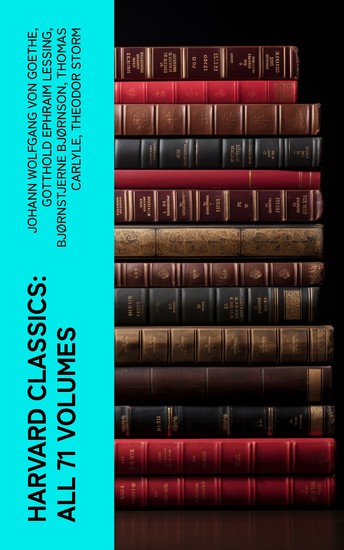
Harvard Classics: All 71 Volumes

Edgar Allan Poe, George Eliot, William Shakespeare, Juan Valera, Pedro Calderón de la Barca, Mark Twain, Jane Austen, Jonathan Swift, Daniel Defoe, Henry David Thoreau, Washington Irving, Niccolo Machiavelli, Nathaniel Hawthorne, Henry James, Adam Smith, Hans Christian Andersen, Michel de Montaigne, John Stuart Mill, Samuel Taylor Coleridge, Guy de Maupassant, David Hume, Thomas De Quincey, Saint Augustine, Immanuel Kant, René Descartes, Martin Luther, Marcus Aurelius, Francis Bacon, John Bunyan, Christopher Marlowe, Richard Henry Dana, William Makepeace Thackeray, Laurence Sterne, Ralph Waldo Emerson, Plutarch Plutarch, Oliver Goldsmith, Dante Alighieri, Pliny the Younger, Robert Burns, Benvenuto Cellini, Robert Louis Stevenson, Thomas Carlyle, John Ruskin, Edward Everett Hale, Percy Bysshe Shelley, George Berkeley, Oliver Wendell Holmes, John Dryden, Robert Browning, Joseph Addison, Bret Harte, Samuel Johnson, William Hazlitt, Edmund Burke, Alphonse Daudet, Alfred de Musset, Thomas Babington Macaulay, George Sand, Gotthold Ephraim Lessing, Pierre Corneille, Wilhelm Grimm, Henry Fielding, Richard Steele, William Penn, Jean-Jacques Rousseau, John Fletcher, Francis Beaumont, John Locke, Philip Massinger, Sydney Smith, Aeschylus Aeschylus, Charles Lamb, Benjamin Franklin, Richard Brinsley Sheridan, James Russell Lowell, Walter Scott, Theodor Storm, Simon Newcomb, Alessandro Manzoni, Ivan Turgenev, Thomas More, Theodor Fontane, Leigh Hunt, Abraham Cowley, Izaak Walton, Blaise Pascal, Thomas Hobbes, Virgil Virgil, Plato, Jean Racine, Bjørnstjerne Bjørnson, Gottfried Keller, Ernest Renan, Thomas A'kempis, Friedrich von Schiller, Tacitus Tacitus, Honore Balzac, John Webster, Victor Hugo, Fyodor Dostoevsky, Thomas Brown, Michael Faraday, Giuseppe Mazzini, Johann Wolfgang von Goethe, George Gordon Byron, William Harvey, Thomas Dekker, Hippocrates Hippocrates, Charles Darwin, Ben Jonson, Joseph Lister, Francis Drake, Walter Bigges, Walter Raleigh, Charles W. Eliot, William Henry Harrison, Francis Pretty, Edward Haies, Jean Froissart, Miguel de Cervantes, Philip Sidney, John Woolman, Ambroise Paré, Louis Pasteur, Alexander L. Kielland, Leo Tolstoy, Marcus Tullius Cicero, William Roper, Charles-Augustin Sainte-Beuve, John Milton, David Garrick, Philip Nichols, Hermann Ludwig Ferdinand von Helmholtz, Archibald Geikie, William A. Neilson, Euripides, Sophocles, Aristophanes, Herodotus, Voltaire, Epictetus, Molière Molière, Thomas Malory, Aesop Aesop, Homer Homer

Maison d'édition: e-artnow

  • 0
  • 0
  • 0

Synopsis

e-artnow presents to you this unique and meticulously edited collection by Dr. Eliot:  The Harvard Classics: V. 1: Franklin, Woolman & Penn V. 2: Plato, Epictetus & Marcus Aurelius V. 3: Bacon, Milton, Browne V. 4: Poems by John Milton V. 5: R. W. Emerson V. 6: Poems by Robert Burns V. 7: St Augustine & Thomas á Kempis V. 8: Nine Greek Dramas  V. 9: Cicero and Pliny V. 10: The Wealth of Nations V. 11: The Origin of Species V. 12: Plutarch's Lives V. 13: Æneid V. 14: Don Quixote V. 15: Bunyan & Walton V. 16: Thousand and One Nights V. 17: Folklore & Fable V. 18: Modern English Drama V. 19: Goethe & Marlowe V. 20: The Divine Comedy V. 21: I Promessi Sposi V. 22: The Odyssey V. 23: Two Years Before the Mast V. 24: Edmund Burke V. 25: J. S. Mill & T. Carlyle V. 26: Continental Drama V. 27 & 28: English and American Essays V. 29: The Voyage of the Beagle V. 30: Scientific Papers V. 31: The Autobiography of Benvenuto Cellini V. 32: Literary and Philosophical Essays V. 33: Voyages & Travels V. 34: French & English Philosophers V. 35:  Chronicle and Romance V. 36: Machiavelli, Roper, More, Luther V. 37: Locke, Berkeley, Hume V. 38: Harvey, Jenner, Lister, Pasteur V. 39: Prefaces and Prologues V. 40–42: English Poetry V. 43: American Historical Documents V. 44 & 45: Sacred Writings V. 46 & 47: Elizabethan Drama V. 48: Blaise Pascal V. 49: Epic and Saga V. 50: Reader's Guide V. 51: Lectures The Shelf of Fiction: V. 1 & 2: The History of Tom Jones V. 3: A Sentimental Journey & Pride and Prejudice  V. 4: Guy Mannering V. 5 & 6: Vanity Fair V. 7 & 8: David Copperfield V. 9: The Mill on the Floss V. 10: Hawthorne, Irving, Poe, Harte, Twain, Hale V.11: The Portrait of a Lady V. 12: Notre Dame de Paris V. 13: Balzac, Sand, de Musset, Daudet, de Maupassant V. 14 & 15: Goethe, Keller, Storm, Fontane V. 16–19: Tolstoy, Dostoevsky, Turgenev V. 20: Valera, Bjørnson, Kielland
Disponible depuis: 13/12/2023.
Longueur d'impression: 30498 pages.


D'autres livres qui pourraient vous intéresser

  • A Truce That Is Not Peace - cover

    A Truce That Is Not Peace

    Miriam Toews

    • 0
    • 0
    • 0
    "Essential reading. A companion for turbulent times."—Laura van den Berg 
      
    Internationally bestselling author Miriam Toews' memoir of the will to write—a work of disobedient memory, humor, and exquisite craft set against a content-hungry, prose-stuffed society. 
      
    “Why do you write?” the organizer of a literary event in Mexico City asks Miriam Toews. Each attempted answer from Toews—all of them unsatisfactory to the organizer—surfaces new layers of grief, guilt, and futility connected to her sister's suicide. She has been keeping up, she realizes, a decades-old internal correspondence, filling a silence she barely understands. And we, her readers, come to see that the question is as impossible to answer as deciding whether to live life as a comedy or a tragedy. 
      
    Marking the first time Toews has written her own life in nonfiction, A Truce That Is Not Peace explores the uneasy pact a writer makes with memory. Wildly inventive yet masterfully controlled; slyly casual yet momentous; wrenching and joyful; hilarious and humane—this is Miriam Toews at her dazzling best, remaking her world and inventing an astonishing new literary form to contain it.
    Voir livre
  • Emotional Exploitation - Taking Advantage of Someone's Emotional State - cover

    Emotional Exploitation - Taking...

    Cito Harder

    • 0
    • 0
    • 0
    Emotional exploitation is a subtle yet deeply damaging form of manipulation that preys on a person's emotions to serve the interests of another. Unlike mutual emotional support, which fosters healthy relationships and personal growth, exploitation involves using someone’s feelings, vulnerabilities, or insecurities to gain control, compliance, or advantage. This can occur in personal relationships, the workplace, and even society at large, leaving individuals feeling powerless, confused, and emotionally drained. Understanding emotional exploitation is crucial to recognizing its effects, breaking free from its grasp, and preventing future manipulation. 
    At its core, emotional exploitation thrives on imbalance. The exploiter takes advantage of another person’s emotional investment, whether it be love, trust, guilt, or fear, while offering little or nothing in return. This dynamic can manifest in many ways, such as a friend who constantly seeks emotional support but disappears when others need help, a romantic partner who uses guilt to control decisions, or an employer who manipulates workers into unpaid overtime by making them feel obligated or ungrateful. Regardless of the setting, the pattern remains the same—one person’s emotions are weaponized to serve another’s self-interest. 
    One of the most harmful aspects of emotional exploitation is that it is often difficult to recognize while it is happening. Many individuals who are exploited rationalize the behavior of their manipulator, believing they are simply helping, being loyal, or fulfilling an obligation. Exploiters frequently use gaslighting, guilt-tripping, or shifting blame to make their targets question their own perceptions.
    Voir livre
  • Borders - A Very Short Introduction (2nd Edition) - cover

    Borders - A Very Short...

    Joshua Hagen, Alexander C. Diener

    • 0
    • 0
    • 0
    First published in 2012, Borders: A Very Short Introduction began with the premise that "we live in a very bordered world." The intervening decade has witnessed a flurry of events and developments that continue to highlight the centrality of borders in contemporary domestic and international affairs, as well as the interstices between the two, including sudden surges in migrant and refugees flows; renewed emphasis on traditional border security and wall construction; growing tensions concerning maritime sovereignty; rapid advances in cybersecurity, surveillance, and biometrics; expanded detention and deportation infrastructures; proliferation of transborder organizations; revived populist and nationalist sentiments; and protectionist and integrationist trade practices, to name some prominent examples from recent headlines. 


    This revised edition accounts for recent developments including Brexit, the 2015 migration crisis across Europe, efforts to build a border wall between the United States and Mexico, growing isolationist and nativist sentiments, demands for indigenous homelands, transnational protest movements, Russian cross-border incursions, and insurgencies and rebellions across much of North Africa and Southwest Asia.
    Voir livre
  • Picking Presidents - How to Make the Most Consequential Decision in the World - cover

    Picking Presidents - How to Make...

    Gautam Mukunda

    • 0
    • 0
    • 0
    Celebrated leadership expert and political scientist Gautam Mukunda provides a comprehensive, objective, and non-partisan method for answering the most important question in the world: is someone up to the job of president of the United States? 


    In Picking Presidents, Gautam Mukunda sets his sights on presidential candidates, proposing a tested method to assess whether they will succeed or fail if they win the White House. Combining political science, psychology, organizational behavior, and economics, Picking Presidents will enable every American to cast an informed vote. 


    In his 2012 book Indispensable, which all but predicted the Trump presidency, Mukunda explained how both the very best and very worst leaders are "unfiltered"—outsiders who take power without the understanding or support of traditional elites. Picking Presidents provides deep analysis of filtered and unfiltered presidents alike, from failed haberdasher and skillful president Harry Truman, to the exceptionally well-qualified—and ultimately reviled—James Buchanan; from Andrew Johnson, who set civil rights back by a century, to Theodore Roosevelt, who evaded party opposition to transform American society. Picking Presidents lays out a clear framework that anyone can use to judge a candidate and answer the all-important question: are they up to the job?
    Voir livre
  • The Aztec Civilization - The history of the rise and fall of the Aztec empire - cover

    The Aztec Civilization - The...

    Days of History

    • 0
    • 0
    • 0
    Are you fascinated by the Aztec Empire?  
    Have you ever wanted to learn more about the people and events that shaped this ancient civilization? Now, you can! 
    With this comprehensive book, you'll explore the Aztec culture and its lasting impact on the world. From their iconic cities to their religious beliefs and customs, you'll gain an insightful look into the Aztecs. We'll take a closer look at their incredible advancements in architecture, astronomy, mathematics, art, trade and commerce, and daily life. 
    Get your copy today and discover the history behind one of the world's most powerful empires! 
    Don't miss out - get your copy now and let the adventure begin!
    Voir livre
  • Ugh As If!: Clueless - cover

    Ugh As If!: Clueless

    Veronica Litt

    • 0
    • 0
    • 0
    A sweet and sly exploration of the Jane Austen–inspired teen movie and its evergreen imperative to be kind, do better, and find the activist within
     
    We are totally butt-crazy in love with Clueless. Since the movie’s premiere in 1995, pop culture has mined Amy Heckerling’s high school comedy for inspiration, from Iggy Azalea and Charli XCX’s “Fancy” music video to Cher’s iconic yellow plaid suit appearing at every Halloween party.
     
    In Ugh As If!, Veronica Litt argues that this seemingly fluffy teen romp is the quintessential thinking woman’s movie, one in which the audience is asked to seriously consider the beauty and power of naïveté. Cher Horowitz’s gradual pivot from oblivious it girl to burgeoning activist is a powerful reminder that even the most unlikely people can change for the better and contribute to their communities. In this bright, shiny film, pursuing a more just society isn’t just possible — it’s enjoyable. This fun, feminine, feel-good movie is a counter-narrative to nihilism, a refusal to give into cynicism, hopelessness, and passivity. Almost without viewers noticing, Clueless teaches Cher, and us, how to become better. Like the film it examines, Ugh As If! nudges even the most jaded viewer into feeling hopeful about the future.
    Voir livre