Join us on a literary world trip!
Add this book to bookshelf
Grey
Write a new comment Default profile 50px
Grey
Subscribe to read the full book or read the first pages for free!
All characters reduced
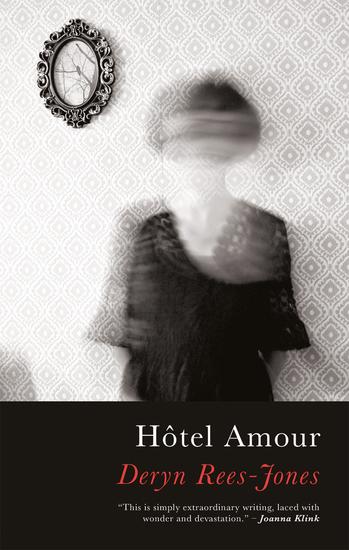
Hôtel Amour - cover

Hôtel Amour

Deryn Rees-Jones

Publisher: Seren

  • 0
  • 0
  • 0

Summary

"This is simply extraordinary writing, laced with wonder and devastation…" Joanna Klink
A sequel to her T. S. Eliot Prize shortlisted Erato, Deryn Rees-Jones' remarkable new collection sees her returning to ongoing preoccupations: the complexities of memory and memorialisation, desire and the body, and poetry's place in a hostile world.
The book begins with a woman checking into Hôtel Amour, a space both real and imagined, in the heart of Paris. This is a hallucinatory city where surreal symbols loom large: the hotel's pink neon sign, elephants, doubles, and lost pairings. A bloody heart lies in the street, books concertina into song, and everywhere is the ever-present noise of birds.
Playful, and moving by turn, Hôtel Amour experiments with fragmented narrative and poetic form, creating a breathing space for a multilayered and powerful meditation on illness, love and time. Hôtel Amour's fierce and formidable exploration of 'the now' and its many ghostly literary pasts, is the work of a poet at the height of her powers as she asks us to listen, and explore our human capacity for transformation and for hope.
Available since: 09/08/2025.
Print length: 112 pages.

Other books that might interest you

  • Rhyme A Dozen A - Sunset - 12 Poets 12 Poems 1 Topic - cover

    Rhyme A Dozen A - Sunset - 12...

    H P Lovecraft, Dante Gabriel...

    • 0
    • 0
    • 0
    ‘A dime a dozen’ as known in America, is perhaps equal to the English ‘cheap as chips’ but whatever the lingua franca of your choice in this series we hereby submit ‘A Rhyme a Dozen’ as 12 poems on many given subjects that are a well-rounded gathering, maybe even an essential guide, from the knowing pens of classic poets and their beautifully spoken verse to the comfort of your ears. 
     
    01 - A Rhyme A Dozen - 12 Poems, 12 Poets, 1 Topic - Sunset - An Introduction 
    02 - At Sunset Time by Paul Laurence Dunbar 
    03 - Sunset in the City by Richard Le Gallienne 
    04 - After Sunset by William Allingham 
    05 - Sunset by H P Lovecraft 
    06 - From Sunset to Star Rise by Christina Georgina Rossetti 
    07 - Sunset by Israel Zangwill 
    08 - Winter Sunset by Katharine Tynan 
    09 - Sunset by Ann Radcliffe 
    10 - How The Old Mountains Drip With Sunset by Emily Dickinson 
    11 - Sunset Wings by Dante Gabriel Rossetti 
    12 - An Autumn Sunset by Edith Wharton 
    13 - The Red Sunsets by Mathilde Blind
    Show book
  • Selected Poems of Calvin C Hernton - cover

    Selected Poems of Calvin C Hernton

    Calvin C. Hernton

    • 0
    • 0
    • 0
    This volume promises to be the definitive guide to Calvin C. Hernton's unparalleled poetic career, re-introducing readers to a major voice in American poetry. Hernton was a cofounder of the Umbra Poets Workshop; a participant in the Black Arts Movement, R. D. Laing's Kingsley Hall, and the Antiuniversity of London; and a teacher at Oberlin College who counted amongst his friends bell hooks, Toni Morrison, and Odetta. As a pioneer in the field of Black Studies, Hernton developed a theoretical and practical pedagogy with lasting impact on generations of students. He may be best known as an anti-sexist sociologist, following in the footsteps of W.E.B. Du Bois, but Hernton viewed himself, above all, as a poet. This volume includes a generous selection of Hernton's previously published poems, from classics like the often anthologized "The Distant Drum" to the visionary epic The Coming of Chronos to the House of Nightsong, reprinted in full for the first time since 1964, alongside uncollected and unpublished material from the Calvin C. Hernton papers at Ohio University, a new critical introduction, and detailed notes, chronology, and bibliography.[sample poem]The Distant DrumI am not a metaphor or symbol.This you hear is not the wind in the trees.Nor a cat being maimed in the street.I am being maimed in the streetIt is I who weep, laugh, feel pain or joy.Speak this because I exist.This is my voiceThese words are my words, my mouthSpeaks them, my hand writes.I am a poet.It is my fist you hear beatingAgainst your ear.
    Show book
  • Never Craven Was the Raven - cover

    Never Craven Was the Raven

    Michael Anthony White

    • 0
    • 0
    • 0
    Amidst an otherwise routine blink, you have just caught glimpse of a curious and unfamiliar binding - one that promises only to lead you gradually off the wayside. Its destination: past the charming whims of poetic joviality into the snarky silhouette of an umbral fowl.
    Show book
  • Starseed Awaken The World - cover

    Starseed Awaken The World

    Justin Wesenberg

    • 0
    • 0
    • 0
    Starseed is a channeled poetry book about the global starseed awakening happening at this time. 
    This poetry book is for those who are ready to connect to their galactic lineage, and our place among the stars. 
    It's time to awaken 
    The starseeds in bloom 
    To discover the truth 
    They will be home soon 
    To uncover the wisdom 
    In the galactic skies 
    To peer through the chaos 
    And all the lies 
    That keep humanity 
    Stuck in delusion 
    Wandering through 
    All the confusion 
    About who they are 
    And the nature of the soul 
    Dividing themselves 
    From what it means to be whole 
    We have come 
    To share the grace 
    To activate humanity 
    As a Galactic Star Race 
    This channeled poetry book was inspired by all the star brothers and sisters working to elevate the consciousness of the planet. 
    If you’re a starseed going through a massive spiritual awakening, allow Starseed Awaken The World to help you step into your purpose and power, to awaken yourself and others!
    Show book
  • Poets of the Early 20th Century The - Volume 2 - Find beauty and hope in a period ravaged worldwide by war - cover

    Poets of the Early 20th Century...

    Edna St. Vincent Millay, TS...

    • 0
    • 0
    • 0
    In England the Victorian Age was about to become the past and a new age of worldwide wars of horror and slaughter would envelop and decimate generations, forever staining mankind.   
     
    The Century would see the World discover strengths. The Democracies would stand firm against Fascism and later Communism yet still keep its own elite and privileged in power and the rest of us underfoot. 
     
    The World was more connected than ever before.  Culture accelerated its kaleidoscopic and interwoven journey. Transport delivered people by car and train and then aeroplane to far flung corners of the globe.  Empires were at their zenith and ready to fragment with new nations, many troubled, rising from their decay. 
     
    The natural world continued to be plundered and pillaged for its resources by industries who pledged ‘more’ and ‘better’ and would clothe and feed a growing world yet sow the seeds now ready to devastate us in our current times. 
     
    The globe was as vibrant and violent as troubled and tarnished as it ever was.  But new ideas, new political systems, new times changed everything once again. 
     1 - The Poets of the Early Twentieth Century  - Volume 2 - An Introduction 
    2 - The Lions by Joseph Mary Plunkett 
    3 - 1841-1891 by Joseph Mary Plunkett 
    4 - If We Return by F W Harvey 
    5 - The Soldier Speaks by F W Harvey 
    6 - The Negro Soldiers by Roscoe C Jamison 
    7 - Into Battle by Julian Grenfell 
    8 - Prayer For Those on the Staff by Julian Grenfell 
    9 - Hymn by Fenton Johnson 
    10 - Tired by Fenton Johnson 
    11 - Sonnet I by Fernando Pessoa 
    12 - If, After I Die by Fernando Pessoa  
    13 - I Have A Rendezvous with Death by Alan Seeger 
    14 - All Thats Not Love by Alan Seeger 
    15 - Maktoob by Alan Seeger 
    16 - The Unseen Planets by Raymond Chandler 
    17 - The Poet's Knowledge by Raymond Chandler 
    18 - I Saw A Man This Morning by Patrick Shaw Stewart 
    19 - Whispers of Immortality by T S Eliot 
    20 - The Love Song of J Alfred Prufrock by T S Eliot 
    21 - Preludes by T S Eliot 
    22 - The Wounded Bird by Katherine Mansfield 
    23 - Stars by Katharine Mansfield 
    24 - A Fine Day by Katherine Mansfield 
    25 - I Taught Myself To Live Simply by Anna Akhmatova 
    26 - When I Write Poems by Anna Akhmatova 
    27 - Poetry by Claude McKay 
    28 - The White House by Claude McKay 
    29 - The Lynching by Claude McKay 
    30 - Strange Hells by Ivor Gurney 
    31 - Crucifix Corner by Ivor Gurney 
    32 - Serenade by Ivor Gurney 
    33 - Break of Day in the Trenches by Isaac Rosenberg 
    34 - Dead Man's Dump by Isaac Rosenberg 
    35 - August 1914 by Isaac Rosenberg 
    36 - Journey's End by Zora Neale Hurston 
    37 - The Dog Tupman by Stella Benson 
    38 - The Ballad of the Harp-Weaver by Edna St Vincent Millay 
    39 - My Heart Being Hungry by Edna St Vincent Millay 
    40 - What Lips My Lips Have Kissed, And Where, And Why by Edna St Vincent Millay 
    41 - Sonnet XVIII - I, Being Born a Woman by Edna St Vincent Millay 
    42 - Unity by Cesar Vallejo 
    43 - Love by Edith Sodergran 
    44 - On Foot I Had to Cross the Solar System by Edith Sodergran 
    45 - Insouciance by Richard Aldington 
    46 - Goodbye by Richard Aldington 
    47 - Grey Hairs by Marina Ivanova Tsvetaeva 
    48 - Lady with Camelias by Marina Ivanova Tsvetaeva 
    49 - To Mother by Marina Ivanova Tsvetaeva 
    50 - Back To Rest by Lietenant William Noel Hodgson MC 
    51 - Before Action  by Lieutenant William Noel Hodgson MC 
    52 - Past One O'Clock by Vladimir Mayakovsky 
    53 - So This Is How I Turned into a Dog by Vladamir Mayakovsky 
    54 - Verse for a Certain Dog by Dorothy Parker 
    55 - A Dream Lies Dead by Dorothy Parker<p
    Show book
  • The Hunting of the Snark - The writer of Alice In Wonderland takes us on a voyage of discovery with wonderful offbeat characters as we chase down the Snark - cover

    The Hunting of the Snark - The...

    Lewis Carroll

    • 0
    • 0
    • 0
    Lewis Carroll was born Charles Lutwidge Dodgson on the 27th January 1832 at Daresbury, Cheshire, the eldest boy and the third child.  Another eight followed.   
     
    When Dodgson was 11, his cleric father moved his family to Croft-on-Tees in the North Riding of Yorkshire.  Although his father was active and highly conservative his son was ambivalent with those values and with the Church as a whole. 
     
    In his early years Dodgson was educated at home and by age 7 he was reading the likes of ‘The Pilgrim's Progress’.  He also spoke with a stammer which he called his ‘hesitation’. 
     
    At 12 he was dispatched to Richmond Grammar School in North Yorkshire and then on to Rugby.  He sailed through the curriculum.  He was accepted at Christ Church, Oxford but two days after arriving he was summoned home: his mother had died of ‘inflammation of the brain’ at only 47. 
     
    Dodgson was exceptionally gifted and, when not distracted, achievement came easily to him.  He remained at Christ Church studying and teaching in various capacities until his death. 
     
    In March 1856, he published the romantic poem ‘Solitude’ as by ‘Lewis Carroll’.  
     
    That same year he took up the new art of photography.  He soon excelled and became a well-known gentleman-photographer, and even toyed with the idea of making a living out of it.  When he ceased photography in 1880, he had his own studio and had created around 3,000 images. 
     
    He enjoyed moderate success with his early poems and short stories but had an array of other interests in the pre-Raphaelite circle, Psychical Research and even ordained in the Church of England in 1861.  
     
    In July 1862 he told a young Alice Liddell the story that would become his first and greatest success.  Alice begged him to write it down, and eventually he did and later presented her with a handwritten and illustrated ‘Alice's Adventures Under Ground’.  The publisher Macmillan agreed to publish it as ‘Alice's Adventures in Wonderland’ by Lewis Carroll.  
     
    It was a huge and sensational life-changing success.  Royalties quickly accumulated as did fan mail.  
     
    In 1871, the darker themed sequel ‘Through the Looking-Glass, and What Alice Found There’ was published.  A half decade later came ‘The Hunting of the Snark’, a fantastical nonsense poem, as nine tradesmen and a beaver set off to find the snark.  It was another enormous success. 
     
    He also loved to invent such delights as a writing tablet ‘the nyctograph’ that allowed note-taking in the dark as well as many word games, such as the precursor to ‘Scrabble’, and alternative systems of parliamentary voting.  Within the discipline of mathematics, he worked in geometry, linear and matrix algebra, mathematical logic, recreational mathematics and wrote nearly a dozen books on the subject.   
     
    Lewis Carroll died of pneumonia following influenza on 14th January 1898 in Guildford, Surrey.  He was 65.  
     
    01 - The Hunting of the Snark by Lewis Carroll - An Introduction 
    02 - The Hunting of the Snark. Fit the First - The Landing 
    03 - Fit the Second - The Bellman's Speech 
    04 - Fit the Third - The Baker's Tale 
    05 - Fit the Fourth - The Hunting 
    06 - Fit the Fifth - The Beaver's Lessom 
    07 - Fit the Sixth - The Barrister's Dream 
    08 - Fit the Seventh - The Banker's Fate 
    09 - Fit the Eighth - The Vanishing
    Show book