Begleiten Sie uns auf eine literarische Weltreise!
Buch zum BĂĽcherregal hinzufĂĽgen
Grey
Einen neuen Kommentar schreiben Default profile 50px
Grey
Jetzt das ganze Buch im Abo oder die ersten Seiten gratis lesen!
All characters reduced
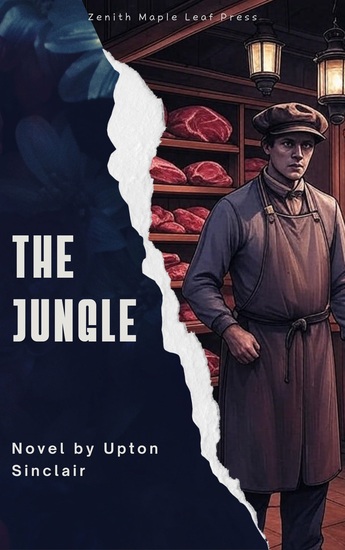
The Jungle - cover

The Jungle

Upton Sinclair

Verlag: Zenith Maple Leaf Press

  • 0
  • 0
  • 0

Beschreibung

🥩 What if the price of your daily bread was human suffering?

Upton Sinclair's groundbreaking novel, The Jungle (1906), shook America to its core with its brutal portrayal of immigrant life and the horrors of Chicago's meatpacking industry.

The story follows Jurgis Rudkus, a Lithuanian immigrant who comes to America dreaming of freedom and prosperity. Instead, he and his family are thrust into a world of relentless labor, exploitation, corruption, and despair. With unflinching realism, Sinclair exposes not only the unsanitary and dangerous practices of the industry but also the crushing weight of poverty and inequality on working-class families.

🌟 Why this novel matters:

Sparked public outrage that led to major reforms in food safety laws.

A landmark of American social and political literature.

A timeless reminder of the struggles of laborers, immigrants, and the poor.

More than a novel, The Jungle is a call to justice—an unflinching testament to the resilience of the human spirit amid overwhelming adversity.

👉 Click Buy Now and experience the book that changed America.
VerfĂĽgbar seit: 22.08.2025.
Drucklänge: 264 Seiten.
Weitere Bücher, die Sie mögen werden

  • It's Not Your Fault - cover

    It's Not Your Fault

    Sally Cook

    • 0
    • 0
    • 0
    It's Not Your Fault delves into what can only be described as communication nightmares as a patient of the medical system. This true accounts show how fragile the trust between medical practitioner and patient can be and how it can be psychologically compromised bringing about negative effects. For example the author was already half way through her first pregnancy when a well known and respected obstetrician/gynaecologist began treating her for infertility and the possibility of a dangerously big tumour,  That large lump turned out to be a baby,
    Zum Buch
  • Moors The: The History of the Muslims Who Lived in North Africa and Europe during the Middle Ages - cover

    Moors The: The History of the...

    Editors Charles River

    • 0
    • 0
    • 0
    The term Moor is a historical rather than an ethnic name. It is an invention of European Christians for the Islamic inhabitants of Maghreb (North Africa), Andalusia (Spain), Sicily and Malta, and was sometimes use to designate all Muslims. It is derived from Mauri, the Latin name for the Berbers who lived in the Roman province of Mauretania, which ranged across modern Algeria and Morocco. Saracen was another European term used to designate Muslims, though it usually referred to the Arabic peoples of the Middle East and derives from an ancient name for the Arabs, Sarakenoi. The Muslims of those regions no more refer to themselves by that term than those of North Africa call themselves Moors. Maghreb, or al-Maghreb, is a historical term used by Arabic Muslims for the territory of coastal North Africa from Alexandria to the Atlantic Coast. It means “The West” and is used in opposition to Mashrek, “The East,” used to refer to the lands of Islam in the Middle East and north-eastern Africa. The Berbers refer to the region in their own language as Tamazgha. In a limited, precise sense it can also refer to the Kingdom of Morocco, the proper name of which is al-Mamlakah al-Maghribiyyah, “Kingdom of the West.” 
    The history of the Spanish Peninsula is closely bound to that of the Moors. The term “Spain” was not in wide use until the region was united by the monarchs of Aragon and Castile, and the Moors called the lands they ruled in the Iberian Peninsula Al-Andalus, traditionally thought to be an Arabic transliteration of Vandal, the Germanic tribe which briefly ruled the region in the early fifth century. The English name Andalusia derives from the Spanish Andalucia, which is still used by Spain to name its southern region. Not surprisingly, three religions attempting to coexist during medieval times resulted in nearly incessant conflicts.
    Zum Buch
  • On Forgiveness - cover

    On Forgiveness

    Russell Hasan

    • 0
    • 0
    • 0
    This is an essay on forgiveness, not in the religious sense, but in a purely secular meaning, as in, when one person forgives another person for something they did wrong. The primary focus is on self-forgiveness, where a person forgives themselves, a concept which this essay explains as "moral bankruptcy," using debts and credits and bankruptcy and economics and finance as a metaphor for the moral debts and moral credits that you owe to yourself and to others, that you owe it to yourself to be a good person, and you owe it to other people to be good to them, and, where you fail, you owe them a debt. The human brain evolved in such a way that humans tend to subconsciously seek to repay moral debts through the infliction of emotional pain, either inflicting emotional pain upon the self for debts owed to self (guilt), inflicting pain upon the self for debts owed to others (shame), or inflicting pain upon others for debts they owe to you (anger). This essay, despite being atheistic and secular in nature, does explore forgiveness in the context of areas that are commonly thought of as religious sins: lust, greed, pride, envy, and evil, as well as shame and guilt. The key central idea is that self-forgiveness, "moral bankruptcy," can help set you free from any guilt, shame, and anger that is holding you back in your life, and forgiveness will enable you to live a happier life, by giving you the confidence to act, and to achieve, with a greater resistance to fear of feeling guilt or shame if you fail, thereby tranquilizing fear of rejection or fear of failure or fear of disappointment. This theory of emotions will define honor, emotional maturity, self-esteem, and confidence, as well as explaining all of the seven major emotions: happiness, sadness, love, fear, guilt, shame, and anger. This book is cold, logical, no-nonsense wisdom about forgiveness, and is not mere wishy-washy empty generalities like most self-help books.
    Zum Buch
  • What Every BODY is Saying - An Ex-FBI Agent’s Guide to Speed-Reading People - cover

    What Every BODY is Saying - An...

    Anonym

    • 0
    • 0
    • 0
    Joe Navarro, a former FBI counterintelligence officer and a recognized expert on nonverbal behavior, explains how to ""speed-read"" people: decode sentiments and behaviors, avoid hidden pitfalls, and look for deceptive behaviors. You'll also learn how your body language can influence what your boss, family, friends, and strangers think of you. You will discover:The ancient survival instincts that drive body language Why the face is the least likely place to gauge a person's true feelings What thumbs, feet, and eyelids reveal about moods and motives The most powerful behaviors that reveal our confidence and true sentiments Simple nonverbals that instantly establish trust Simple nonverbals that instantly communicate authority  
    Filled with examples from Navarro's professional experience, this definitive book offers a powerful new way to navigate your world. Listen this book and send your nonverbal intelligence soaring.
    Zum Buch
  • Aftermath of World War II The: The Political Legal and Technological Ramifications of History’s Deadliest Conflict - cover

    Aftermath of World War II The:...

    Charles River Editors

    • 0
    • 0
    • 0
    At the end of World War II, the world was faced with some sobering statistics. With over 50,000,000 deaths when both military and civilian losses had been accounted for, the death toll was devastating, and for many of those who lived in countries that had been ravaged by war, hunger and financial strain had become parts of daily life. Furthermore, beyond the physical damage was the growing knowledge of the atrocities that had been committed both before and during the war. In fact, the Allies were discussing how to dole out justice for Axis war crimes as early as 1943, and once the war was over, it was time for the nations to turn their attention towards determining the proper punishments.  
    	In the wake of the war, the European continent was devastated, and the conflict left the Soviet Union and the United States as uncontested superpowers. This ushered in over 45 years of Cold War, and a political alignment of Western democracies against the Communist Soviet bloc that produced conflicts pitting allies on each sides fighting, even as the American and Soviet militaries never engaged each other. Though it never truly got “hot” between the two superpowers directly, the Cold War was a tense era until the dissolution of the USSR, and nothing symbolized the split more than the division of Berlin.  
    	If anyone wondered whether the Cold War would dominate geopolitics, any hopes that it wouldn’t were dashed by the Soviets’ blockade of West Berlin in April 1948, ostensibly to protest the currency being used in West Berlin but unquestionably aiming to extend their control over Germany’s capital. By cutting off all access via roads, rail, and water, the Soviets hoped to force the Allies out, and at the same time, Stalin’s action would force a tense showdown that would test their mettle.
    Zum Buch
  • The Enigma Story - The Truth Behind the 'Unbreakable' World War II Cipher - cover

    The Enigma Story - The Truth...

    Dermot Turing

    • 0
    • 0
    • 0
    The Enigma cipher was supposed to be the German's impenetrable defence for its military communications against prying eyes during World War II. All manner of secrets were entrusted to it. When the Allies finally managed to crack the code, it heralded a turning point in the war. 
     
    This is the fascinating story of how the code was created, adopted by the Nazis, and finally broken. Dermot Turing, the nephew of the great codebreaker Alan Turing, explores the twists and turns of German encryption efforts from the end of World War I through to Hitler's demise and the great lengths to which the Allies went to break it. 
     
    The Enigma Story reveals the efforts of the codebreakers at Bletchley Park, the machines called 'bombes' specially designed to break it, and the vast resources devoted in America to decrypting German messages. From the cloak-and-dagger heroics of men like Hans-Thilo Schmidt and Gustave Bertrand to the brilliant mathematical discoveries of men like Henryk Zygalski and Dilly Knox to the fraught decision-making of Allied High Command, the battle for the code was at the heart of the Allied victory in World War II. 
     
    This extraordinary tale of intrigue, ingenuity and courage brings to life the complete story of the Enigma in a lively and entertaining narrative.
    Zum Buch