Begleiten Sie uns auf eine literarische Weltreise!
Buch zum Bücherregal hinzufügen
Grey
Einen neuen Kommentar schreiben Default profile 50px
Grey
Jetzt das ganze Buch im Abo oder die ersten Seiten gratis lesen!
All characters reduced
Utopia - Enriched edition - cover

Utopia - Enriched edition

Thomas Moore

Verlag: DigiCat

  • 0
  • 0
  • 0

Beschreibung

In "Utopia," Thomas More presents a poignant exploration of political philosophy and social critique through the lens of fictional narrative. Written in 1516, this seminal work contrasts the societal ills of early 16th-century Europe with the idealized, communal life of the inhabitants of the imaginary island of Utopia. With its incisive dialogues and satirical undertones, More's blend of humanism and skepticism invites readers to reflect on the nature of justice, property, and governance, thus situating the text within the broader context of Renaissance thought and the emerging discourse on social reform. Thomas More, a statesman and scholar who later became a martyr, crafted "Utopia" amidst the backdrop of political and religious upheaval. His experiences at the court of Henry VIII and his deep engagement with humanist ideals profoundly influenced his vision of an equitable society. The blend of his legal acumen and personal convictions is woven throughout the narrative, ultimately constructing a powerful critique of contemporary European politics while offering a visionary alternative. "Utopia" remains an essential read for anyone interested in the intersection of philosophy, politics, and society. More's incisive observations about human nature and governance continue to provoke thought and inspire debate, making it not just a book of its time but a timeless reflection on the quest for an ideal society.

In this enriched edition, we have carefully created added value for your reading experience:
- A succinct Introduction situates the work's timeless appeal and themes.
- The Synopsis outlines the central plot, highlighting key developments without spoiling critical twists.
- A detailed Historical Context immerses you in the era's events and influences that shaped the writing.
- An Author Biography reveals milestones in the author's life, illuminating the personal insights behind the text.
- A thorough Analysis dissects symbols, motifs, and character arcs to unearth underlying meanings.
- Reflection questions prompt you to engage personally with the work's messages, connecting them to modern life.
- Hand‐picked Memorable Quotes shine a spotlight on moments of literary brilliance.
- Interactive footnotes clarify unusual references, historical allusions, and archaic phrases for an effortless, more informed read.
Verfügbar seit: 11.10.2022.
Drucklänge: 101 Seiten.
Weitere Bücher, die Sie mögen werden

  • Representative Democracy - A Justification - cover

    Representative Democracy - A...

    Dimitri Landa, Ryan Pevnick

    • 0
    • 0
    • 0
    Despite the not-so-distant invocations of the "end of history," representative democracy is, today, under siege even from corners where one once might have expected strong sympathy and support. Indeed, confidence in representative democracy has, in recent years, been shaken by the economic and political performance of many such regimes. 
     
    Representative Democracy explains why the definitive institutional features of representative democracy—the electoral selection of policymaking officials who are independent in the interim between elections—are attractive relative to salient alternatives (including direct democracy, lottery-based systems, and meritocratic alternatives) and, relatedly, why it is a distinctively attractive institutional arrangement, rather than—as it is often perceived to be—a pale stand-in for more robust and genuine forms of democratic government. Building on novel arguments that connect the distinctive institutional features of representative democracy to important epistemic and stability-based benefits, the book provides a normative account of a well-functioning system of representative democracy against which proposed reforms can be evaluated.
    Zum Buch
  • The Hollow Crown - Shakespeare on How Leaders Rise Rule and Fall - cover

    The Hollow Crown - Shakespeare...

    Eliot A. Cohen

    • 0
    • 0
    • 0
    What Shakespeare's plays can teach us about modern-day politics 


    William Shakespeare understood power: what it is, how it works, how it is gained, and how it is lost. 


    In The Hollow Crown, Eliot A. Cohen reveals how the battling princes of Henry IV and scheming senators of Julius Caesar can teach us to better understand power and politics today. The White House, after all, is a court—with intrigue and conflict rivaling those on the Globe's stage—as is an army, a business, or a university. And each court is full of driven characters, in all their ambition, cruelty, and humanity. Henry V's inspiring speeches reframe John F. Kennedy's appeal, Richard III's wantonness illuminates Vladimir Putin's brutality, and The Tempest's grace offers a window into the presidency of George Washington. 


    An original and incisive perspective, The Hollow Crown shows how Shakespeare's works transform our understanding of the leaders who, for good or ill, make and rule our world.
    Zum Buch
  • A Kidnapped West - The Tragedy of Central Europe - cover

    A Kidnapped West - The Tragedy...

    Milan Kundera

    • 0
    • 0
    • 0
    “We should welcome the context Kundera gives for the struggles between Russia and Europe, and the plight of those caught between them. His defense of small languages, small cultures, and small nations feels pressing.”—Claire Messud, Harper's Magazine 
    “Kundera focuses on the relationship of Europe’s central ‘small nations’ like Czechoslovakia and Ukraine to Western culture and argues that their cultural identities were increasingly threatened.”—New York Book Review  
    A short collection of brilliant early essays that offers a fascinating context for Milan Kundera’s subsequent career and holds a mirror to much recent European history.  It is also remarkably prescient with regard to Russia’s current aggression in Ukraine and its threat to the rest of Europe. 
    Milan Kundera’s early nonfiction work feels especially resonant in our own time. In these pieces, Kundera pleads the case of the “small nations” of Europe who, by culture, are Western with deep roots in Europe, despite Russia imposing its own Communist political regimes in Hungary, Czechoslovakia, Poland, Ukraine, and elsewhere. Kundera warns that the real tragedy here is not Russia but Europe, whose own identity and culture are directly challenged and threatened in a way that could lead to their destruction. He is sounding the alarm, which chimes loud and clear in our own twenty-first century. 
    The 1983 essay translated by Edmund White (“The Tragedy of Central Europe”), and the 1967 lecture delivered to the Czech Writers’ Union in the middle of the Prague Spring by the young Milan Kundera (“Literature and the Small Nations”), translated for the first time by Linda Asher, are both written in a voice that is at once personal, vehement, and anguished. Here, Kundera appears already as one of our great European writers and truly our contemporary. Each piece is prefaced by a short presentation by French historian Pierre Nora and Czech-born French political scientist Jacques Rupnik.
    Zum Buch
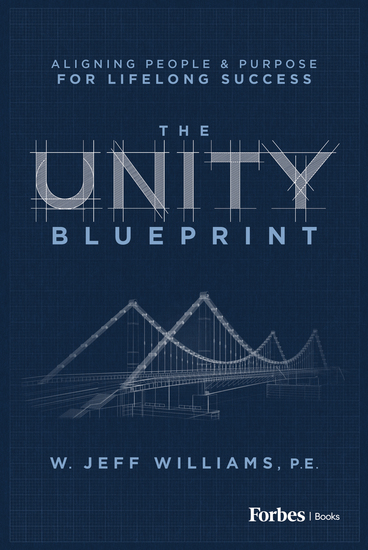
  • The Unity Blueprint - Aligning People & Purpose for Lifelong Success - cover

    The Unity Blueprint - Aligning...

    W. Jeff Williams

    • 0
    • 0
    • 0
    What if the greatest achievements in your organization, community, or life weren't dependent on your brilliance alone but on your ability to unite people around shared purpose? In The Unity Blueprint, W. Jeff Williams draws from decades of leadership experience to show how intentional unity creates extraordinary results.
    Zum Buch
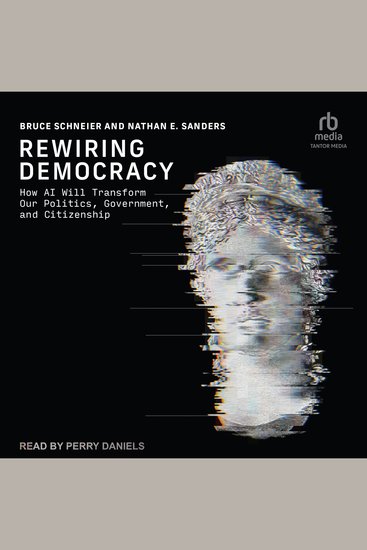
  • Rewiring Democracy - How AI Will Transform Our Politics Government and Citizenship (Strong Ideas) - cover

    Rewiring Democracy - How AI Will...

    Bruce Schneier, Nathan E. Sanders

    • 0
    • 0
    • 0
    In this advisedly optimistic book, Rewiring Democracy, security technologist Bruce Schneier and data scientist Nathan Sanders cut through the AI hype and examine the myriad ways that AI is transforming every aspect of democracy—for both good and ill.The authors describe how the sophistication of AI will fulfill demands from lawmakers for more complex legislation, reducing deference to the executive branch and altering the balance of power between lawmakers and administrators. They show how the scale and scope of AI is enhancing civil servants' ability to shape private-sector behavior, automating either the enforcement or neglect of industry regulations. They also explain how both lawyers and judges will leverage the speed of AI, upending how we think about law enforcement, litigation, and dispute resolution.Whether these outcomes enhance or degrade democracy depends on how we shape the development and use of AI technologies. Powerful players in private industry and public life are already using AI to increase their influence, and AIs built by corporations don't deliver the fairness and trust required by democratic governance. But, steered in the right direction, AI's broad capabilities can augment democratic processes and help citizens build consensus, express their voice, and shake up long-standing power structures.
    Zum Buch
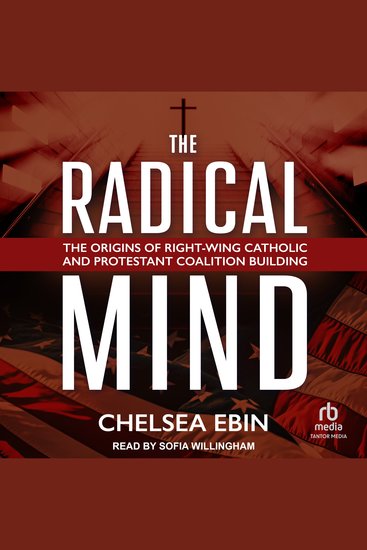
  • The Radical Mind - The Origins of Right-Wing Catholic and Protestant Coalition Building - cover

    The Radical Mind - The Origins...

    Chelsea Ebin

    • 0
    • 0
    • 0
    The Radical Mind is a groundbreaking analysis of the origins of the Christian Right, whose political victories are radically reshaping the landscape of American society. Scholars and the public alike have traditionally regarded the New Right and the Christian Right as separate movements. Insofar as both are conservative efforts, most people view them as reactionary and driven by a culture-war backlash against liberal changes to society. 


    Chelsea Ebin's The Radical Mind aims to overturn this consensus. Through a close analysis of New Right architects Connaught Marshner and Paul Weyrich (who is often seen as secular but was a committed Catholic), this book explores the way conservative Catholics and Protestants overcame their long-standing antipathy to form a political coalition—what Ebin calls the New Christian Right. Drawing on extensive archival research, Ebin shows how the movement’s key architects infused right-wing activism with religion. 


    The radical aims of the New Christian Right have been obscured by the way they cultivated a shared identity of victimhood and manipulated the discourse about backlash to create a nostalgic idea of the past that they then leveraged to justify their right-wing policy goals. The Catholic-Protestant alliance constructed an imagined past that they projected into the future as their ideal vision of society. Ebin calls this strategy "prefigurative traditionalism"—a paradoxical prefiguring of a manufactured past. Using this tactic, the New Christian Right coalition disguised the radicality of its politics by framing their aims as reactionary and defensive rather than proactive and offensive.
    Zum Buch